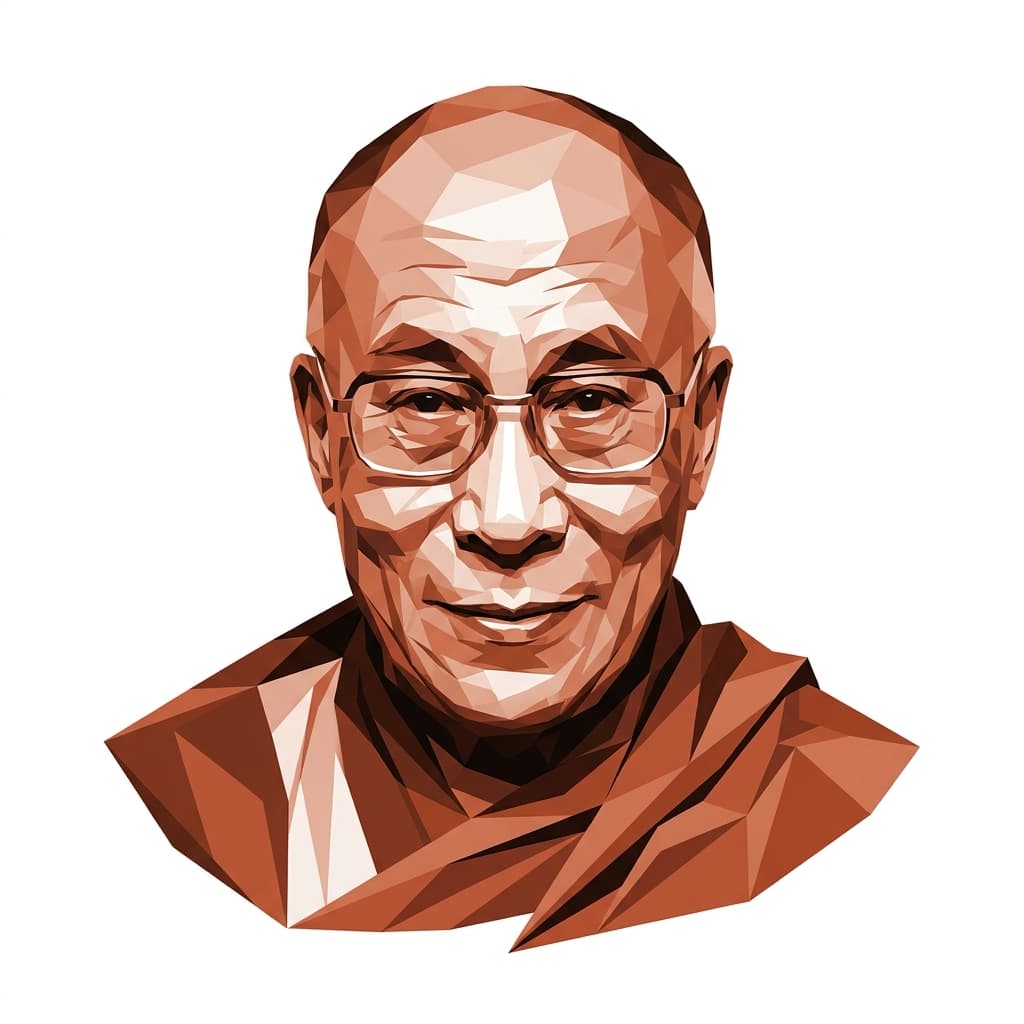
Dalai Lama
Tibetan Buddhist spiritual leader, exiled head of state, and global voice for compassion and nonviolence.
Design
- Q21.6
- h48.6
- R24.6
- g60.2
- i56.2
- S36.3
- T2.5
- U57.2
- V43.4
- W37.1
- X3.5
- Y64.2
- Z62.4
Personality
- Q39.4
- h38.4
- R40.4
- g61.2
- i62.2
- S12.4
- T29.4
- U57.4
- V1.1
- W37.5
- X27.4
- Y64.1
- Z62.5
Tenzin Gyatso, the 14th Dalai Lama, is a Generator — built with the steady, renewable energy to do the same work, day after day, for the better part of a century without burning out. Recognized at age two as the reincarnation of his predecessor, he was taken from a farming village in Amdo and installed in the Potala Palace, where the rigorous monastic curriculum he'd spend decades absorbing was already waiting. The chart fits the life: a man whose response to being handed an impossible institutional role was not to push against it but to settle in and master it slowly.
He was fifteen when China invaded Tibet in 1950, and the years that followed forced him into the kind of decisions that no fifteen-year-old should make from an emotional spike. He negotiated with Mao in Beijing. He tried, for nearly a decade, to find a workable arrangement with the Chinese government before finally fleeing across the Himalayas in 1959. The pattern is consistent: long deliberation, then commitment. His insistence on a Middle Way Approach — autonomy rather than independence — has frustrated Tibetans who want a harder line, but it carries the signature of a long emotional wave settled into clarity, a position revisited and re-confirmed across decades rather than declared in a moment of grief.
His 4/6 profile shows up in how he actually works: through a vast network of personal relationships — scientists, monks, politicians, the Dalai Lama's English-speaking friends from the 1960s who became lifelong correspondents — and through the unmistakable role-model posture he settled into in midlife. He genuinely seems to enjoy meeting people, and his warmth functions as institutional infrastructure for a stateless government. The Nobel Peace Prize in 1989 was less a turning point than a recognition of something that had been quietly accumulating: a man whose refusal to advocate violence against China, maintained for sixty years through provocations that would break most leaders, is itself the teaching.
The famous laugh — the giggle that punctures the gravity of every room he enters — comes from somewhere specific in the chart. He has an almost surgical sense of when to break a heavy silence and when to let it sit, and he uses humor the way other spiritual teachers use parable. His dialogues with neuroscientists through the Mind & Life Institute, sustained since 1987, reveal a mind that genuinely wants to take things apart and see how they work, a curiosity about the mechanics of consciousness, attention, compassion. He has said, more than once, that if science disproves a Buddhist claim, Buddhism must change. This is unusual talk from a religious head of state.
In 2011 he did something most god-kings never do: he devolved political authority to a democratically elected Tibetan leadership, ending a four-century-old institutional structure with the same matter-of-factness he brings to everything else. He has hinted he may be the last Dalai Lama, or that the next one might be found outside Tibet, or female. The thread running through all of it is a willingness to let old structures break so new ones can take shape, paired with the patience to wait for events to find their own timing. Now in his late eighties, he still wakes at 3 a.m. to meditate. The work is the same work it has always been.