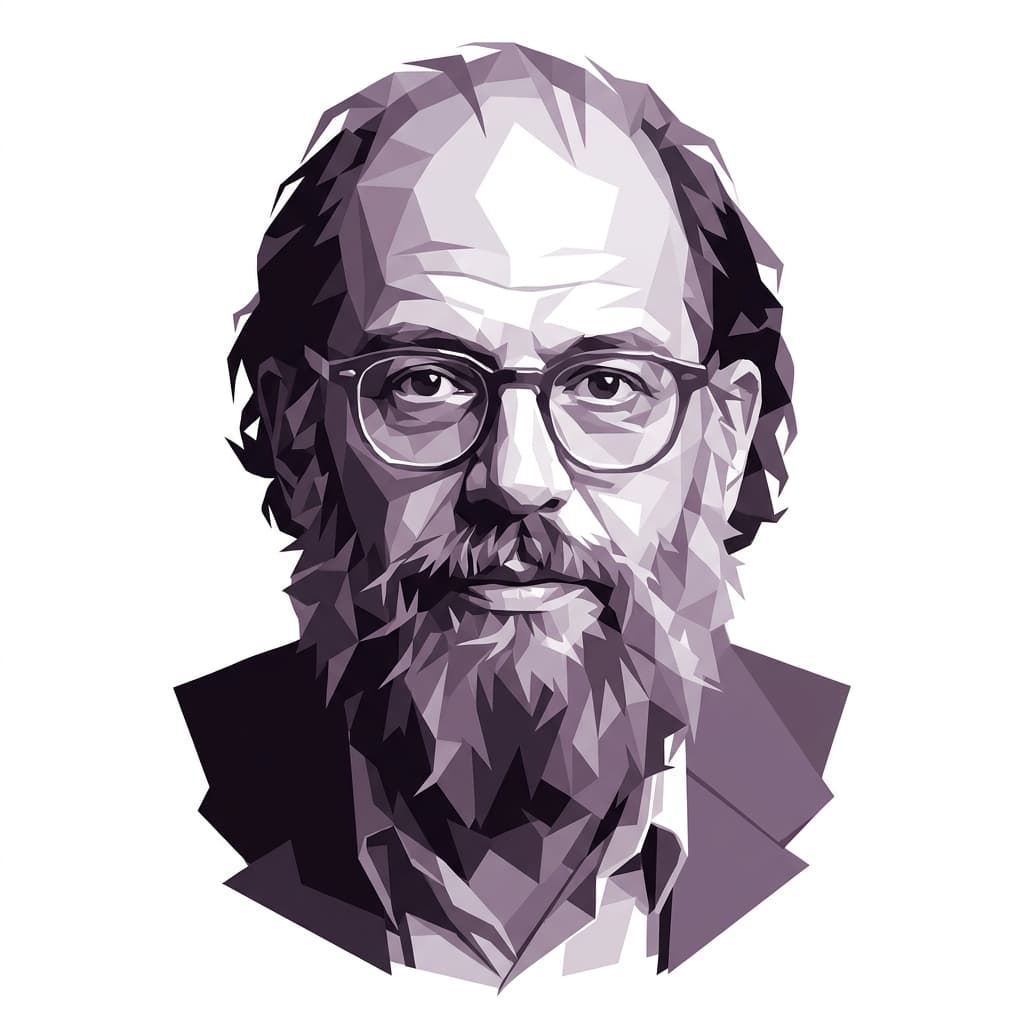
Allen Ginsberg
Beat Generation poet whose howling, ecstatic verse rewired American literature and protest culture.
Design
- Q63.3
- h64.3
- R1.4
- g62.4
- i61.4
- S25.1
- T19.4
- U54.3
- V13.1
- W14.2
- X36.3
- Y4.5
- Z39.4
Personality
- Q35.1
- h5.1
- R37.6
- g53.2
- i54.2
- S16.5
- T3.5
- U22.6
- V30.3
- W43.3
- X25.1
- Y4.4
- Z39.5
Allen Ginsberg was a Manifestor — wired to set things in motion that other people would spend decades trying to catch up with. In October 1955, at the Six Gallery in San Francisco, he stood up and read the first part of "Howl" out loud for the first time. Kerouac was passing wine jugs. Rexroth was weeping by the end. Ginsberg hadn't waited for a publisher, an editor, or anyone's permission; he'd written the thing in a fit and then simply announced it into the room, which is how most of his life worked.
He was a 1/3 profile, the investigator who also had to live everything to know it. He read Blake obsessively as a Columbia undergraduate, claimed to hear Blake's voice in a Harlem apartment in 1948, and spent the rest of his life trying to verify that vision by getting his hands dirty in experience after experience — Benzedrine, ayahuasca in Peru, eight months in a psychiatric institute, the Tangier expatriate scene, India with Peter Orlovsky, Cuba (where he was expelled), Czechoslovakia (where he was crowned May King and then expelled again). Each trip was research. Each expulsion was data.
"Howl" itself is a Gate 22 document — emotionally acoustic, mood-driven, full of the long Whitman-breath line he claimed he could only write when his feelings were running hot. The obscenity trial that followed in 1957 turned him into a public figure overnight, and he handled it with the strange open-hearted innocence that friends always noted in him: even when the FBI was photographing him at protests, he kept showing up with finger cymbals and a harmonium, chanting. He was a natural provocateur who somehow stayed warm about it, levitating the Pentagon in 1967, testifying at the Chicago Seven trial in a Uncle Sam hat.
His emotional life ran on long waves, and he learned — eventually — to let decisions settle before he committed. "Kaddish," the long elegy for his mother Naomi, took years of accumulated grief before he could write it across forty hours fueled by amphetamines and coffee in 1959. The poem is a deep listener's document, a son who had absorbed his mother's madness and political ferocity and finally found the form to release it. He carried other people's voices the way some people carry photographs.
Ginsberg was always beginning things: the Jack Kerouac School of Disembodied Poetics at Naropa, the campaign to legalize marijuana, the introduction of Bob Dylan to the Beats, the introduction of Buddhism to half of American poetry. He had the breakthrough mind that arrived at insights without showing its work, and he trusted those flashes enough to act on them publicly, often badly, sometimes brilliantly. The restless drive toward what mattered never quieted; he was photographing friends and writing letters to senators and chanting Hare Krishna into the last weeks of his life.
He died in April 1997, in his East Village loft, surrounded by the community he'd spent fifty years building — having initiated, by then, more than he could ever have finished alone.