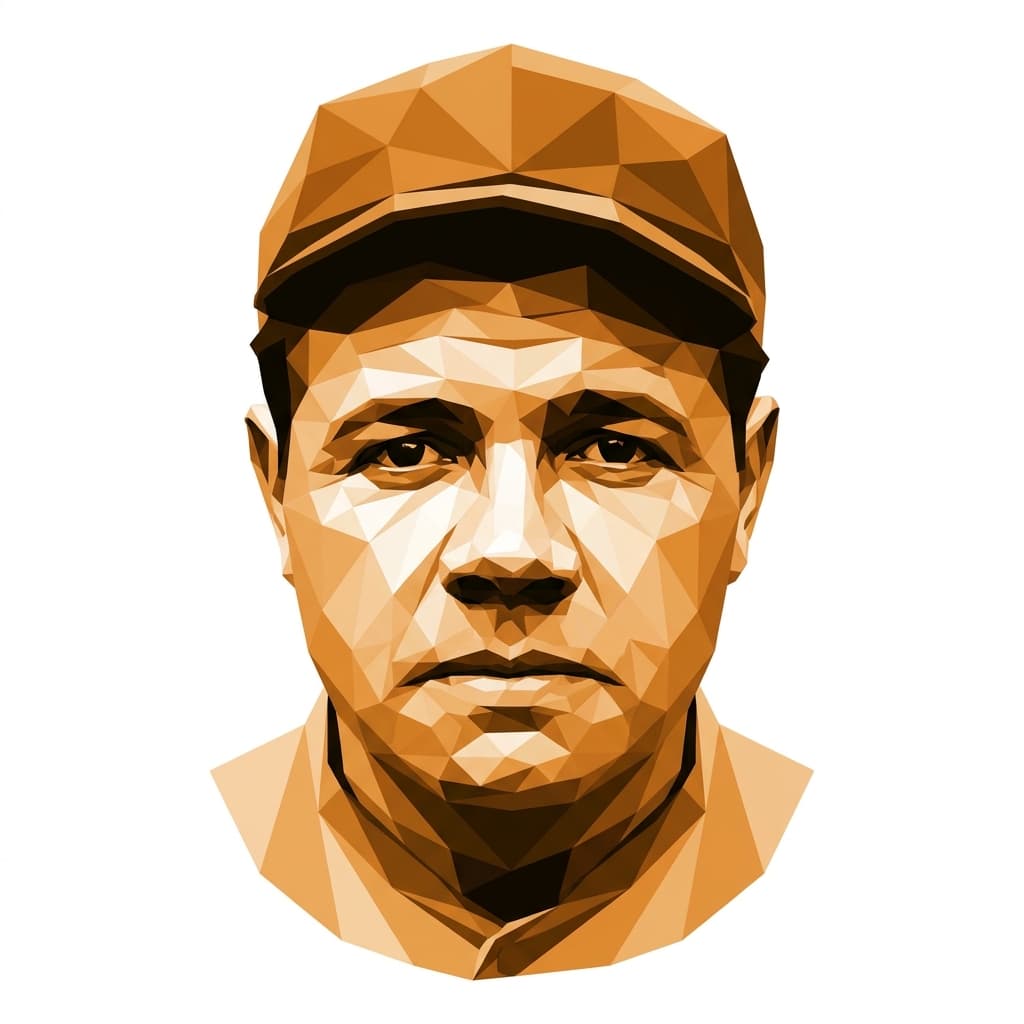
Babe Ruth
American baseball legend who transformed the game with his prodigious home runs and outsized personality.
Design
- Q43.1
- h23.1
- R27.4
- g25.3
- i46.3
- S1.4
- T1.3
- U42.2
- V52.3
- W50.5
- X1.3
- Y35.4
- Z16.6
Personality
- Q13.5
- h7.5
- R52.3
- g22.6
- i47.6
- S55.6
- T55.5
- U2.5
- V12.5
- W28.6
- X43.2
- Y35.2
- Z16.5
George Herman "Babe" Ruth was a Manifesting Generator — built for speed, sustainable power, and the kind of non-linear career arc that ignores how things are supposed to go. He started as one of the best left-handed pitchers in the American League with the Red Sox, then pivoted to the outfield because his bat was too valuable to sit between starts. Most players would have picked a lane. Ruth, characteristically, refused, and the pivot reshaped baseball.
Sent to St. Mary's Industrial School in Baltimore at seven, he found baseball there and a mentor in Brother Matthias, and the game became the skill he gave himself over to entirely, refined through endless repetition until his swing was unmistakable. The 5/1 in his chart shows up here too — a practical investigator who became the authority on something the sport hadn't seen before. Before Ruth, the home run was an accident. After Ruth, it was the point. He hit 29 in 1919, then 54 in 1920, a number that exceeded the total of most entire teams. He had studied the problem of how to hit a baseball further than anyone else and arrived at an answer nobody had bothered to ask the question about.
His personal life moved at the same pace as his swing. He ate enormously, drank enormously, stayed out late, showed up hung over, hit three home runs anyway. He made decisions on feel, and when his feel was off — when he was on an emotional low or sulking through a contract dispute — the results showed up in the box score. He had Emotional Authority without the patience for it, and the seasons where he held out, fought management, or played angry are the seasons he hit .290 instead of .370. The clarity came in waves; so did the slumps.
The called shot in the 1932 World Series is the Ruth story everyone tells, and it's the right one — pointing toward center field at Wrigley with the count full, then driving the next pitch exactly there. Whether he meant it or not almost doesn't matter. He had the sense for the moment that made the gesture land, and his career was full of these — promising a sick kid a home run and hitting it, calling his shot at a barnstorming game, narrating his own legend in real time. He waited for the pitch he wanted and then unloaded on it, which is also more or less how he lived.
Off the field he was a soft touch — visiting hospitals unannounced, signing every baseball pushed at him, genuinely undone by a sick child in a way teammates found startling. He had grown up institutionalized and treated other discarded kids as his particular responsibility, the caretaker instinct that ran underneath the bravado. Teammates called him a big kid and meant it kindly; sportswriters called him a big kid and meant something more complicated.
His final years were difficult — denied the managing job he badly wanted, traded to the Boston Braves for a sad coda, dead of throat cancer at 53. But the completion he brought to the project of the home run was total. He didn't just hold the record; he invented the category. Everyone who has hit one since has been following a path he carved when nobody could see it yet.