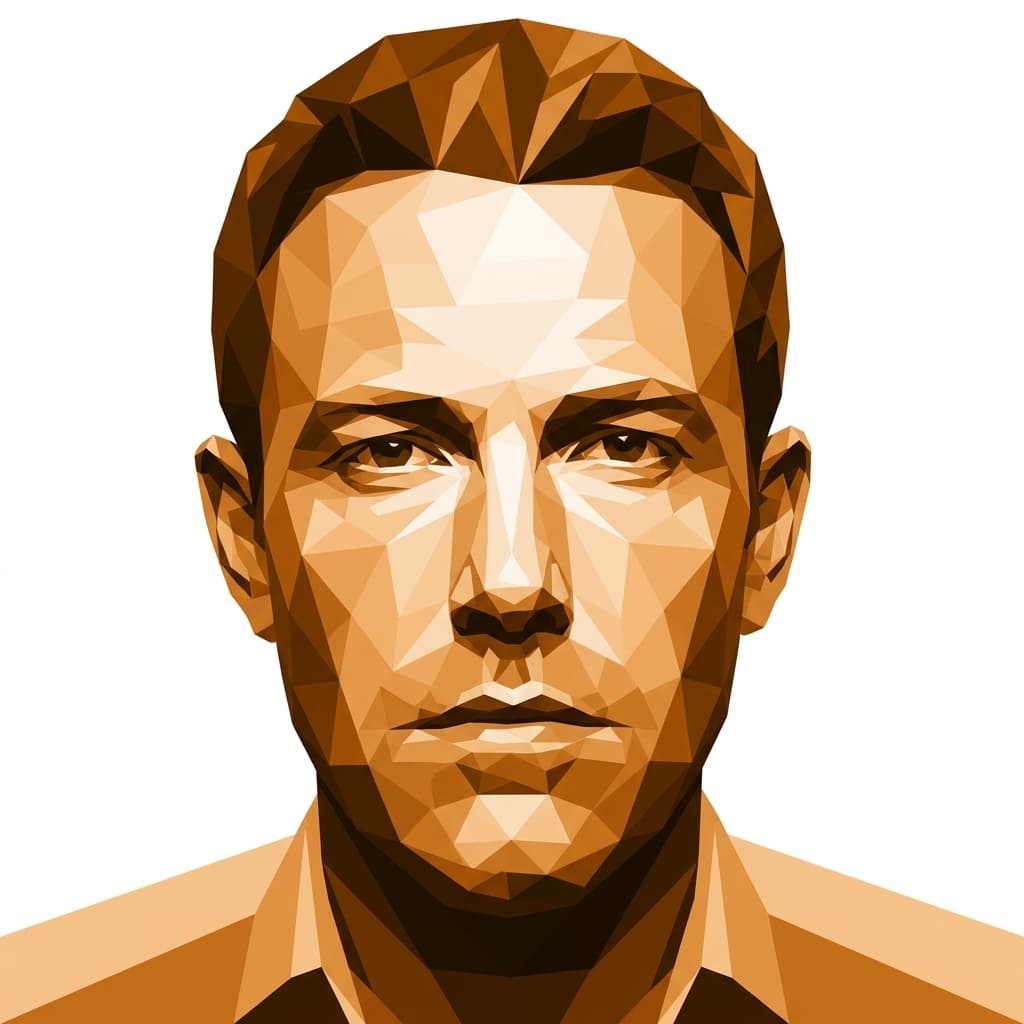
Ben Affleck
Oscar-winning actor, writer, and director whose career has lurched between blockbuster stardom and personal reinvention.
Design
- Q8.1
- h14.1
- R12.4
- g60.2
- i56.2
- S27.3
- T15.5
- U15.4
- V58.5
- W16.3
- X48.6
- Y34.5
- Z46.2
Personality
- Q4.5
- h49.5
- R28.3
- g61.6
- i62.6
- S33.4
- T52.4
- U59.1
- V10.1
- W45.2
- X57.1
- Y34.3
- Z46.3
Ben Affleck is a Manifesting Generator — wired to juggle several careers at once rather than settle into a single lane — and his résumé reads exactly like that: actor, screenwriter, director, studio executive, producer, occasional pundit, and serial reinventor. He shot to fame at twenty-five when Good Will Hunting, the script he wrote with childhood friend Matt Damon, won them an Academy Award in 1998. Within a few years he was a tabloid fixture, an action lead in Armageddon and Pearl Harbor, and, by the mid-2000s, a cautionary tale about how quickly Hollywood turns on its golden boys.
What separated Affleck from the other young actors of his cohort was his refusal to niche down when his energy stopped fitting the role. After the Gigli era flattened his leading-man stock, he disappeared into research mode — reading, watching, taking meetings — and re-emerged in 2007 directing Gone Baby Gone, a Dennis Lehane adaptation set in the Boston neighborhoods he'd grown up around. The Town and Argo followed, the latter winning Best Picture in 2013. The pivot had the texture of a 5/1 profile at full power: investigate deeply, build a real foundation, then step out and solve a problem no one expected you to solve.
His decision-making, in interviews and in the documented chaos of his choices, runs through an in-the-moment gut response more than any long-term plan. He has talked openly about taking the Batman role for his kids and then realizing, mid-suit, that he didn't want it — a clean read of responding before committing going sideways when he overrode the no. He walks away from projects that no longer light him up and re-enters them when something shifts; the Air production with Damon in 2023 had the look of a man finally doing work he actually loved again, and the difference on screen was visible.
Affleck's public voice carries a real sense of timing — long quiet stretches punctuated by interviews where he says something startlingly candid about addiction, divorce, or the machinery of fame. He has been sober, relapsed, sober again, and discussed all of it on the record, which gives his storytelling the weight of someone reporting back from the edges rather than performing wisdom he hasn't earned. His best directorial work has the same quality: stories told from inside the experience, Boston accents intact, no glossing.
The harder material — the marriages, the paparazzi-documented smoking-on-the-curb photos, the very public oscillations with Jennifer Lopez — fits a chart wired for extremes rather than steady middles. He gravitates toward big swings: founding Pearl Street Films with Damon, taking on Warner Bros.' DC era, then walking away from it. With his friend he co-founded Artists Equity, a studio explicitly designed to share profit with crews and casts — leadership oriented toward the people working under him rather than the executives above. At fifty-something, Affleck reads less like a star managing a brand and more like someone who's learned which problems are actually his to solve and which ones he can finally put down.