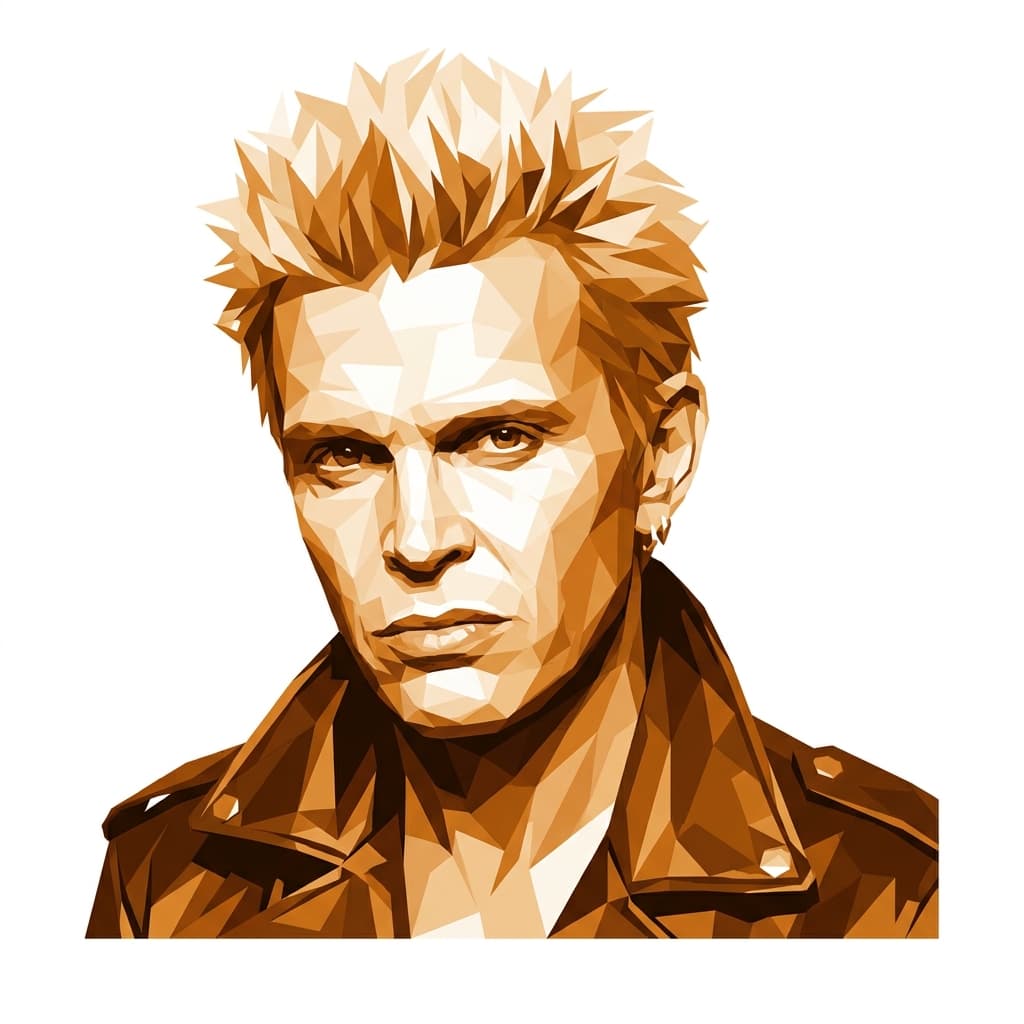
Billy Idol
English punk-turned-pop-rock icon whose sneer, peroxide spike, and MTV-era hits defined 1980s rebellion.
Design
- Q40.5
- h37.5
- R22.1
- g11.1
- i12.1
- S46.5
- T40.5
- U59.5
- V7.5
- W1.4
- X56.5
- Y32.6
- Z29.3
Personality
- Q9.3
- h16.3
- R45.5
- g26.1
- i45.1
- S34.6
- T10.3
- U50.5
- V59.1
- W14.1
- X31.1
- Y50.4
- Z29.5
Billy Idol — born William Broad in Stanmore, England — is a Manifesting Generator whose career was never going to follow one straight line. He fronted Generation X at the front of London's punk explosion, then bolted to New York at the dawn of MTV and reinvented himself as a leather-clad pop-rock pin-up. The sneer was the same; the genre kept changing. That refusal to pick a lane — punk, new wave, dance-rock, even a dalliance with cyberpunk on 1993's Cyberpunk — is the restless multi-lane energy of someone who'd rather chase the next exciting thing than perfect the last one.
His 3/5 profile is written all over the wreckage and the comebacks. The crashes — the 1990 motorcycle accident in Hollywood that nearly cost him a leg, the very public years lost to heroin and pills — are the textbook learning by smashing into things that 3s do, and the way he keeps returning, scarred but useful, telling the story plainly in his memoir Dancing With Myself, is the 5 stepping forward with hard-earned practical wisdom. He doesn't pretend the mistakes didn't happen; he turns them into stories that make the lesson land.
The Idol persona itself — peroxide spike, curled lip, fist-pump — is a piece of disciplined craft. He and guitarist Steve Stevens drilled the hits ("White Wedding," "Rebel Yell," "Eyes Without a Face," "Dancing With Myself") into something that holds up live thirty-five years later, the kind of mastery built through endless repetition that looks effortless only because the reps are invisible. His vocal delivery is pure timing as instrument — the pause before the sneer, the held vowel, the yeahhh that arrives exactly when it should.
He's an Emotional Authority in a profession that rewards snap decisions, and the long arc of his catalog suggests the best Idol records are the ones he sat with. Cyberpunk — rushed, theory-first, made when he was deep in his William Gibson obsession — is the cautionary tale: a record made from an idea rather than from the gut. The 2014 comeback Kings & Queens of the Underground and 2021's The Roadside EP, by contrast, feel like decisions made from a cool, settled place rather than from the heat of wanting to prove something.
What's kept him interesting past the nostalgia circuit is a kind of stubborn aliveness — the refusal to be a wax-museum version of himself. He still tours hard, still writes, still shows up on tracks with Miley Cyrus or Avril Lavigne without seeming to grasp for relevance. He talks openly about sobriety, about his kids, about the parts of the rock-star myth that nearly killed him, and the candor reads as the long-earned right to say it plainly. He was never the deepest songwriter of his cohort, but he understood something most of them didn't: that pure self-expression, loud and unapologetic, can be its own kind of art, and that a great hook delivered with absolute conviction is harder than it looks.