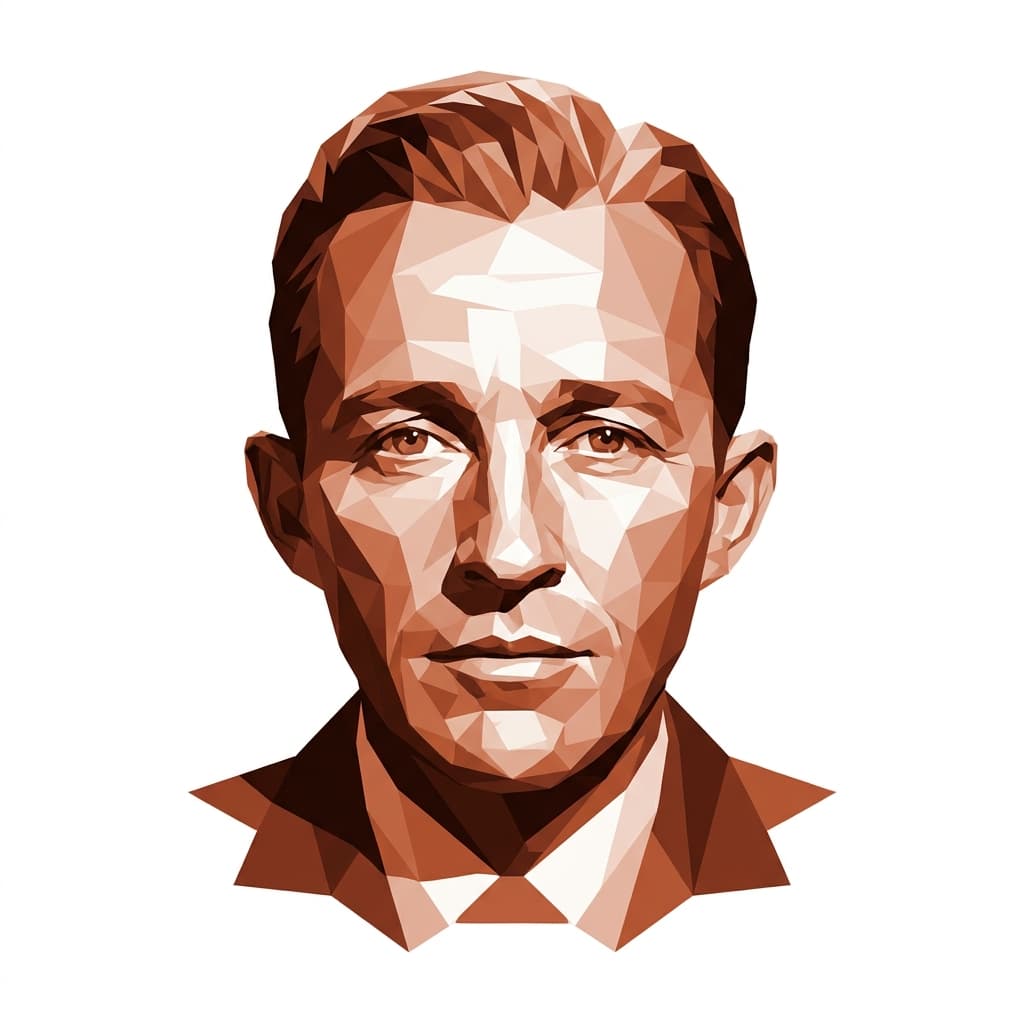
Bing Crosby
American crooner, film star, and radio pioneer whose relaxed baritone defined mid-century popular music.
Design
- Q13.2
- h7.2
- R3.5
- g57.4
- i51.4
- S19.3
- T55.1
- U48.6
- V30.2
- W60.6
- X11.2
- Y15.4
- Z45.1
Personality
- Q24.6
- h44.6
- R33.1
- g57.1
- i51.1
- S20.3
- T45.2
- U6.6
- V63.6
- W19.2
- X11.3
- Y15.4
- Z45.2
Bing Crosby was a Generator — built for sustained, masterful work in a single craft, and he poured that engine into one of the most prolific recording careers in American history. Between 1926 and his death in 1977, he cut more than 1,600 commercial sides, sold an estimated half-billion records, and held the number-one spot on the charts longer than Elvis and the Beatles combined. He did it without ever appearing to strain. The defining quality of his voice was that it sounded like he wasn't trying.
That ease was technique. Crosby was among the first vocalists to truly understand the microphone — to sing into it conversationally rather than projecting over it — and his innovation made the intimate baritone the dominant pop sound for the next thirty years. He had the kind of depth others kept drawing out of him, a phrasing instinct that musicians like Louis Armstrong and Frank Sinatra openly studied. He didn't theorize about it much. He showed up, waited for the song to land in his gut, sang it in one or two takes, and went golfing.
His 6/2 profile — the role-model-and-natural-hermit — fit him uncannily. The wild early Crosby of the Paul Whiteman years drank hard, missed sessions, and nearly got fired; by his mid-thirties he had retreated into the rhythm that would define him: work in the morning, golf in the afternoon, family at night, and a famous reluctance to be drawn into Hollywood's social machinery. He liked stretches of his own company and protected them fiercely. Friends described a man who could be warmly present for a scene or a song and then completely disappear into himself the moment the red light went off.
The Crosby persona — the pipe, the cardigan, the half-smiled aside to Bob Hope — was a study in saying exactly what the moment needed and not a syllable more. On the Road pictures with Hope he ad-libbed constantly, but his timing was a gut-level read of the room rather than a writer's calculation. "White Christmas," recorded in eighteen minutes in 1942, became the best-selling single of all time partly because he refused to oversell it; he sang it like a man remembering something quietly true rather than performing nostalgia.
He was also an early and shrewd businessman, the rare entertainer who understood resources as something to steward, not just spend. He bankrolled Ampex's development of magnetic tape because he wanted to pre-record his radio shows and play more golf — a decision that transformed broadcasting. He owned a piece of the Pittsburgh Pirates, real estate, racehorses, and a thoroughbred breeding operation, and he ran them all with the same unhurried competence he brought to a vocal booth.
The private Crosby was harder. His first marriage to Dixie Lee ended with her death from cancer in 1952; his relationship with his four sons by that marriage was, by their own accounts, severe and distant. There was a restlessness beneath the cardigan, a man who protected himself with reserve more than he probably knew. He died as he'd lived — on a golf course outside Madrid, having just shot an 85, walking off the eighteenth green.