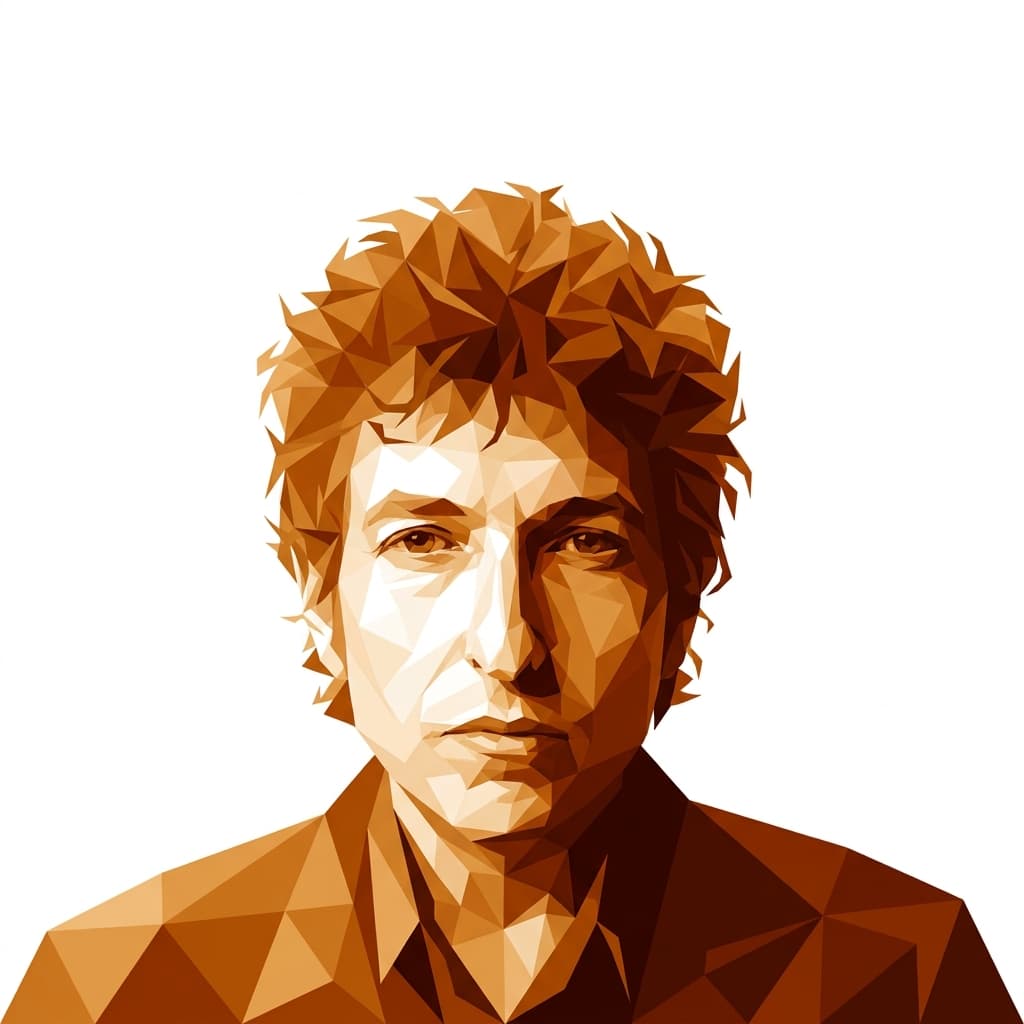
Bob Dylan
American songwriter and Nobel laureate whose voice reshaped folk, rock, and the meaning of popular song.
Design
- Q55.6
- h59.6
- R13.4
- g46.4
- i25.4
- S37.5
- T49.4
- U58.1
- V24.4
- W24.3
- X23.4
- Y6.5
- Z31.1
Personality
- Q20.4
- h34.4
- R23.3
- g46.2
- i25.2
- S12.1
- T35.2
- U37.1
- V8.6
- W23.2
- X8.3
- Y6.3
- Z31.1
Bob Dylan is a Manifesting Generator — wired to chase several lives at once without picking just one — and his career is a long argument against ever holding still. He arrived in Greenwich Village in 1961 as a folk acolyte, was crowned the voice of a generation by 1963, plugged in an electric guitar in 1965 and detonated that title, vanished into Woodstock after a motorcycle crash, came back with country records, then gospel records, then nothing anyone could classify. The non-linear path isn't a career strategy. It's the shape of his nervous system.
The famous turn at Newport in 1965 — when he walked onstage with the Paul Butterfield Blues Band and got booed for it — is usually told as defiance, but it tracks better as the gut saying go before the mind caught up. He'd been responding to the records around him, to the Beatles, to his own boredom with protest songs. As a 4/6 he'd built his early career inside a tight Village community that thought it owned him; when his energy pivoted, the relational cost was enormous, and he absorbed it. The second half of that profile — the rooftop observer — has been visible ever since in his decades of refusing to explain himself.
His songwriting is where the gift of distilling complicated knowing into a line anyone can sing shows up most plainly. "How does it feel" is four words. "The times they are a-changin'" is six. He has an uncanny sense for when a phrase should land and when silence does the work, and his vocal phrasing — that maddening, late-on-the-beat drawl — is the technique of a writer who only speaks when the moment is exactly ripe. Even when he's wrong, he's on time.
Dylan is an Emotional Authority, which is the unglamorous secret behind the legend of his unpredictability. Decisions ripen in him over days, weeks, sometimes years; the Christian conversion of 1979, the Rolling Thunder Revue, the endless touring that began in 1988 — none of it was impulsive even when it looked it. He rides waves. The same wiring shows up in the songs themselves, which carry the full register of emotional weather, highs and flats both, and in his fascination with the shock that breaks a life open and the innocence that survives it — a theme running from "A Hard Rain's A-Gonna Fall" through "Not Dark Yet."
He has always been a listener first. The early years in Hibbing and Minneapolis were spent absorbing Woody Guthrie records, Robert Johnson sides, Appalachian ballads — collecting other people's stories and waiting to give them back transformed. The travelogue impulse, the hunger for the next experience and the next and the next, kept him moving even after he had nothing to prove. The Nobel committee in 2016 called it "new poetic expressions within the great American song tradition." Dylan, characteristically, took two weeks to respond and then sent someone else to collect it. The wave had to settle first.