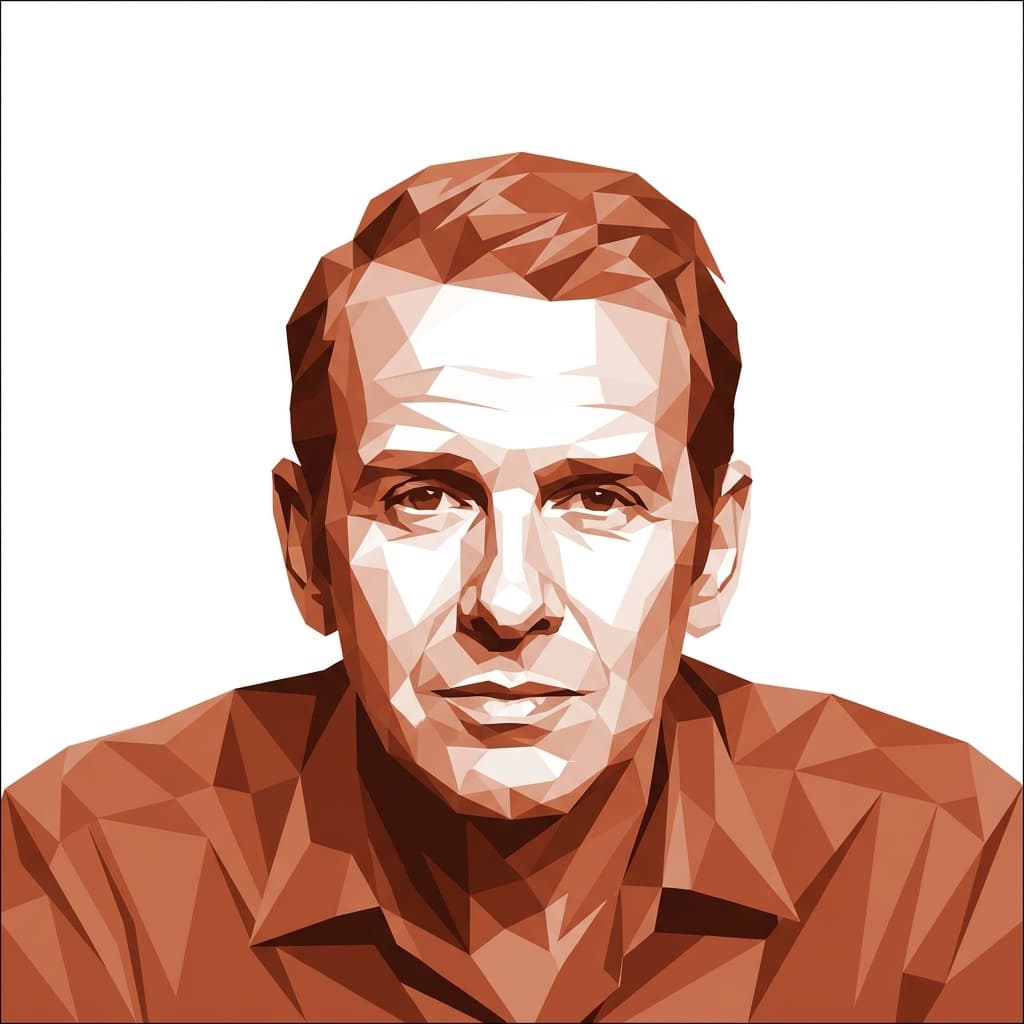
Bob Fosse
American choreographer and director who reinvented Broadway and film with sharp, sensual, jazz-inflected movement.
Design
- Q25.6
- h46.6
- R26.3
- g15.5
- i10.5
- S63.3
- T27.1
- U35.6
- V63.5
- W9.2
- X25.2
- Y29.1
- Z39.5
Personality
- Q15.4
- h10.4
- R42.4
- g12.6
- i11.6
- S56.1
- T7.4
- U33.4
- V25.5
- W34.3
- X25.6
- Y29.1
- Z39.6
Bob Fosse was a Generator — built for the long, obsessive grind of a craft, and he poured that stamina into reshaping what American dance on stage and screen could look like. From the time he was a teenager working Chicago burlesque houses, he was rehearsing, performing, watching, copying, refining. The bowler hat, the turned-in knees, the snapped fingers, the slouched shoulders — none of it was theory. It was a vocabulary built by a body that wouldn't stop moving until the move was exactly right.
He had a 4/6 profile, the role-model-through-community pattern, and his career bears it out: Fosse worked almost entirely through a tight ensemble of dancers, collaborators, and former lovers he kept returning to — Gwen Verdon above all. Younger choreographers and dancers studied him like scripture, but he didn't court that influence; he just kept making the work and let people find their way to it. His earlier years were the messy experimental half — the failed Hollywood dance career, the marriages, the breakdowns — and the wisdom of the later half came directly out of refusing to pretty up what he'd actually lived through.
His decisions were physical, not theoretical. He cast from the floor in the room, made cuts on instinct, and rewrote choreography overnight when his body said the number wasn't working. The famous Fosse style — isolations, the angled hip, the precise wrist — emerged partly because he had bad posture and balding early and couldn't dance like the leading men of his era, so he turned his own physical quirks into the whole aesthetic. He was relentless about the tiny details no one else noticed: the angle of a glove, the half-beat before a head turn, where exactly a light should hit a shoulder.
Sex, death, and showbiz hypocrisy were his lifelong subjects, and he had no interest in softening any of them. Cabaret, Pippin, Chicago, and All That Jazz all push at audiences in the same way — stirring up feelings most musicals worked hard to avoid, then refusing to let them off the hook. He was a persuasive showman who could sell darkness as entertainment, wrapping cynicism in razzle-dazzle so seductive that audiences cheered the very thing being indicted. All That Jazz, his autobiographical film about a chain-smoking, pill-popping director choreographing his own death, was him telling the story so honestly it hurt to watch.
The cost was enormous. He drove himself and everyone around him with a yes-to-everything appetite for work, pills, women, and cigarettes that put him in the hospital for open-heart surgery in 1974 and killed him at sixty. He never really learned to rest. He won the Oscar, the Emmy, and the Tony in the same year — the only person ever to do it — and described the achievement with characteristic mordancy as proof of nothing in particular. He needed the next experience, the next show, the next late-night rewrite the way other people need sleep, and he kept pushing every project to its absolute completion right up to the night he collapsed on a Washington sidewalk during the Sweet Charity revival.