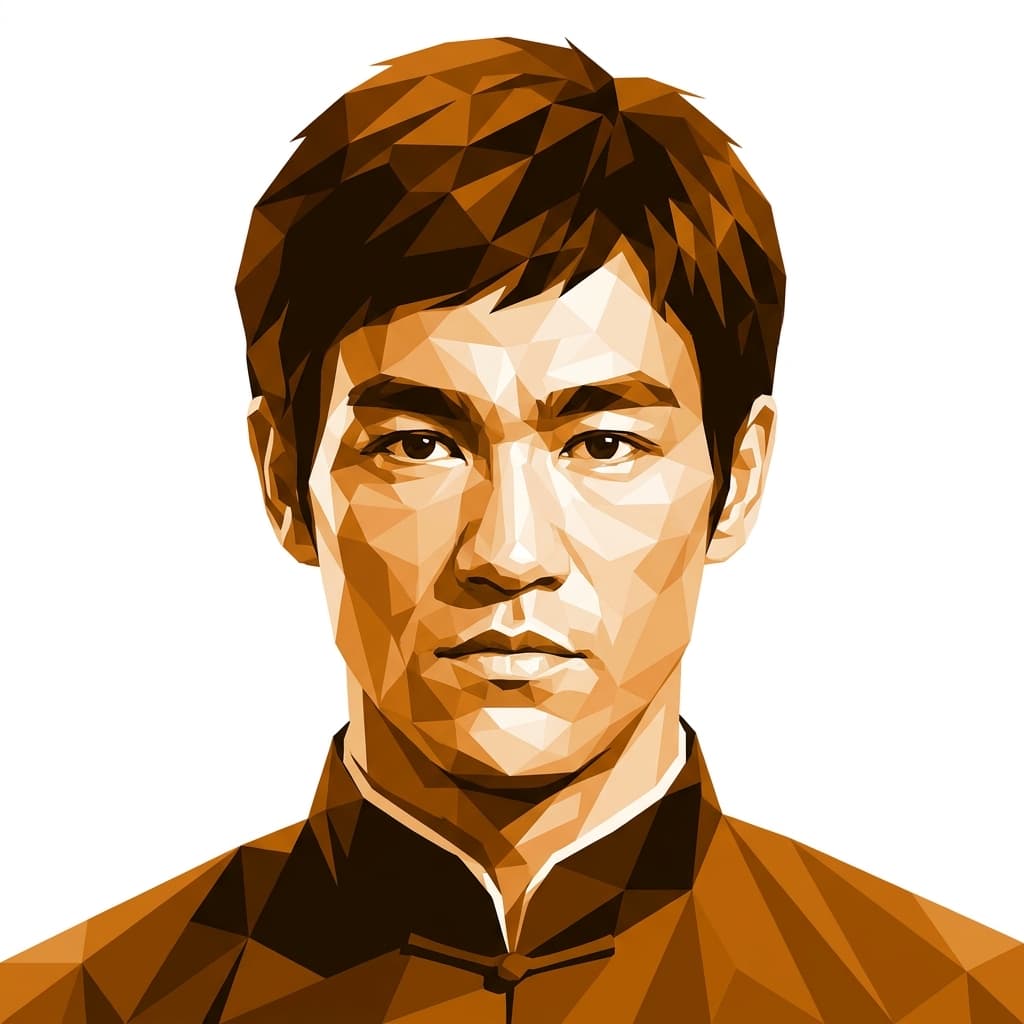
Bruce Lee
Martial artist, philosopher, and actor who redefined Asian representation in cinema and revolutionized martial arts.
Design
- Q40.2
- h37.2
- R31.3
- g48.3
- i21.3
- S59.3
- T62.1
- U40.2
- V2.3
- W2.2
- X8.2
- Y6.3
- Z31.2
Personality
- Q34.6
- h20.6
- R44.5
- g48.1
- i21.1
- S1.3
- T50.6
- U28.3
- V27.6
- W24.2
- X23.6
- Y6.6
- Z31.3
Bruce Lee was a Manifesting Generator — wired for speed, multiple obsessions, and the kind of efficiency that skips the polite steps — and his life was exactly that engine running flat out. He was a child star in Hong Kong cinema before he could drive, a cha-cha champion at 18, a philosophy student at the University of Washington, a martial arts instructor running a school out of his garage, and eventually the man who rewrote what an Asian lead could be on a Hollywood screen. The through-line wasn't a plan. It was a body that knew, immediately, what it wanted to chase next.
He developed Jeet Kune Do because he found traditional Wing Chun too rigid, too rule-bound, too slow to adapt mid-fight. "Absorb what is useful, discard what is useless, add what is essentially your own" — the phrase reads now like a refusal to maintain the same old, same old, and it was. He took what he needed from boxing, fencing, judo, and Wing Chun and made something nobody had quite seen before, then drew the world's attention to it. His teaching attracted Steve McQueen, James Coburn, Kareem Abdul-Jabbar — people who wanted to know how he did things, the kind of magnetism that arrives when influence is genuinely invited rather than chased.
His 6/2 profile — the role model who needs solitude to develop the gifts they're known for — explains the famous training regimen. He read voraciously, took dense notes on his own movement, filled notebooks with philosophy from Krishnamurti to Lao Tzu. The depth was real; the intelligence underneath the spectacle was what made the spectacle work. He'd disappear into study and emerge with a framework — a kicking system, a fitness protocol, a piece of writing — that felt fully formed, almost inevitable.
The decisions that defined his career ran on feeling, then time, then certainty. He turned down the Kung Fu TV series when it became clear the studio wouldn't give the lead to an Asian actor, went back to Hong Kong, and built his own vehicles. The choice to leave Hollywood looked impulsive from outside; from inside it was a wave that had been building. He had a gift for sensing which fights were actually worth having — the representation fight, the artistic-control fight, the let-me-direct-this fight — and which were ego noise to walk away from.
On screen his voice was minimal and exact. The famous "Be water, my friend" interview is barely a paragraph of speech, but it lands because he'd distilled the idea down to the fewest words it could survive on. He fought the same way: no wasted motion, pure raw vitality channeled into the present instant, responding to the opponent in front of him rather than running a memorized form. Even when he was performing, he was reacting in real time to what was actually there.
He died at 32, mid-stride, with Game of Death unfinished and Enter the Dragon weeks from release. The career was short and the influence was disproportionate — martial arts cinema, mixed martial arts, Asian-American representation, fitness culture — because he'd spent every year of it doing only the things that genuinely lit him up. He showed his daughter Shannon and son Brandon what caring about your craft enough to refuse the easy version actually looks like.