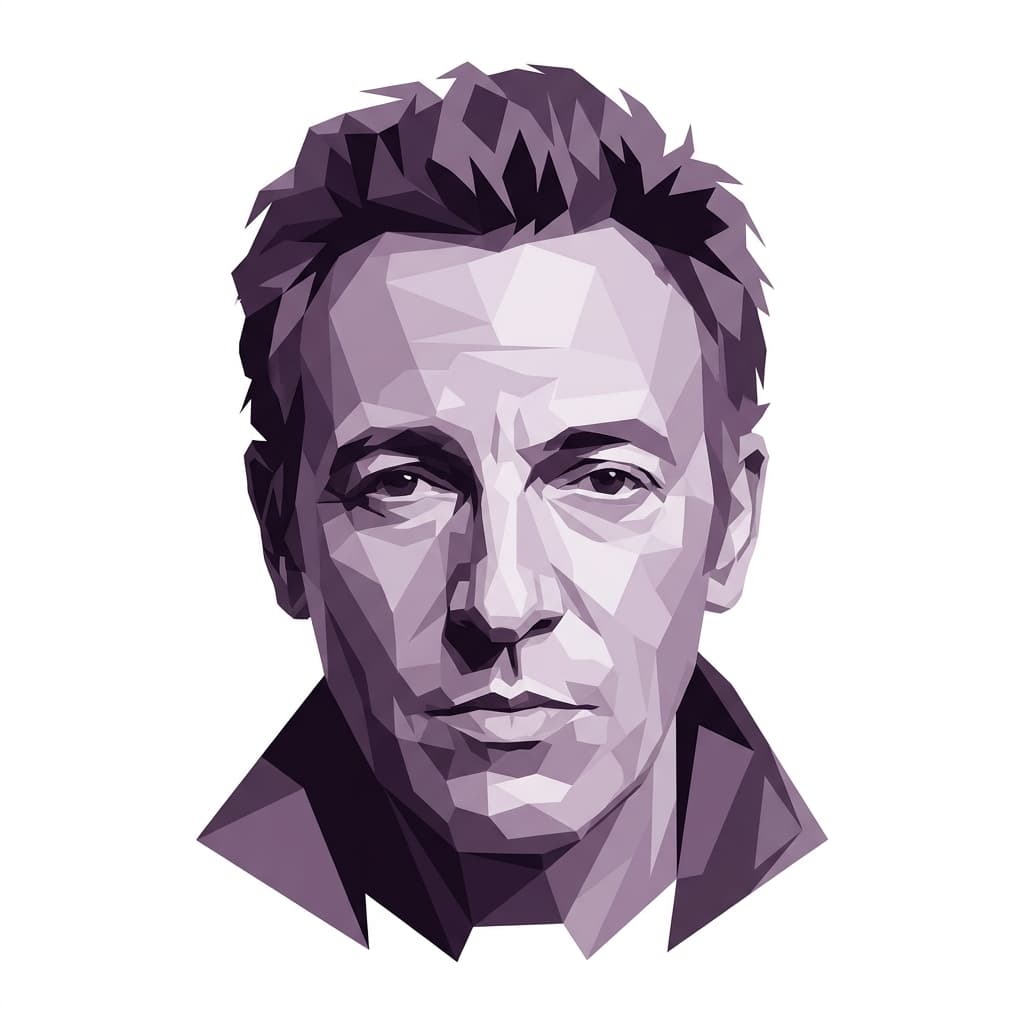
Bruce Springsteen
American rock musician and songwriter whose working-class anthems defined a generation of heartland rock.
Design
- Q15.5
- h10.5
- R16.6
- g42.3
- i32.3
- S35.1
- T62.1
- U16.5
- V60.5
- W59.2
- X15.3
- Y48.4
- Z7.2
Personality
- Q46.3
- h25.3
- R32.3
- g51.2
- i57.2
- S57.4
- T44.4
- U33.4
- V61.2
- W64.1
- X52.2
- Y48.6
- Z7.5
Bruce Springsteen is a Manifestor — wired to start things on his own terms and pull others into a vision they didn't know they were waiting for. He grew up in Freehold, New Jersey, a kid who watched his father struggle with factory work and silence, and decided early that a guitar would be his way out. By his late teens he was already leading bands up and down the Jersey Shore, the bandleader who decided what the night would sound like and who'd play it with him.
His breakthrough wasn't fast. Greetings from Asbury Park and The Wild, the Innocent & the E Street Shuffle both undersold, and Columbia nearly dropped him before Born to Run in 1975 — an album he famously made by chasing a sound until it bent to him, rerecording, rewriting, and pushing the band through take after take. That obsessive perfectionism is the texture of someone who learns by doing it wrong until it's right, the trial-and-error worker whose mistakes become the material. The Time and Newsweek covers landed the same week. He'd built the legend by hand.
What followed was a career defined by the kind of instant gut calls that don't need a reason. He sued his manager Mike Appel in 1976 and lost three years of recording to the fight — a move nobody around him advised, but one he made anyway. He pulled "Born in the U.S.A." out of the Nebraska sessions because it didn't fit, then resurrected it as the title track of the biggest album of his life. He dissolved the E Street Band in 1989 with a phone call to each member, letting people know after he'd already decided, and reassembled them a decade later when something in him said it was time.
The songs themselves are a long act of witnessing what working people actually live, giving voice to mill towns and Vietnam vets and Mary in her summer dress. Nebraska, recorded alone on a four-track in a rented house in Colts Neck, is the sound of retreating to make sense of what he'd seen. The River chases the full spectrum from honky-tonk joy to quiet devastation, often within the same side of vinyl. And the live shows — three, four hours, no setlist sometimes — are an exercise in meeting an audience with everything he has, night after night, decade after decade.
He's married Patti Scialfa since 1991, raised three kids in Colts Neck, and used the long stretches between records to process what an experience actually meant before saying anything about it. The 2016 memoir Born to Run was the same impulse extended: forty years of touring distilled into a book he wrote himself, longhand. Springsteen on Broadway took it further — five nights a week, alone on a stage, telling the stories behind the songs to an audience small enough to see.
At seventy-five he's still touring, still rewriting setlists in the wings, still trusting the instinct that arrives without explanation. The Boss never asked permission. He informed.