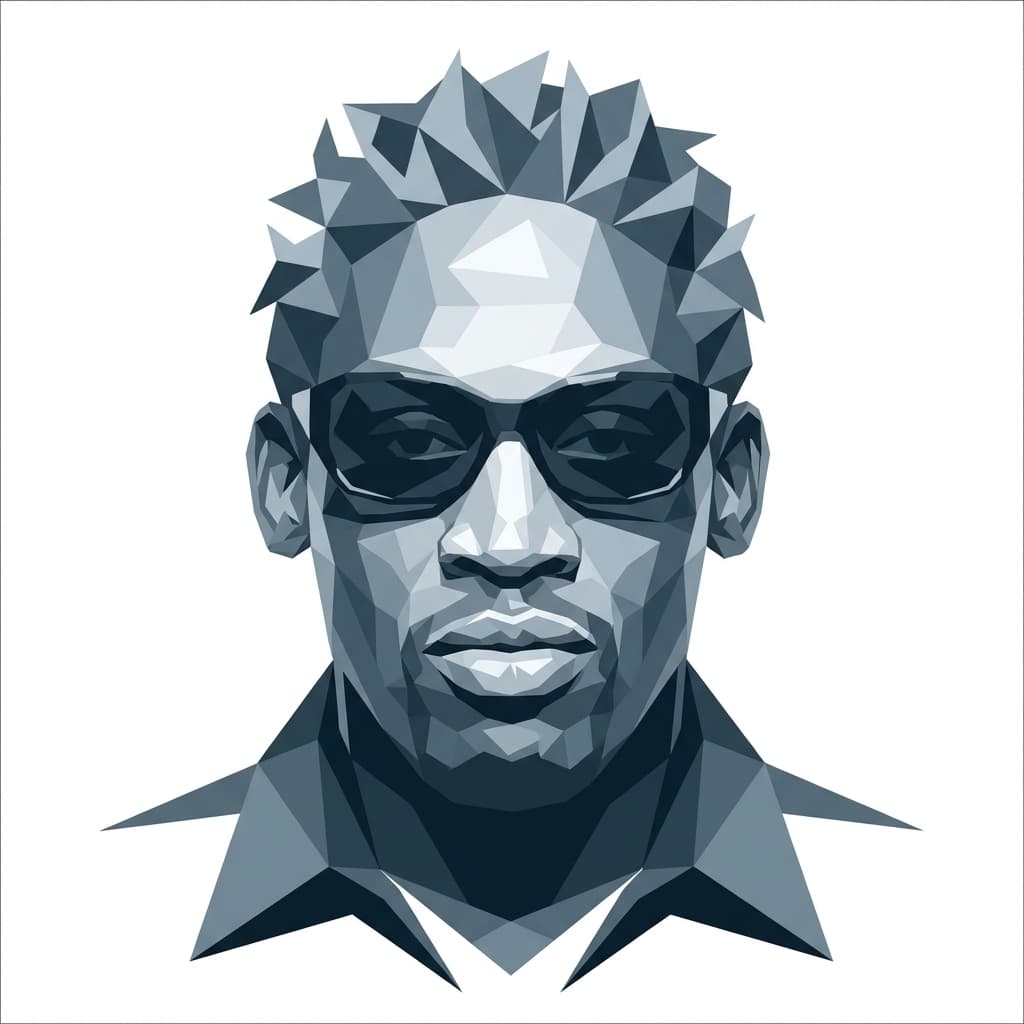
Dennis Rodman
Hall of Fame NBA rebounder, defensive savant, and cross-dressing provocateur who redefined basketball celebrity.
Design
- Q49.6
- h4.6
- R61.3
- g40.1
- i37.1
- S37.4
- T21.1
- U15.3
- V61.4
- W61.5
- X4.6
- Y44.4
- Z40.2
Personality
- Q23.4
- h43.4
- R27.2
- g59.3
- i55.3
- S20.6
- T21.6
- U31.2
- V41.6
- W60.4
- X4.4
- Y44.3
- Z59.6
Dennis Rodman is a Projector — not built to out-run or out-muscle anyone, but to read the floor, see what others missed, and steward the energy around him into wins. The story basketball tells about Rodman usually fixates on the hair, the piercings, the wedding dress, the Madonna tabloids. The truer story is that he was one of the most efficient role players the NBA ever produced, a man who turned a single specialty — knowing exactly where a missed shot was going to land — into two Defensive Player of the Year awards and five championships.
He came to the game late and sideways. Cut from his high school team, working as an airport janitor in Dallas, he didn't seriously play organized basketball until his twenties, after a late growth spurt added nearly a foot to his frame. That long, messy runway is classic 4/6 territory — years of experimentation before the role model emerged. By the time the Detroit Pistons drafted him in 1986, the wisdom was already baked in. He had an eye for patterns nobody else was tracking, studying the rotation of the ball off the rim, the shooter's release, the angle of the backboard — turning rebounding into something closer to a science than a hustle stat.
In Detroit he was Chuck Daly's favorite, the engine of the Bad Boys, and emotionally tethered to his coach in a way that bordered on filial. When Daly left, Rodman cratered — sitting in his truck in the Palace parking lot with a rifle, by his own later admission. The collapse was the shadow side of his deep need for chosen, loyal community, and of emotional waves he didn't yet know how to ride out rather than act on. What followed — the dyed hair, the nights out, the reinvention in San Antonio and then Chicago — looked like chaos. It was also a genuine appetite for living at the extremes, a refusal to be just one thing.
On the Bulls he became the third piece beside Jordan and Pippen, and the role suited him perfectly: waiting for the team that actually wanted what only he could give. Phil Jackson recognized him, gave him room to be strange, and Rodman responded by leading the league in rebounding three more years in a row. He took only the shots he was supposed to take. He defended Shaq, Malone, Ewing — anyone, any size. His value was a kind of self-contained leadership that didn't need the ball, a willpower others could lean on without him ever asking for the spotlight on offense.
Off the court he was harder to read. He'd disappear to Las Vegas mid-season, marry himself in a Manhattan bookstore, publish a memoir titled Bad As I Wanna Be, and later wander into Pyongyang to drink with Kim Jong-un — a restless dreamer always chasing the next unfamiliar feeling. Some of it was provocation, some of it was loneliness, some of it was an instinct to break old rules about what an athlete was allowed to be. What's clear in hindsight is that Rodman wasn't performing weirdness for attention. He was saying, in his own stripped-down language, exactly what he meant — and the culture, eventually, caught up.