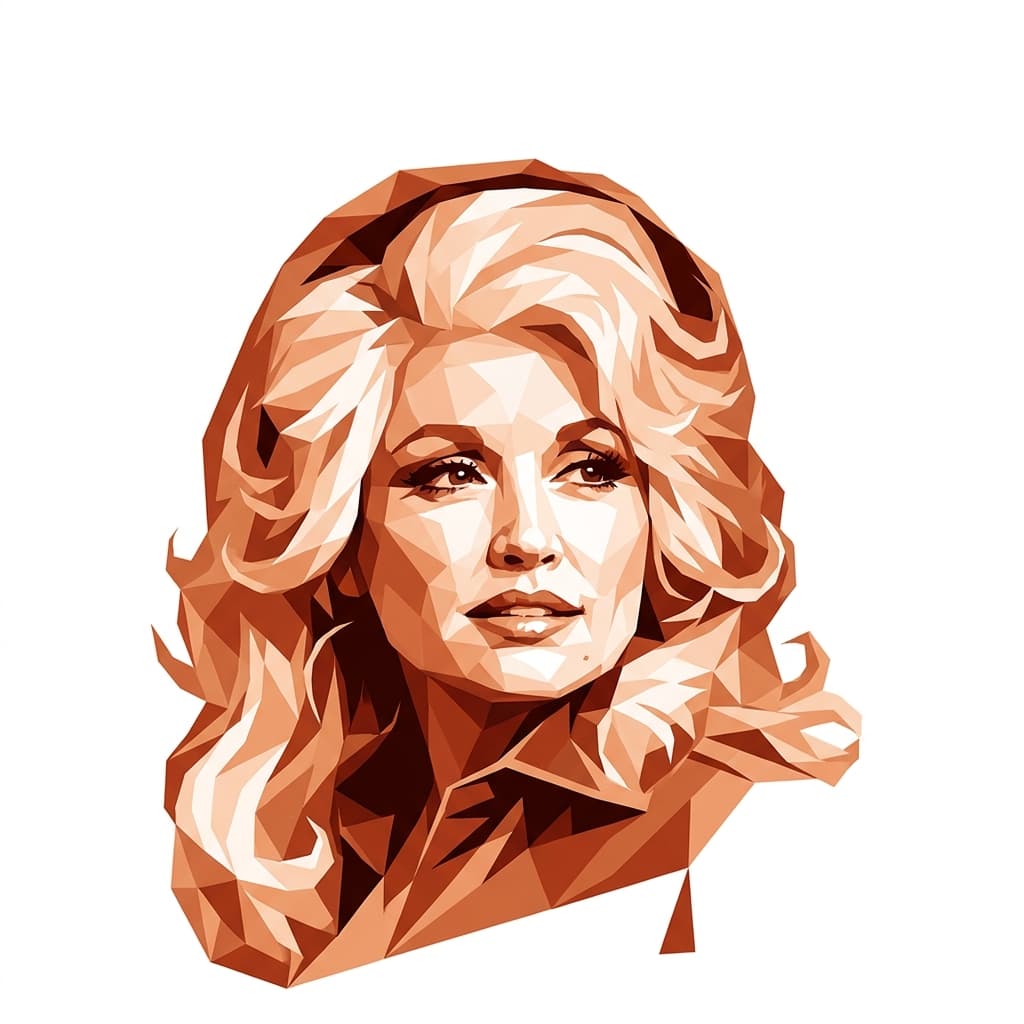
Dolly Parton
Country music icon, songwriter, and businesswoman whose warmth and work ethic built an American empire.
Design
- Q50.6
- h3.6
- R12.5
- g15.4
- i10.4
- S1.3
- T18.4
- U62.4
- V48.4
- W62.5
- X45.1
- Y18.4
- Z33.5
Personality
- Q60.4
- h56.4
- R59.1
- g15.2
- i10.2
- S54.1
- T60.1
- U62.1
- V50.1
- W62.1
- X35.3
- Y18.6
- Z33.4
Dolly Parton is a Generator — built with the kind of consistent, lit-up energy that lets a person write 3,000 songs, run a theme park, and still seem genuinely delighted to be at work. She grew up the fourth of twelve children in a one-room cabin in the Smoky Mountains, where her father paid the doctor who delivered her with a sack of cornmeal. By the time she graduated high school, she'd already appeared on the Grand Ole Opry. The morning after graduation, she got on a bus to Nashville.
That instinct — go now, the gut says yes — is textbook Sacral Authority, and she's spoken about it her whole career in plainer language: she just knew. She famously turned down Elvis Presley's request to record "I Will Always Love You" when Colonel Tom Parker demanded half the publishing rights. She cried in her car about it, then said no. Whitney Houston's version a decade later earned Parton millions. That capacity to feel the full-bodied no even when the offer is glittering is the kind of values-based discernment that has organized her entire business life.
Her 4/6 profile — the relational role model who experiments hard in the first half of life and grows into a kind of living example in the second — tracks almost too neatly. The early Dolly was scrappy, broke, ambitious, navigating Porter Wagoner's controlling shadow on his TV show until she wrote her way out of it. The later Dolly is the one people bring their children to meet, the one who quietly funded Moderna's COVID vaccine research, the one whose Imagination Library has mailed over 200 million books to children. She leads resources toward the people she comes from without ever making it feel like charity.
The songwriting is where her particular originality lives most clearly. "Jolene" was written in about the same afternoon as "I Will Always Love You." "Coat of Many Colors," which she calls her favorite, turns a childhood humiliation into a small theological argument about worth. She writes the way other people breathe, and she's precise about the details that make a song land — the specific rags, the specific shade of auburn hair, the specific way her mama stitched. Her storytelling instinct is what makes a three-minute country song feel like a short film.
The persona — the hair, the nails, the rhinestones, the cheerful jokes about her own figure — is its own act of self-acceptance dressed as spectacle. "It costs a lot of money to look this cheap," she likes to say, and underneath the line is a woman who decided early that she would look exactly how she wanted and dared anyone to make it her problem. She's been married to the same man, Carl Dean, since 1966; he has almost never appeared in public with her, and she has protected that private life with quiet ferocity.
She is, at this point, less a celebrity than a steady drive that keeps building things — businesses, scholarships, songs, a theme park that employs thousands of her neighbors in East Tennessee. The appetite for variety and reinvention is still there in her seventies: a rock album, a Christmas musical, a novel co-written with James Patterson. She keeps responding to what shows up, and what shows up keeps being interesting.