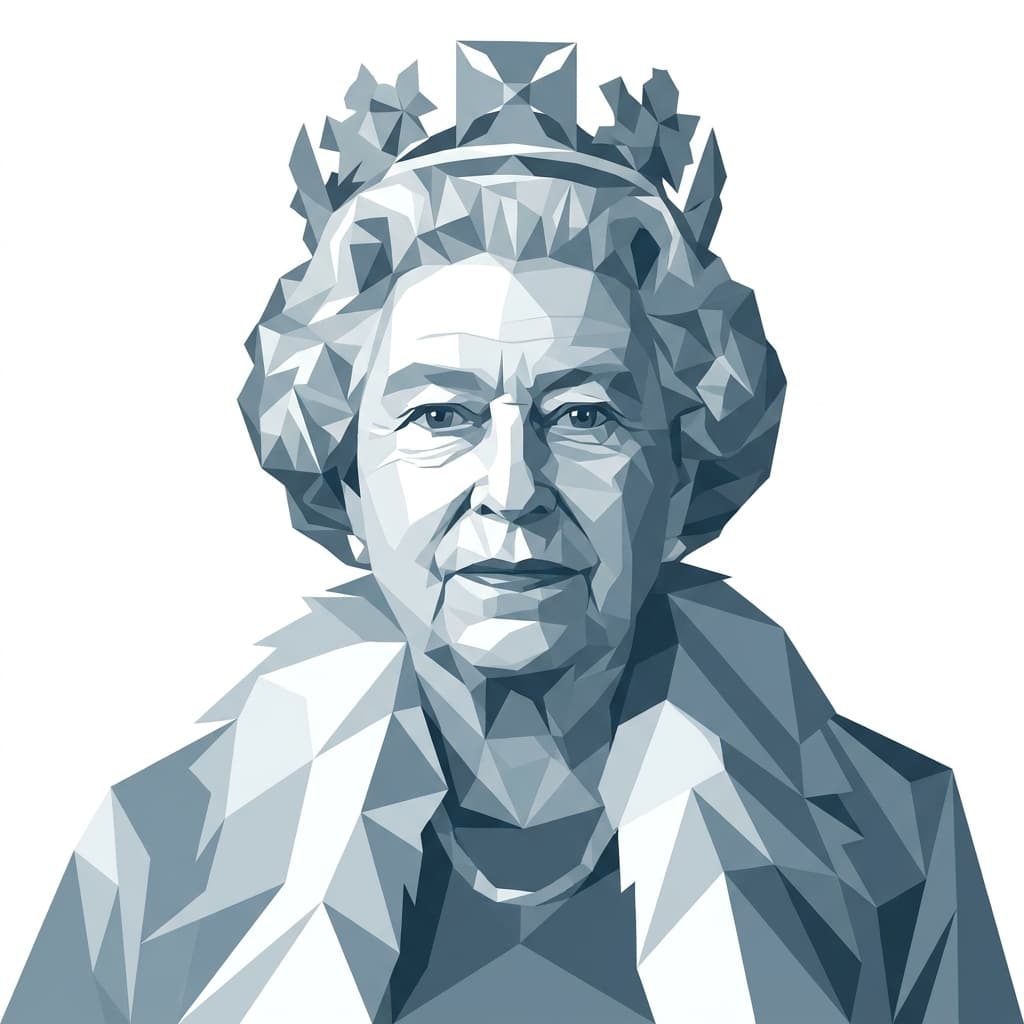
Elizabeth II
Queen of the United Kingdom from 1952 to 2022, the longest-reigning British monarch in history.
Design
- Q41.1
- h31.1
- R8.3
- g62.6
- i61.6
- S54.2
- T30.2
- U26.2
- V41.3
- W14.1
- X36.1
- Y4.6
- Z39.5
Personality
- Q3.5
- h50.5
- R33.5
- g53.6
- i54.6
- S17.1
- T63.3
- U49.3
- V49.4
- W43.6
- X36.6
- Y4.4
- Z39.4
Elizabeth II was a Projector — a quiet observer of people and systems whose authority came not from output but from the precision of her seeing, and the seventy-year reign she stewarded looked exactly like that. She was never the loudest figure in any room she entered, but by the end she had outlasted fifteen British prime ministers, fourteen U.S. presidents, and seven popes, and most of them remembered her as the most perceptive person at the table.
She wasn't supposed to be queen. Her uncle's abdication in 1936 redirected the entire shape of her life when she was ten, and from that moment on she trained — slowly, methodically, in the way of a 5/1 profile that needs the foundation before the leadership. She drove and serviced trucks during the war, learned constitutional law from tutors at Eton, and built the deep procedural literacy that would later let her sit across from Churchill in her early twenties and hold her own. Her gift was bringing quiet order to whatever chaos the century produced — coronations, decolonization, the dismantling of empire, the slow modernization of an institution designed to resist change.
Her decision-making was famously slow. Aides described red boxes worked through every evening, weekends at Sandringham spent re-reading dispatches, decisions returned to over days rather than settled in the heat of a meeting. When the Suez crisis broke, when Diana died, when Charles wanted to marry Camilla — she took her time, sometimes to public criticism, and almost always emerged with a position that held. The 1997 week of silence after Diana's death was the most visible cost of that pacing; the recovery from it was the most visible proof of waiting until the wave had passed before speaking.
She rarely volunteered an opinion. The constitutional convention required it, but it also suited her — she was wired to wait until she was genuinely asked before offering what she saw. Prime ministers from Wilson to Blair to Cameron described the weekly audience the same way: she asked questions that revealed she'd read everything, and her observations landed because she'd earned the right to make them. Her influence operated through presence rather than persuasion, through the slight tilt of an eyebrow, through the carefully chosen brooch worn to meet a difficult guest.
The values were unmovable. Duty, service, the Commonwealth, the Church of England, the horses, the corgis — a set of principles she refused to revise no matter which decade demanded it, and a sense of guardianship over an institution she believed mattered more than any individual inside it, including herself. She made her twenty-first birthday pledge in 1947 — "my whole life, whether it be long or short, shall be devoted to your service" — and kept it literally, taking meetings with her fifteenth prime minister two days before she died at ninety-six.
In her last decades she became something the institution had not previously produced: a figure whose wisdom grew quieter and more concentrated with age, distilled through a lifetime of watching everyone else's certainties come and go. She had seen Churchill weep, Thatcher fall, the Berlin Wall come down, three of her children divorce on the front pages. She kept her counsel. That was, in the end, the work.