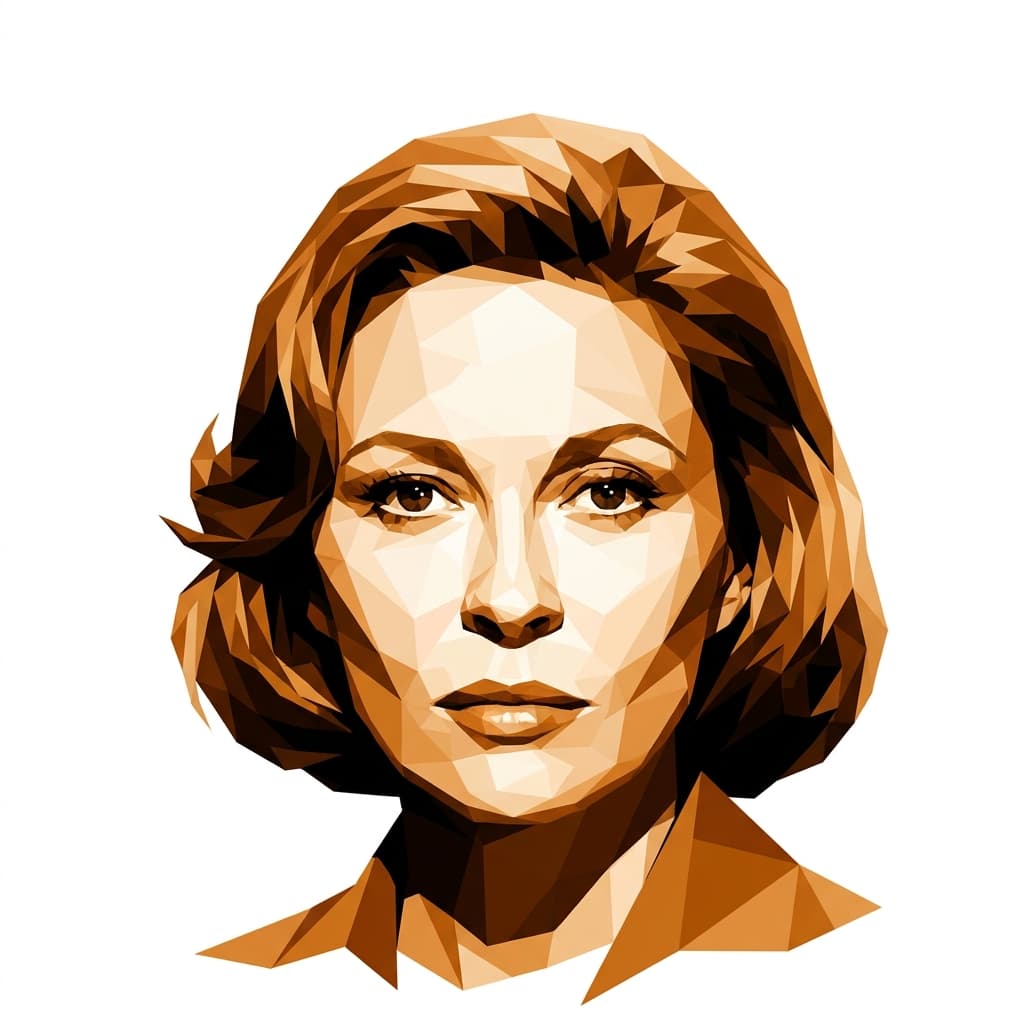
Faye Dunaway
Oscar-winning American actress known for Bonnie and Clyde, Chinatown, and Network's incandescent Diana Christensen.
Design
- Q50.1
- h3.1
- R16.3
- g48.2
- i21.2
- S43.3
- T64.5
- U18.6
- V24.6
- W24.6
- X8.1
- Y6.5
- Z31.3
Personality
- Q61.5
- h62.5
- R7.3
- g18.1
- i17.1
- S60.1
- T10.4
- U9.2
- V27.5
- W24.1
- X23.4
- Y6.6
- Z31.2
Faye Dunaway was a Manifesting Generator — built for speed and intensity, capable of inhabiting wildly different women back-to-back without losing the thread of her own ferocity. She arrived in Hollywood in the mid-sixties from a small Florida town and a peripatetic military childhood, and within two years she had walked off a Broadway stage and into Bonnie and Clyde, the role that announced her as something new. The beret, the cigar, the long bob — she helped invent a look that the culture immediately copied, which is what happens when someone with a gift for spotting what deserves attention shows up at exactly the right moment.
Her instinct for choosing material was almost feline. She turned down what didn't move her and pounced on what did, operating from the kind of gut certainty that doesn't need a second opinion. Chinatown, Network, Three Days of the Condor, Mommie Dearest — these came in quick succession because she was responding to what landed in front of her rather than chasing a career plan. She often said she didn't strategize; she simply knew, in the room, whether something was hers.
As a 5/1, the practical investigator who becomes a trusted authority, Dunaway researched obsessively. For Mommie Dearest she studied Joan Crawford's gestures, voice, posture for months. For Network, she rewrote her own behavior to capture Diana Christensen's manic, television-addled velocity. The 1 in her needed the deep foundation before stepping into the part, and the 5 in her stepped out and solved a director's problem with terrifying precision. The projection field that comes with that profile was, of course, brutal: tabloids, biographers, and co-stars built a Faye Dunaway who was difficult, demanding, impossible — a portrait she spent decades pushing back against.
She was famously a perfectionist on set, and that came with a sharp eye for what wasn't working in a scene. Roman Polanski clashed with her on Chinatown; so did several directors after. But the perfectionism was inseparable from the work — she would refine a single line through dozens of takes until it sat exactly where she wanted it. Sidney Lumet, who directed her in Network, said she was one of the most prepared actresses he ever worked with. She brought order to scripts that arrived as chaos, often reshaping a role before the cameras rolled.
The roles themselves tell a coherent story: women in control, or women fighting for it. Bonnie Parker, Evelyn Mulwray, Diana Christensen, Joan Crawford — all variations on the theme of a woman trying to manage the resources and power around her. Dunaway understood these women because she shared their wiring. Her best performances had the quality of saying only what the moment required, then letting the silence do the rest.
In later decades she worked less in film and more in theater, took on television, mentored younger actresses, and lived largely on her own terms in New York and Los Angeles. The legend hardened around her, sometimes unfairly. What remains, beneath all of it, is the work — five or six performances that anyone learning to act still studies frame by frame.