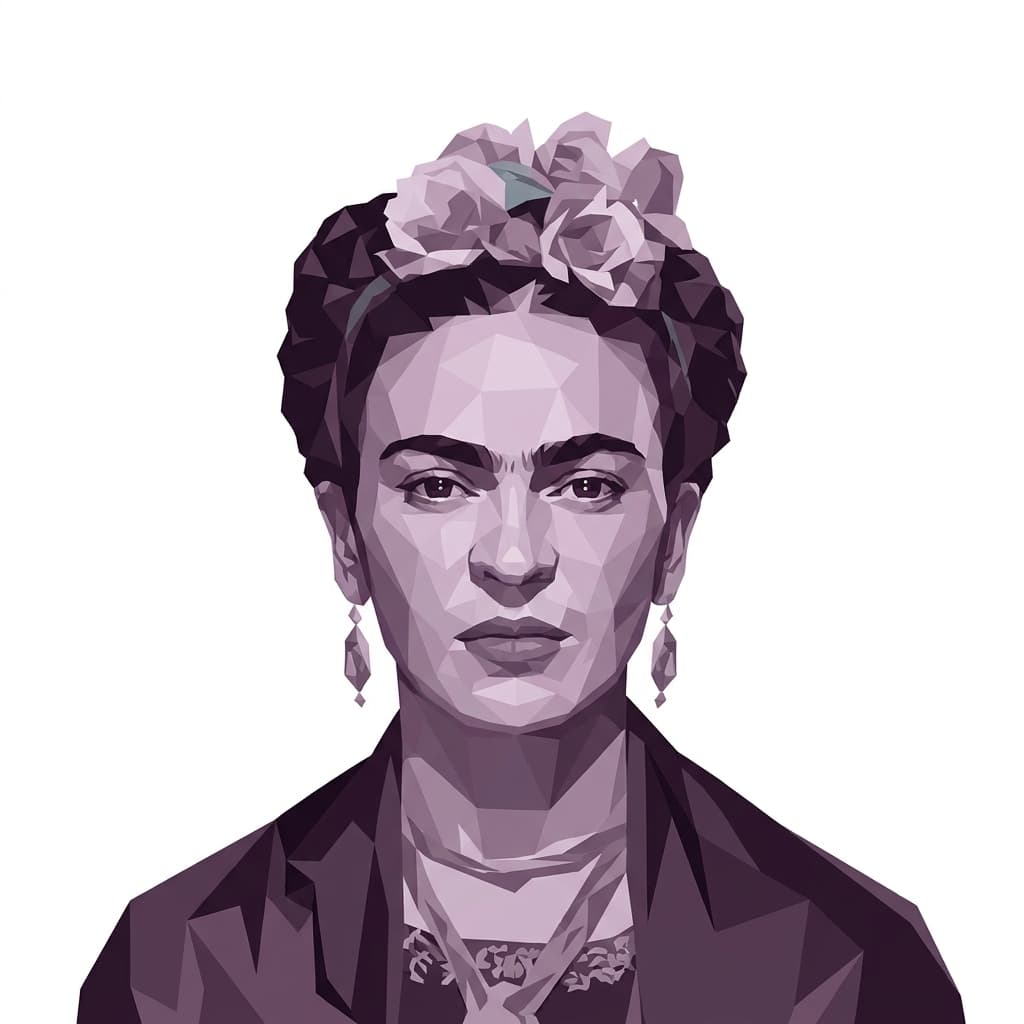
Frida Kahlo
Mexican painter whose self-portraits turned physical pain and political fire into a singular visual language.
Design
- Q51.1
- h57.1
- R61.4
- g56.4
- i60.4
- S22.4
- T55.6
- U10.5
- V15.6
- W22.5
- X38.4
- Y39.1
- Z45.6
Personality
- Q39.5
- h38.5
- R8.6
- g62.3
- i61.3
- S31.5
- T12.2
- U38.5
- V53.6
- W36.6
- X38.2
- Y39.4
- Z12.2
Frida Kahlo was a Manifestor — built to initiate something the world hadn't yet seen and then let others catch up. She didn't train her way into being a painter; a streetcar accident at eighteen pinned her to a bed, a mirror was rigged above her, and she began painting herself because she was, as she put it, the subject she knew best. From that immobilized position she launched a body of work that no one had asked for and no movement had named, which is exactly the kind of move her wiring made inevitable.
Her 5/1 profile — the investigator who becomes a public problem-solver — shows up in how she built her practice. She read anatomy texts, studied Mexican retablos, dug into pre-Columbian iconography, and assembled a visual vocabulary brick by brick before she ever let it out into galleries. When André Breton later tried to claim her as a Surrealist, she famously refused the label: "I never painted dreams. I painted my own reality." That correction is pure self-love that refuses to be redefined by others, and pure 5/1 — she knew her foundation too well to let someone else's frame land on her.
Frida lived the full spectrum of emotional weather as material, which is why her canvases work the way they do. The Two Fridas, Henry Ford Hospital, The Broken Column — these aren't allegories, they're emotional waves rendered with anatomical exactness. She had a way of provoking truth out of any room she entered, wearing Tehuana dress in Paris drawing rooms, smoking and swearing through Rockefeller dinners, and forcing the polite art world to actually look at miscarriage, disability, and colonized identity. Her emotional authority showed in the years-long arc of her decisions about Diego Rivera — marrying him, divorcing him, remarrying him — each move made only after the wave had run its course.
The pain was relentless: thirty-some surgeries, a leg eventually amputated, a body held together by plaster corsets she sometimes painted directly onto. She translated all of it through a fighter's instinct for what was worth the suffering and the courage to shock people awake with her own body. Her diary's late entries — the ink-blot drawings, the wild color — are someone working creatively because of the constraint, turning the cage into the studio. She joined the Communist Party, sheltered Trotsky, and made her politics inseparable from her paint.
She also understood the precise moment a sentence or an image lands. Her letters to Diego, to Nickolas Muray, to her doctors, read like small detonations — timed, charged, unforgettable. Her wardrobe was the same: ribbons, rebozos, gold teeth, a unibrow she refused to pluck. She made herself the story she wanted told, decades before anyone had a word for self-curation.
Her first major solo show in Mexico opened in 1953 while she was bedridden; she arrived by ambulance and held court from a four-poster bed installed in the gallery. She died a year later at forty-seven, having initiated a way of seeing that the rest of the century is still catching up to.