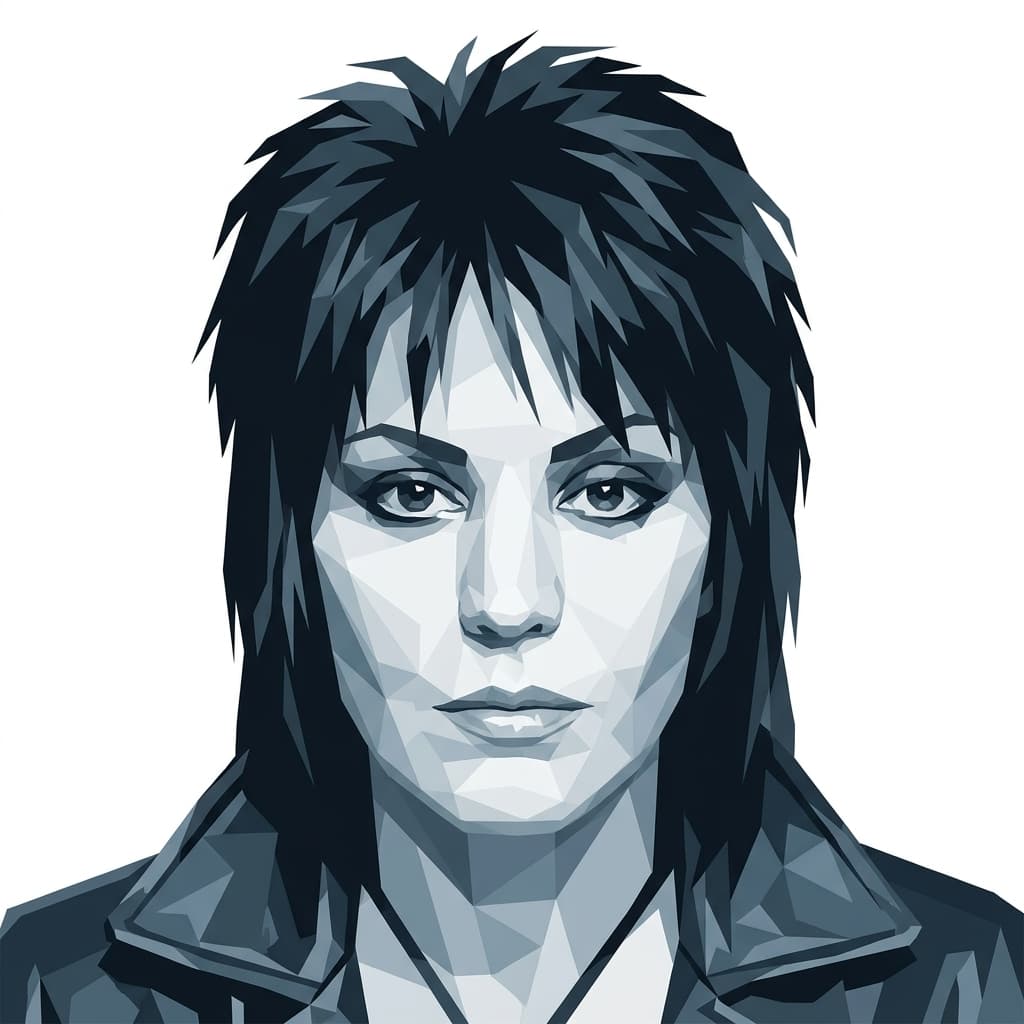
Joan Jett
Pioneering rock guitarist and frontwoman of The Runaways and Joan Jett & the Blackhearts.
Design
- Q15.4
- h10.4
- R64.6
- g50.3
- i3.3
- S52.4
- T8.2
- U21.2
- V32.2
- W26.6
- X33.2
- Y28.1
- Z59.1
Personality
- Q46.2
- h25.2
- R41.1
- g32.2
- i42.2
- S47.2
- T64.6
- U20.1
- V28.2
- W26.3
- X7.2
- Y28.2
- Z59.3
Joan Jett is a Projector — built not for endless output but for seeing exactly what a song, a band, or a scene needs and channeling everyone's energy toward it. That's a strange shape for a rock star, a role that usually rewards Generator stamina, but Jett's whole career has been about doing rock and roll her own way. She doesn't tour like a workhorse and never did; she conserves, then detonates.
She found her instrument at fifteen, when her parents bought her a guitar for Christmas and the first teacher she tried told her girls don't play rock and roll. She quit lessons and taught herself. Within two years she'd co-founded The Runaways with Sandy West, scouted by producer Kim Fowley — the kind of recognition that opens a door her Projector wiring needed to step through. The band was a teenage all-girl rock outfit at a moment when the industry had no category for them, and Jett's rhythm guitar was the engine underneath Cherie Currie's vocals and Lita Ford's leads.
When The Runaways collapsed in 1979, Jett was nineteen and broke. She recorded a solo album that twenty-three labels rejected before she and manager Kenny Laguna pressed it themselves and sold it out of the trunk of his Cadillac — the kind of refusal to quit that finds its own purpose in the struggle. They eventually founded Blackheart Records, one of the first independent labels run by a woman. "I Love Rock 'n Roll" hit number one in 1982 and stayed there seven weeks. The song, a cover she'd loved since hearing it on British TV in 1976, was her instinct that something was worth preserving and amplifying — a gift for spotting what others had walked past.
Her 2/4 profile shows up plainly: famously private, she lives modestly, doesn't do the celebrity circuit, retreats into her vegan, animal-rights work and her Long Beach home — and yet her career has been built entirely through community. Kenny Laguna has been her partner and producer for over forty years. Miley Cyrus, Pink, Bikini Kill, the Foo Fighters — she gets pulled back out by the people who genuinely see her, then disappears again. Her stage uniform — black leather, shag, eyeliner — has barely changed since 1977, a refusal to soften herself for anyone's comfort.
When she sings "I don't give a damn 'bout my bad reputation," it isn't a pose. She fought a decade-long war with a music industry that wanted her to be cuter, more compliant, more marketable, and she simply outlasted them — saying the true thing in the moment it needed saying. She produced the Germs' only studio album, championed the Riot Grrrl movement before most critics knew it existed, and toured for U.S. troops in war zones because she felt called to. She hears the next sound before the mainstream does and has spent her whole career handing the microphone to women coming up behind her.
She was inducted into the Rock and Roll Hall of Fame in 2015. She showed up in leather.