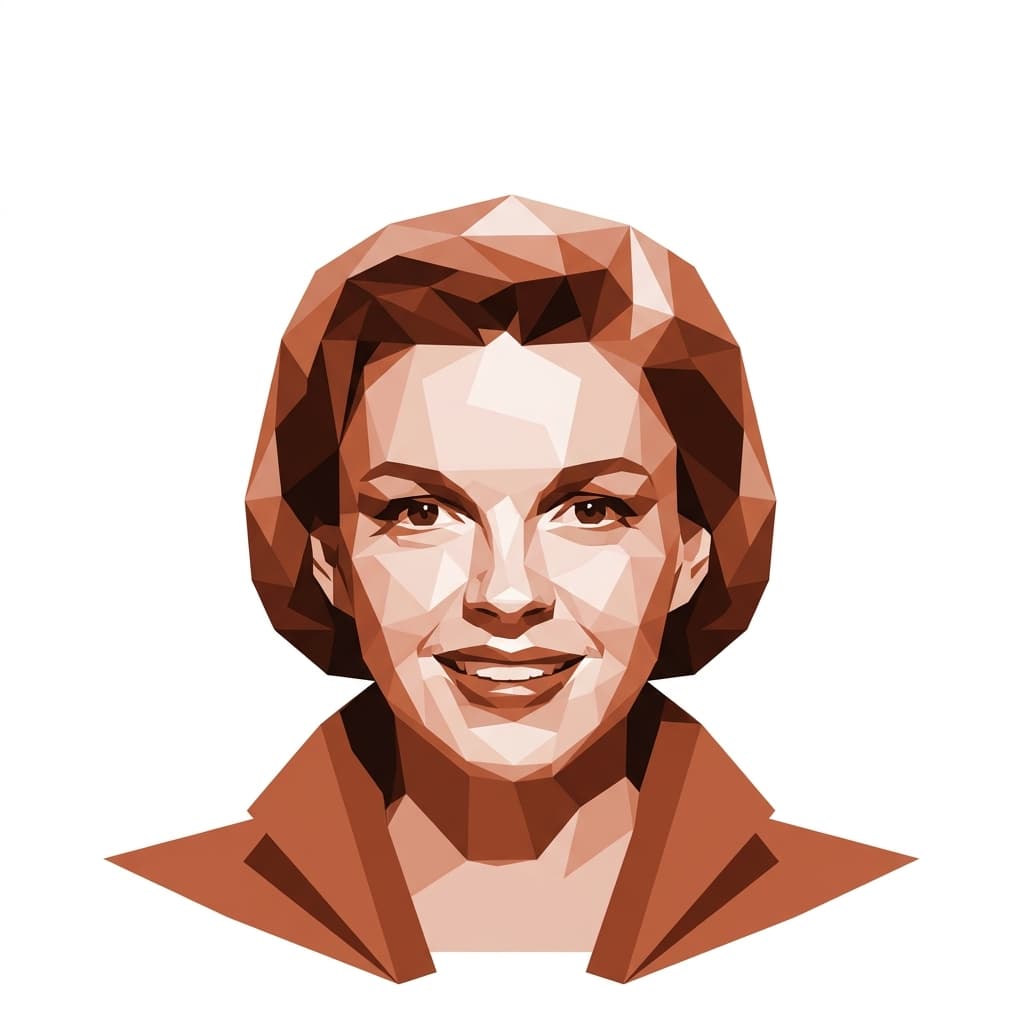
Judy Garland
American singer and actress whose voice and vulnerability made her one of Hollywood's defining stars.
Design
- Q22.5
- h47.5
- R59.2
- g18.6
- i17.6
- S49.5
- T25.1
- U9.5
- V57.2
- W18.2
- X37.5
- Y7.1
- Z52.5
Personality
- Q45.2
- h26.2
- R10.1
- g18.3
- i17.3
- S15.3
- T53.5
- U26.3
- V18.6
- W46.3
- X63.3
- Y7.1
- Z52.6
Judy Garland was a Generator — built with the kind of deep, renewable stamina that let her work a six-day MGM schedule as a teenager and still belt "Over the Rainbow" on the seventh take as if it were the first. From the moment Frances Gumm stepped onto a vaudeville stage at age two, that engine was running, and for the next four and a half decades it almost never stopped, even when everything around her — studios, marriages, pharmacies — tried to redirect it.
Signed to MGM at thirteen, she was put on a regimen of amphetamines to keep her thin and barbiturates to make her sleep. It's the cruel inversion of a body designed to know things her mind couldn't yet articulate: a teenager whose gut knew exactly when something was wrong, taught instead to override it on schedule. Louis B. Mayer called her his "little hunchback." She made The Wizard of Oz anyway, then Meet Me in St. Louis, then Easter Parade — showing up and lighting up on cue for material other people kept handing her, which is exactly the trap and the gift of her wiring.
Her 2/5 profile — the hermit who keeps getting pulled out to save the day — read all over her adult life. She'd retreat to a rented house, gain weight, refuse calls, then re-emerge at the Palace or Carnegie Hall and deliver one of the most electrifying live performances of the century. The April 1961 Carnegie concert is the cleanest example: a thirty-eight-year-old written off by Hollywood walks onstage and pulls every emotional room in the building into one shared frequency. Critics called it the greatest night in showbusiness. She had been, two months earlier, barely speaking.
What audiences felt from her was something closer to an open-hearted innocence that refused to close even after everything. She'd been married five times, bankrupted, hospitalized, declared dead in tabloids while still alive, and she'd still walk out on a stage and sing "The Man That Got Away" like she meant every word for the first time. That was the texture of her extremes — radical highs and equally radical lows, lived at full volume. Friends described months of laughter and pranks giving way to weeks she couldn't get out of bed; she didn't modulate, she just went where the wave took her.
She was also, unmistakably, someone people followed without quite knowing why — Liza, Lorna, and Joey watched her work; Sinatra and Astaire deferred to her instincts on a set. Her musical perfectionism was the Generator's deep mastery in plain sight, drilling a phrasing change for hours until the comma landed right. And her loyalty was ferocious — the friend who turned every chorus line and crew into family, feeding everyone, remembering names, picking fights with executives on their behalf.
She died in London in June 1969, forty-seven years old. The official cause was an accidental barbiturate overdose; the truer cause was a body that had been asked to live by someone else's clock for forty-five years. What survives on the records is the part nobody could schedule out of her — the voice, and the wide-open thing behind it.