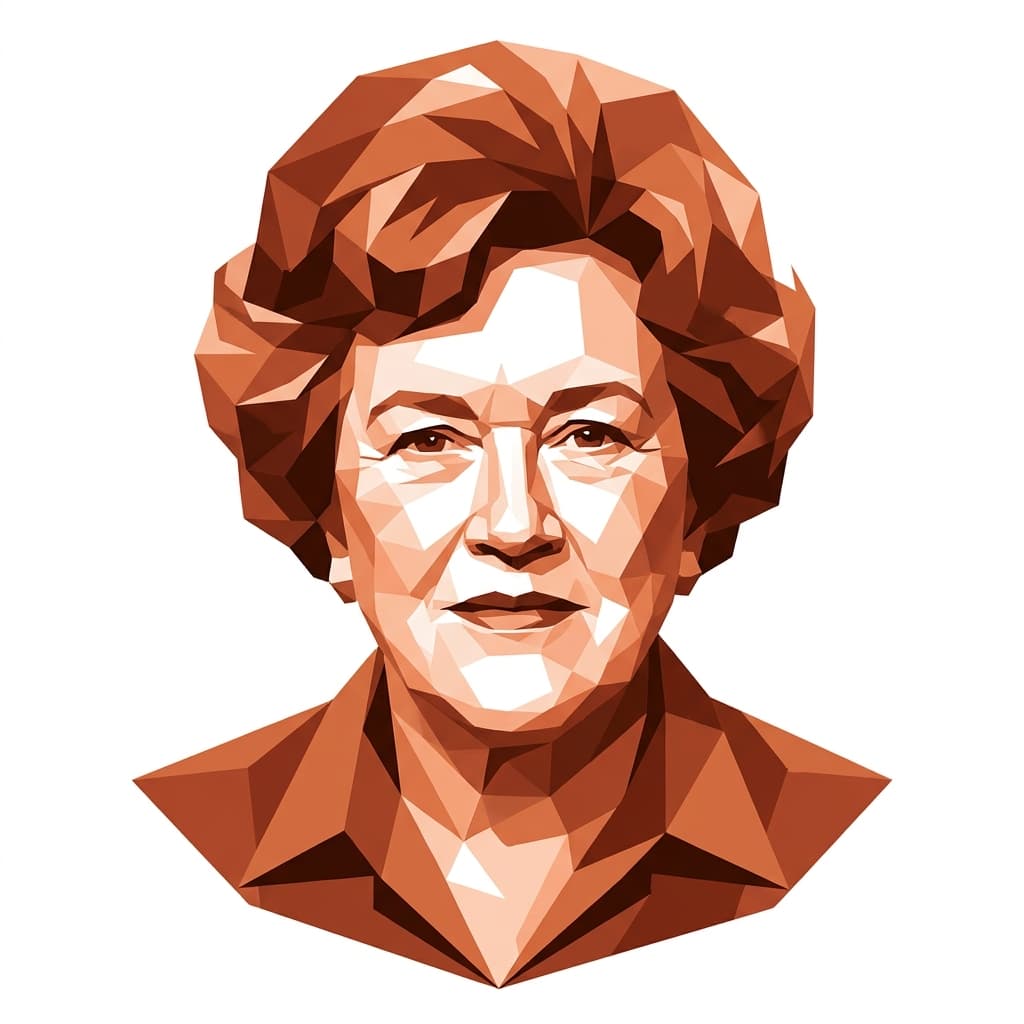
Julia Child
American chef, author, and television personality who brought French cooking to mainstream America.
Design
- Q8.1
- h14.1
- R2.4
- g42.1
- i32.1
- S3.4
- T24.4
- U62.3
- V5.2
- W23.6
- X41.2
- Y62.1
- Z12.6
Personality
- Q4.5
- h49.5
- R48.2
- g21.5
- i48.5
- S59.5
- T59.5
- U47.3
- V9.1
- W20.4
- X60.5
- Y62.5
- Z15.2
Julia Child was a Generator — built for the long, satisfying haul of mastering something thoroughly and then teaching it for the rest of her life. She didn't find cooking until she was nearly forty, living in Paris as the wife of a diplomat, when a single lunch of sole meunière at La Couronne in Rouen lit her up so completely that she enrolled at Le Cordon Bleu and refused to leave until they took her seriously. Everything that followed — the cookbook, the television show, the foundation — grew out of that gut-level yes at a Rouen lunch table.
At Le Cordon Bleu she was the only woman in a class of GIs, and she stayed late, came early, and practiced flipping potatoes onto her kitchen floor until she could do it without losing one. This was her 5/1 profile at full throttle — the investigator who has to build the foundation herself before she's willing to step out as the expert. Mastering the Art of French Cooking, written with Simone Beck and Louisette Bertholle over eight years, was an exercise in organizing every fact and measurement until the recipes actually worked in American kitchens. She tested béarnaise sauce dozens of times. She weighed flour by the gram before American home cooks knew what a gram was.
When Knopf finally published the book in 1961, she was forty-nine. The French Chef premiered on WGBH the next year and ran for a decade, and what made it work wasn't polish — it was the opposite. She dropped things. She laughed at herself. She talked to the camera like it was a friend who'd dropped by, translating the intimidating into the obvious with a voice that warbled up an octave when she was delighted. She had a sense of exactly when to land a joke or a piece of advice, and her warmth was the show's real recipe.
She was relentless about doing the work properly. She believed butter, cream, and the long-simmered stock were worth defending when food fashions turned against them in the seventies and eighties, and she said so, on television, repeatedly. She had a nose for which young cooks and which techniques would actually last — she championed Jacques Pépin, Alice Waters, and a generation of chefs who came up watching her. Her kitchen in Cambridge, eventually installed at the Smithsonian, was the same rhythms repeated thousands of times: pegboard outlined in Sharpie so every pot had its place.
She kept going. The Way to Cook came out when she was seventy-seven. She filmed Cooking with Master Chefs in her eighties. She and Paul had no children, and their marriage — she always credited him as the one who taught her to taste, to see, to write — was the kind of deep partnership she built her whole adult life around. She stayed in motion, kept saying yes to the next show, the next book into her nineties, because the work still satisfied her. She died in 2004, two days short of ninety-two, having closed the cycle she opened at that Rouen lunch with nothing left undone.