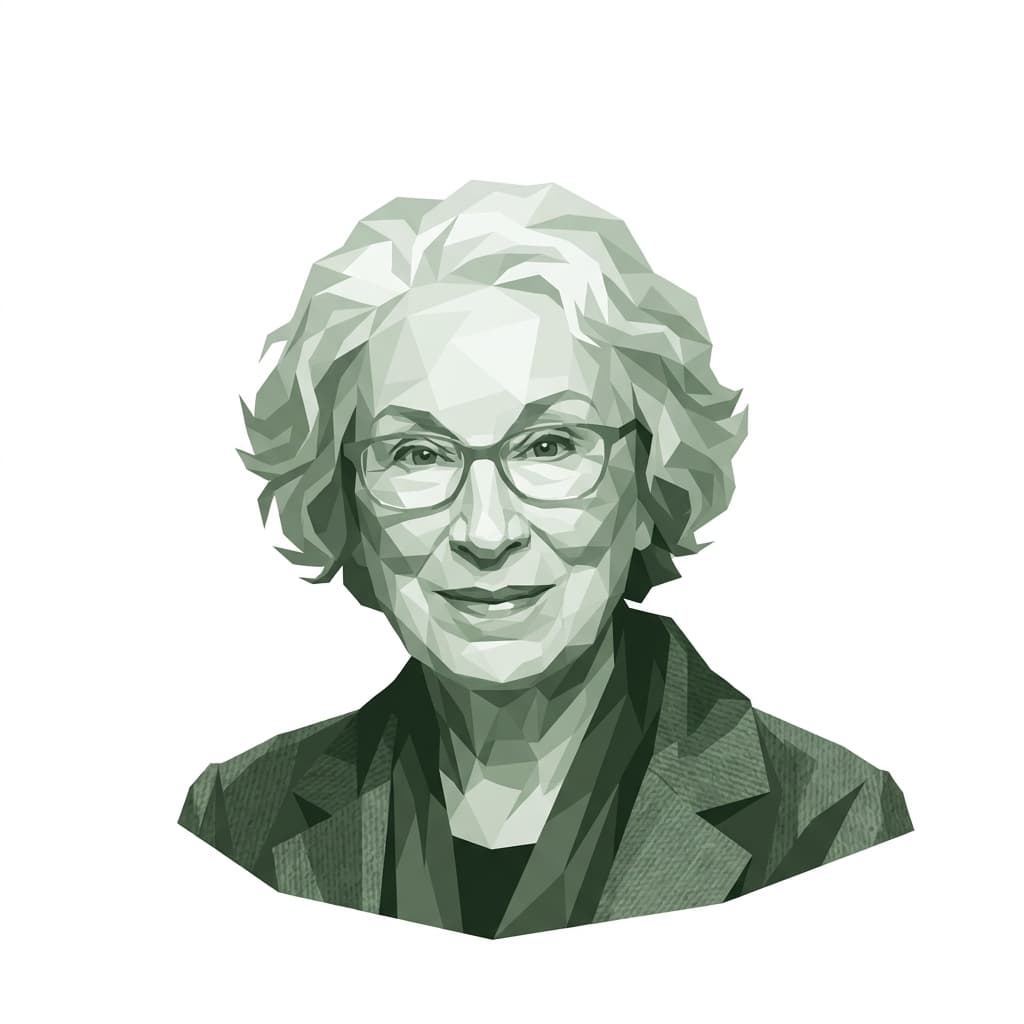
Margaret Atwood
Canadian novelist, poet, and critic whose speculative fiction reshaped how readers think about power and gender.
Design
- Q29.4
- h30.4
- R14.1
- g50.6
- i3.6
- S33.5
- T4.5
- U61.4
- V17.5
- W3.6
- X23.4
- Y47.6
- Z56.6
Personality
- Q14.2
- h8.2
- R30.1
- g50.3
- i3.3
- S5.3
- T5.4
- U30.6
- V25.1
- W42.6
- X23.1
- Y6.3
- Z31.1
Margaret Atwood is a Reflector — the rarest of the Human Design types, designed to sample the temperature of an era and mirror it back with unnerving precision. It's a fitting chart for a writer who has spent six decades looking at her own country, her own gender, and her own species, and reporting what she sees with a dryness that can take a moment to land. The Handmaid's Tale didn't come from a fevered imagination so much as from a Reflector's habit of absorbing the room and noticing what no one wants to name; she famously refused to put anything into Gilead that humans hadn't already done somewhere.
Her 2/4 profile — the hermit-opportunist who needs solitude to develop her gifts and community to release them — describes her working life almost too well. She writes at home, in longhand or on whatever device is nearby, and has been clear for decades that the book happens in long stretches of being unbothered. Then she emerges: PEN events, Twitter feuds with cabinet ministers, the Giller Prize, a co-invention of the LongPen so authors could sign books remotely. The network around her — Graeme Gibson, the Writers' Trust of Canada, the birding community, her literary agents of forty years — is the community that draws the work out and steers it toward the right rooms.
As a Lunar Authority operating on her Wait a Lunar Cycle strategy, Atwood is constitutionally suited to the long arc. The Handmaid's Tale sat in her notebooks for years before she wrote it in West Berlin in 1984. The Testaments arrived thirty-four years after that. She's spoken often about letting an idea wait until she's sure of it, which is a tidy description of decisions ripening across full cycles rather than being seized in a moment of enthusiasm.
The texture of her prose is where the gates live. Her sentences are exercises in taking something complicated and saying it plain — the cool, slightly amused Atwood voice that can deliver an apocalypse in one clause and a joke about gardening in the next. She has an unmistakable gift for arranging chaos into a structure a reader can walk through, which is what speculative fiction at her level actually requires: you build the rules of Gilead or the Republic of Crake brick by brick until the reader forgets to question them. And her opinions — on Canadian identity, on free expression, on the publishing industry, on whether her work is "science fiction" — are grounded in evidence she'd happily produce if asked.
She is now in her mid-eighties and writing essays, reviewing books, tweeting bird photos, releasing poetry collections, showing up at climate events. The storyteller's pull toward making meaning from a long life lived seems undiminished. Atwood once said her job was to pay attention, and that's been the through-line: a Reflector who took the assignment literally, closed her cycles with care, and turned what she noticed into the books we now use to talk about our own future.