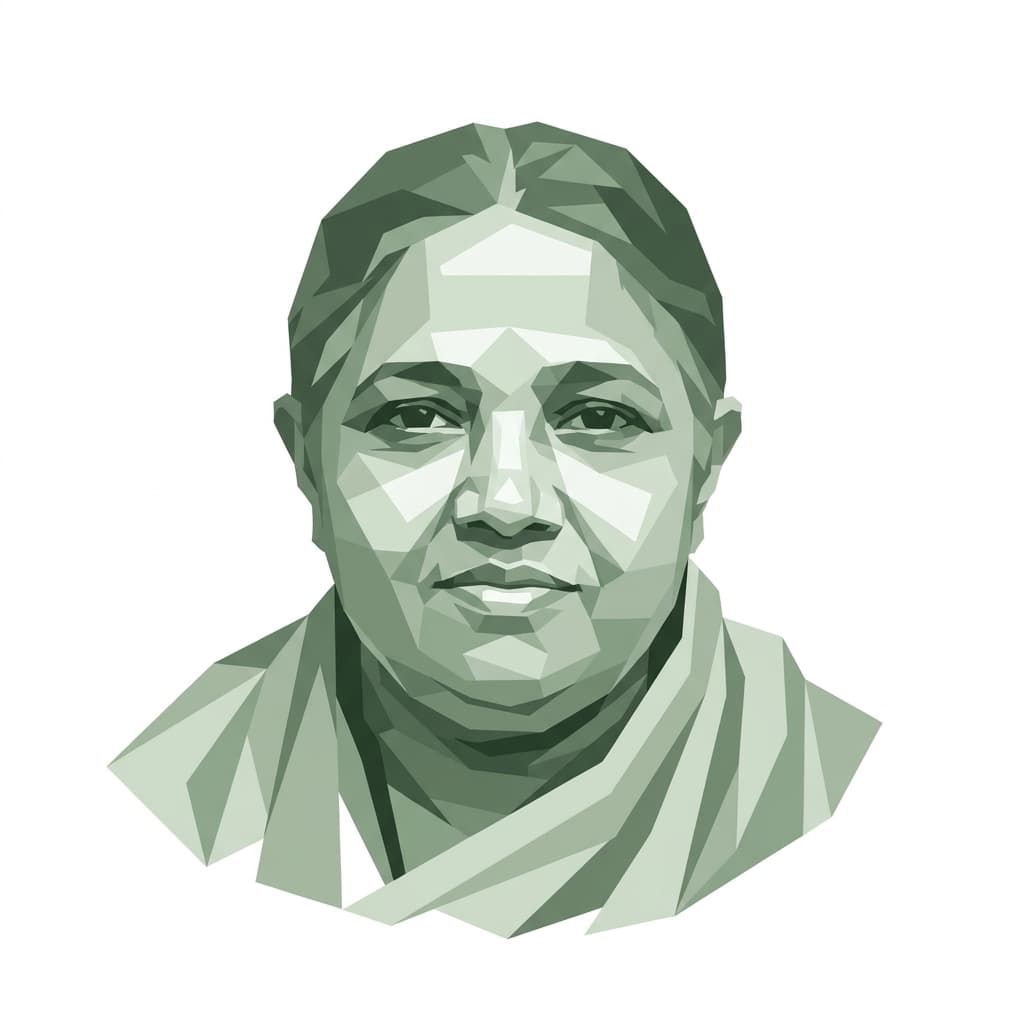
Mata Amritanandamayi
Indian spiritual leader and humanitarian known as Amma, the "hugging saint" of Kerala.
Design
- Q52.2
- h58.2
- R38.5
- g41.2
- i31.2
- S56.6
- T23.2
- U52.6
- V35.1
- W57.6
- X53.4
- Y32.1
- Z4.3
Personality
- Q46.6
- h25.6
- R8.6
- g60.6
- i56.6
- S57.4
- T59.4
- U40.3
- V12.4
- W50.1
- X62.3
- Y32.3
- Z4.6
Mata Amritanandamayi — known to millions simply as Amma, "Mother" — is a Reflector, the rarest energetic type, designed to mirror and amplify the health of the people and places around her. It's a fitting design for someone whose entire public ministry consists of physically holding strangers. Born in a fishing village in coastal Kerala in 1953, she was a dark-skinned girl in a caste-conscious family, pulled out of school at nine to do domestic work, and reportedly spent her childhood in long solitary states of devotional absorption that her family read as madness.
The shape of her life follows the 6/2 profile almost diagrammatically — the messy experimental youth, the long withdrawal, the eventual emergence as a role model. Through her teens she was beaten for giving away the family's food and clothes to the poor, and she retreated into the solitude where her natural gifts quietly developed without anyone, including herself, narrating them as gifts. She wasn't trying to become a guru. She was simply unable to walk past suffering without responding to it, and she had a clear instinct about what was worth her care and what wasn't.
The hug — the darshan that has now been given more than forty million times — began organically in the mid-1970s when villagers started coming to her. She would embrace them. She still does, sometimes for twenty hours straight, person after person, no breaks. It's a practice that only makes sense for someone with the kind of patience that doesn't need to control the timing of arrivals; pilgrims come to her, she does not chase them. Her organization grew the same way — by invitation, by people planting themselves nearby and asking her to guide what they were already trying to build.
What she built is enormous and specific: a university, a chain of hospitals serving the poor, disaster relief networks, housing for tsunami survivors, scholarships for widows. She made these decisions slowly, the way someone tracks a feeling across weeks rather than minutes, consulting senior swamis, sitting with proposals, refusing to be rushed by donors or governments. She has a nose for what will actually last and what is vanity dressed as charity, and she has been known to quietly shelve grand plans that didn't pass that test.
In public she speaks rarely and briefly, almost always in Malayalam, and the words land with weight because of the restraint around them — she waits for the moment when the room is ready to hear, then says something disarmingly simple. Her teachings translate dense Vedantic material into language a fisherman's child can hold. She tells stories from her own life to make abstract devotion tangible, turning lived experience into something others can step into, and she frames service to the suffering as the only spiritual practice that finally matters.
What sustains it all appears to be an unguarded open-heartedness that the worst of human pain has not closed — the steady capacity to receive whoever arrives next, whatever they bring, and to meet them as if they were the only one.