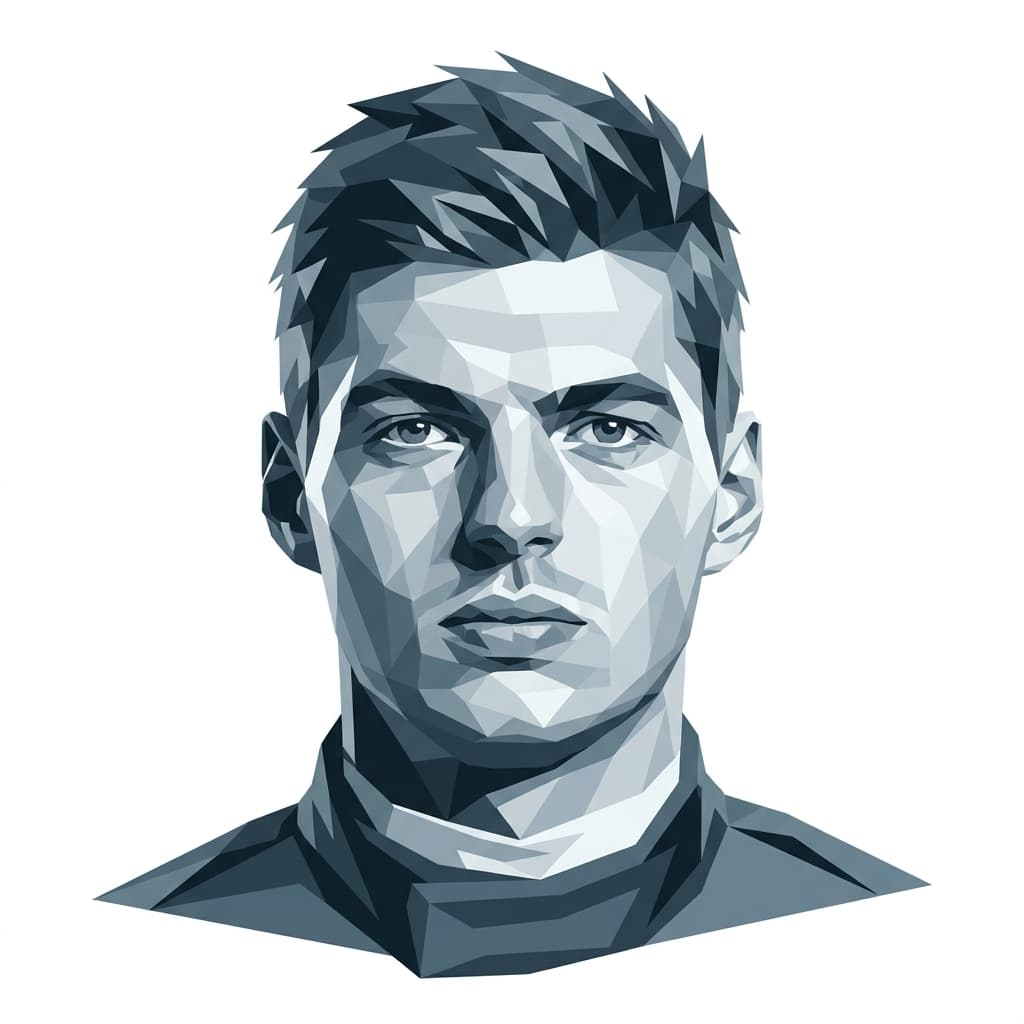
Max Verstappen
Dutch-Belgian Formula 1 driver, four-time World Champion known for ruthless precision and uncompromising racecraft.
Design
- Q52.6
- h58.6
- R8.1
- g6.1
- i36.1
- S53.1
- T31.1
- U18.2
- V49.3
- W51.5
- X19.1
- Y60.3
- Z34.4
Personality
- Q18.4
- h17.4
- R6.2
- g47.3
- i22.3
- S6.5
- T43.3
- U34.2
- V19.5
- W51.3
- X41.4
- Y60.1
- Z34.4
Max Verstappen is a Projector in one of the most energy-hungry sports on earth — a Type designed to see patterns and steward systems, somehow operating inside a machine that demands superhuman output. The contradiction is the story. He doesn't drive on raw stamina the way some of his rivals do; he drives on a kind of unnervingly clear seeing — the spatial knowing that lets him place a car within centimeters of a wall at 300 kph, arriving at the answer before the corner has even unfolded.
Raised by Jos Verstappen on a karting circuit before he could legally cross a road, Max lived a textbook 4/6 profile early arc: messy, intense apprenticeship years, a famously volatile father-coach, crashes and controversies in his teens that read now as the chaotic training ground for a role model he's since become. By 17 he was the youngest F1 driver in history. By 18 he'd won his debut race for Red Bull. The community he leads now — engineers, strategists, a whole Dutch fanbase in orange — formed around someone who had already lived through every public mistake.
On the radio he is famously, surgically opinionated, and able to back it with the data. When the car is wrong, he says exactly what's wrong, in what corner, in what phase — a critic's instinct turned toward the machine rather than himself, paired with the zest for making the package faster that his engineers describe as relentless. He is not diplomatic. He is not trying to be. The people who've earned his trust get the unvarnished read; the people who haven't get silence or a shrug.
His decision-making, particularly off-track, runs on a long fuse. He's said publicly he won't drive past his mid-thirties, that he doesn't romanticize the sport, that he'll walk when it stops feeling right — the kind of statement that only makes sense from an authority that needs days, not minutes, to settle. Contract negotiations, team loyalty, the sim-racing empire he's built on the side: all of it carries the fingerprint of someone who waits until the emotional charge clears before committing. The 2021 Abu Dhabi title and the dominant years that followed didn't come from chasing; they came from being in exactly the right seat at exactly the right time, recognized by Helmut Marko and Red Bull when no one else would gamble on a teenager.
What makes him singular on a grid is the stillness inside the cockpit — the ability to hold focus over a 70-lap stint without the small unraveling that catches most drivers. Combine that with a willingness to send it where others lift, a restless appetite for the next thing, and the raw vitality that keeps him sim-racing for six hours after a Grand Prix, and you get a driver who treats limits — tire walls, track edges, regulations — as constraints to innovate against rather than obey. He is, in the most literal sense, a Projector who got the invitation early and has never stopped earning the next one.