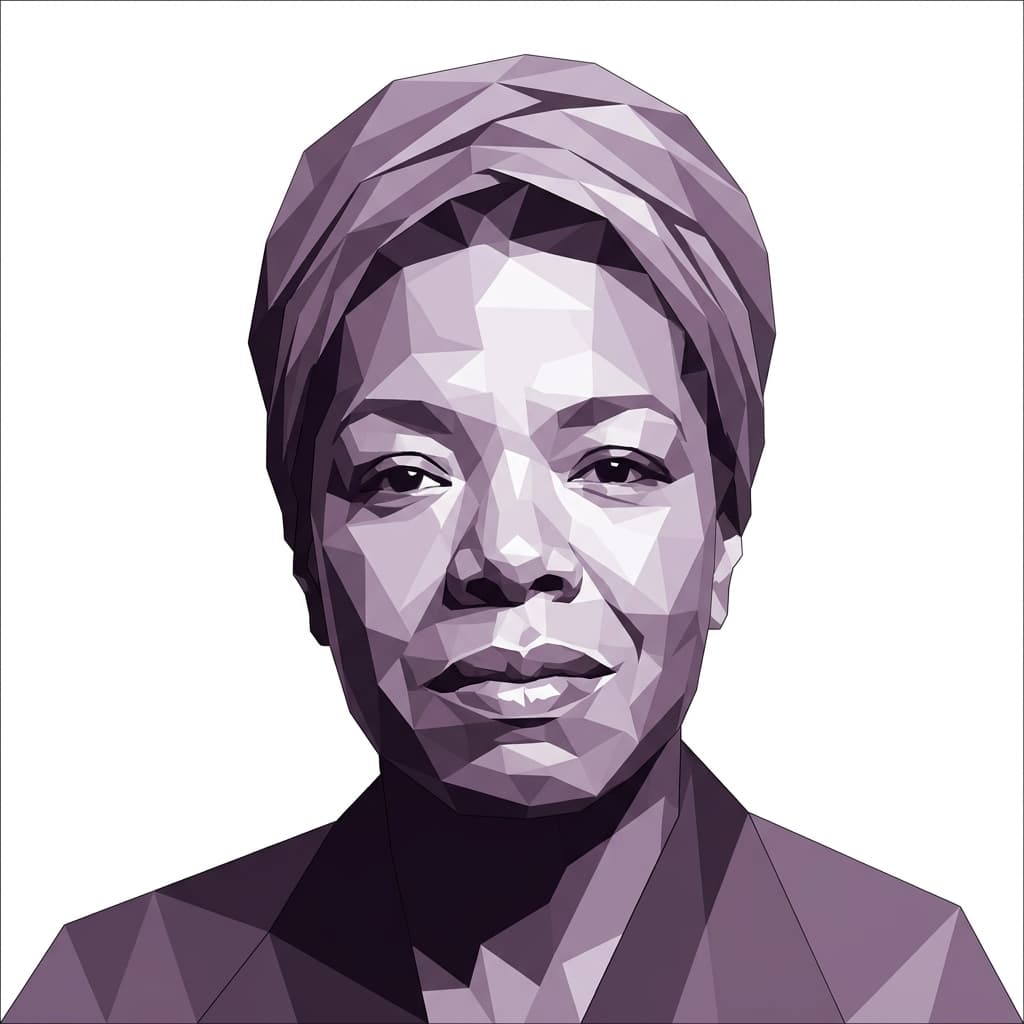
Maya Angelou
American poet, memoirist, and civil rights voice whose autobiographies redefined Black women's storytelling.
Design
- Q54.2
- h53.2
- R56.5
- g45.2
- i26.2
- S54.2
- T34.6
- U26.6
- V36.6
- W5.4
- X25.2
- Y29.5
- Z53.1
Personality
- Q21.6
- h48.6
- R48.2
- g16.6
- i9.6
- S22.4
- T22.6
- U30.4
- V51.2
- W26.3
- X17.1
- Y29.3
- Z39.6
Maya Angelou was a Manifestor — designed to initiate, disrupt, and clear a path others would later walk down — and her life reads like a sequence of bold first moves followed by long periods of distillation. She was the first Black woman to write a screenplay produced in Hollywood, the first to publish a bestselling autobiography about her own childhood sexual abuse, the first to recite a poem at a presidential inauguration in over thirty years. None of these were invited. She moved, and then she informed the world what she had done.
Her early years were exactly the trial-and-error wandering of a 6/2 profile: she was a streetcar conductor in San Francisco at sixteen, a single mother at seventeen, a calypso dancer, a madam, a journalist in Cairo and Accra, an organizer for Martin Luther King Jr. She tried everything, often saying yes to experiences from a place of real commitment without knowing where they would lead. The pattern only made sense in retrospect, which is precisely how that profile is meant to gather its wisdom — by living messily first and observing the meaning later.
The pivot came at forty, when James Baldwin and an editor essentially dared her to write her childhood. I Know Why the Caged Bird Sings arrived in 1969 with the shock of someone willing to go first into territory Black women's literature had largely kept private. She wrote about rape, about the muteness that followed, about a grandmother's store in Stamps, Arkansas. The book worked because she trusted the quiet, immediate knowing about which memory to put down and which to leave — a splenic writer's instinct for the single right detail.
Her process was famously ritualized. She rented a hotel room by the month, arrived at 6:30 a.m. with a Bible, a thesaurus, a deck of cards, a bottle of sherry, and yellow legal pads, and worked lying across the bed until early afternoon. She had the walls stripped of art. This was the kind of devotion to rhythm that protected her output for fifty years, paired with the patience to refine a sentence until it rang. She would write a passage, read it aloud, and rewrite it until the cadence was musical — she trusted that her ear, trained by years of singing and dancing, knew before her mind did.
On the page and on the stage, she carried a voice that gathered authority without raising itself, the kind that made audiences lean in rather than sit back. Her phrasing had the weight of someone who had survived enough to speak slowly, and her readings of her own poems — "Still I Rise," "Phenomenal Woman," "On the Pulse of Morning" at Clinton's 1993 inauguration — felt less like performance than testimony. She provoked feeling in rooms that had numbed themselves, often by simply naming what was true.
In her later decades she became the wise elder her profile had been building toward — courted by Oprah, lecturing at Wake Forest, dispensing aphorisms that traveled further than most poems. She kept the open-hearted innocence of someone who had every reason to be bitter and refused. "I've learned that people will forget what you said, people will forget what you did, but people will never forget how you made them feel." She made people feel met.