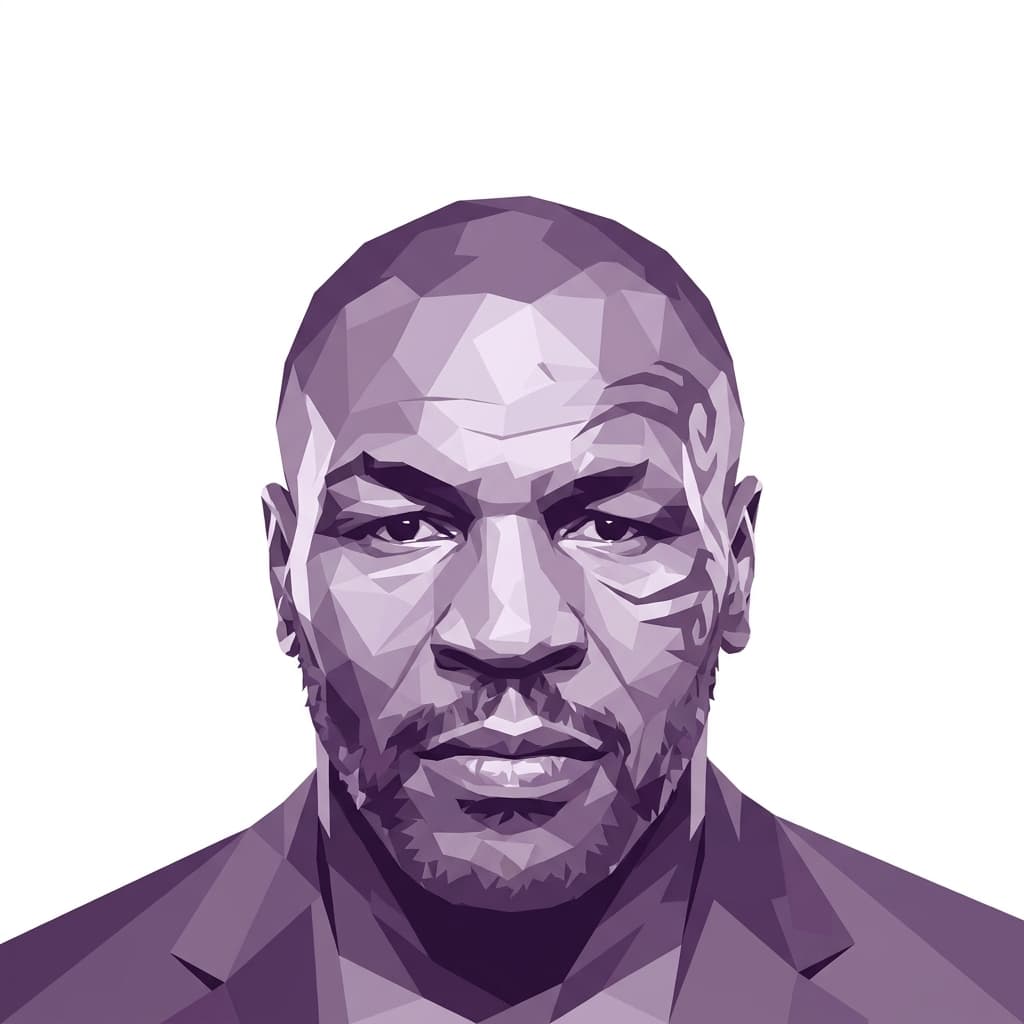
Mike Tyson
Former undisputed heavyweight boxing champion, youngest ever to win the title, cultural icon and provocateur.
Design
- Q21.1
- h48.1
- R56.6
- g8.2
- i14.2
- S36.1
- T49.6
- U51.2
- V12.2
- W22.6
- X64.6
- Y43.4
- Z64.6
Personality
- Q52.5
- h58.5
- R5.1
- g8.1
- i14.1
- S31.3
- T20.6
- U12.1
- V39.3
- W25.2
- X64.6
- Y43.1
- Z64.6
Mike Tyson is a Manifestor — built to detonate first and explain later, and the whole shape of his life follows that wiring. By twenty he was the youngest heavyweight champion in history, having compressed a decade of conventional career-building into a few violent, electrifying years under Cus D'Amato's roof in Catskill. He didn't wait for permission to enter the sport's pantheon; he kicked the door in.
D'Amato's gym is where the 5/1 profile of the investigator-turned-authority comes into focus. Tyson didn't just train — he studied. He watched grainy footage of Jack Dempsey and Henry Armstrong until he could mimic their footwork in his sleep, and he read fight history like other teenagers read comics. That obsessive foundation-laying, the well of technical depth most fans never noticed under the knockouts, is why his peek-a-boo style felt less like brawling than like a thesis being defended in real time. The 5 in his profile is also why the world projected so much onto him, and why those projections eventually buried the man underneath.
In the ring he was pure presence, pure now, reacting at a speed that made opponents look like they were boxing in syrup. The first-round demolitions of Michael Spinks and Marvis Frazier were the kind of risk-taking that rewrites what's possible in a sport; he carried a competitive fire that wanted to be first at everything and a dive-into-intensity emotional makeup that fueled it. But he was also an Emotional Authority in a profession that demands instant decisions, which is part of why his life outside the ropes — the marriage to Robin Givens, the split from Bill Cayton, the firing of Kevin Rooney — produced so much wreckage. Decisions made on emotional peaks rarely survived the next morning.
Then came the unraveling. The 1992 rape conviction, three years in prison, the 1997 ear-biting against Holyfield, the bankruptcy despite over $300 million earned. He spoke, often, in words that arrived with disturbing emotional weight — the "I want to eat his children" press conferences, the philosophical asides about Schopenhauer, the soft-voiced confessions about being scared. That capacity to provoke whatever truth a room was avoiding made him impossible to look away from and impossible to manage. Don King couldn't, the Nevada commission couldn't, and for long stretches Tyson couldn't either.
The third act has been the strange, public reinvention: the one-man Broadway show with Spike Lee, the cameos, the podcast where he interviews everyone from Sebastian Maniscalco to Ric Flair. He has rebuilt a ritualized daily life around training, fatherhood, and a cannabis business that became his second fortune. There's a hard-won, almost childlike openness in how he now talks about pain — his daughter's death, his own abuse, his addictions — that would have been unthinkable from the 1988 version of him. The fighter who once seemed engineered only to destroy turned out to be capable of making meaning out of his own wreckage, telling the story in a way that lands because he actually lived every second of it.