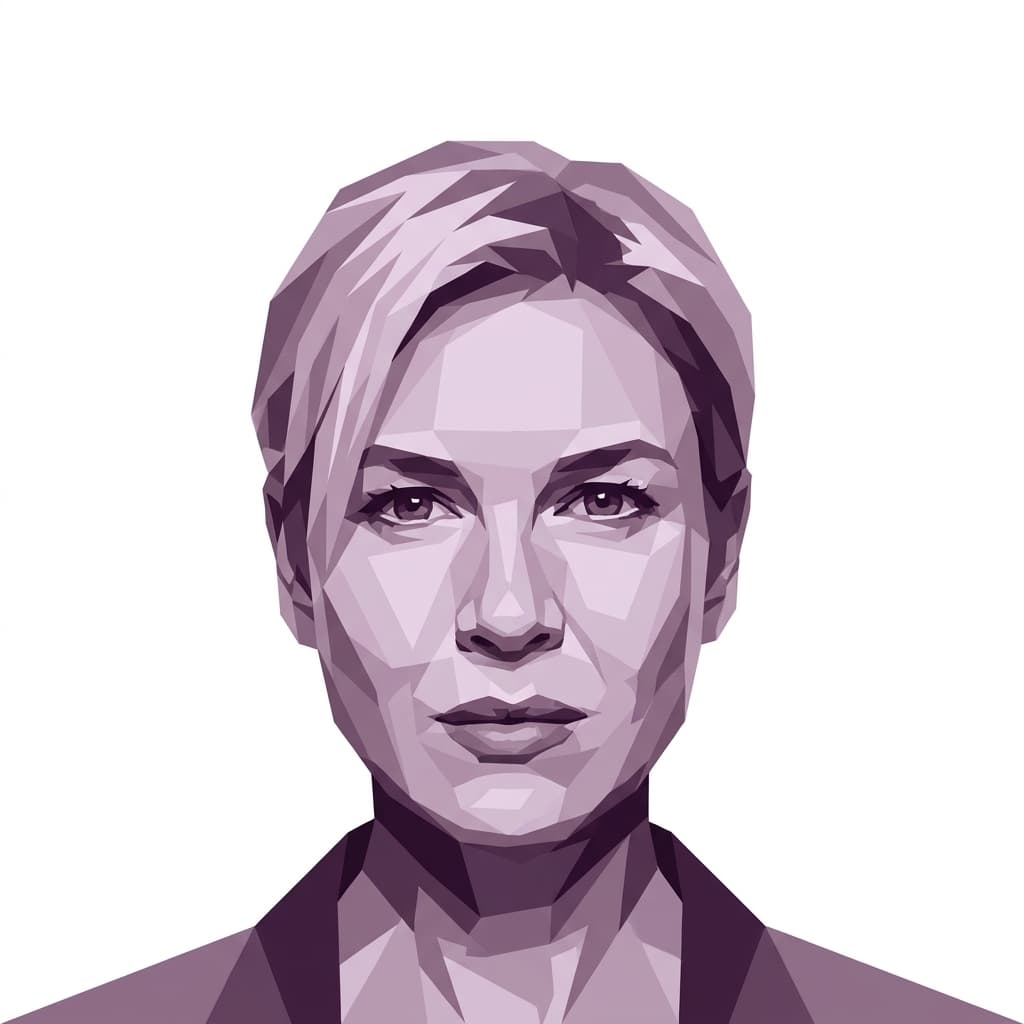
Renée Zellweger
Texas-born actress whose Bridget Jones, Roxie Hart, and Judy Garland performances earned multiple Oscars.
Design
- Q41.6
- h31.6
- R20.2
- g25.5
- i46.5
- S19.5
- T36.2
- U1.3
- V18.3
- W51.6
- X46.6
- Y14.5
- Z6.3
Personality
- Q27.4
- h28.4
- R7.5
- g25.2
- i46.2
- S23.5
- T21.2
- U5.6
- V6.5
- W3.4
- X46.3
- Y14.4
- Z6.1
Renée Zellweger is a Manifestor — wired to act on instinct, disappear when she needs to, and come back only when something genuinely pulls her. Her career has moved in distinct bursts rather than a continuous climb: a stretch of work, a withdrawal, a return on her own terms. That rhythm is the spine of who she is, and it's the reason her best performances feel like events rather than entries on a résumé.
She studied English at the University of Texas at Austin, working bar shifts and picking up Texas commercials before drifting toward film. Early roles in Empire Records and Love and a .45 were the experiments of a 4/6 profile still in its messy first act — the warm, connection-driven part of her finding her way through small parts and odd choices, building toward the role-model phase that came later. Her breakthrough as Dorothy Boyd in Jerry Maguire arrived through a casting process where she simply spoke about the part with the conviction of someone who already knew, and Cameron Crowe later said her audition reading was the audition.
The Bridget Jones decision is the cleanest example of her wiring. She gained the weight, mastered the accent, and absorbed criticism from British tabloids who didn't want an American in the role — then moved first, informed people second, and didn't apologize for it. For Chicago she trained as a singer and dancer from scratch in a few months, the kind of compressed, all-in preparation that suits someone whose energy comes in concentrated bursts rather than steady output. She won her Oscar for Cold Mountain the following year and looked, on camera, like someone genuinely surprised by it.
Then in 2010 she stopped. Six years off — no films, no press circuit, no explanation owed. She moved back toward private life, studied international law at UCLA, and largely refused to perform the celebrity part of celebrity. It was a withdrawal that read as composure rather than crisis, and it confused an industry that expects continuous availability. When she returned in Bridget Jones's Baby and then Judy, the work had a different weight to it — the lived-experience wisdom of someone who had stepped away long enough to actually have something new to say.
Her Judy Garland in Judy (2019) won her a second Oscar, this time for Best Actress. The performance is unnervingly close to the bone: a study of a woman wrung dry by the business, and Zellweger plays it with the tenderness of someone who recognized the shape of that exhaustion without quite having lived it. She sang the songs herself rather than lip-syncing, a small bet on her own preparation that paid off.
Off-screen she keeps a low profile, lives mostly in Connecticut, and gives interviews that politely deflect rather than disclose. She has the discernment about who gets close of someone who learned early that warmth and access aren't the same thing — friendly to everyone, intimate with very few, and clear about the difference.