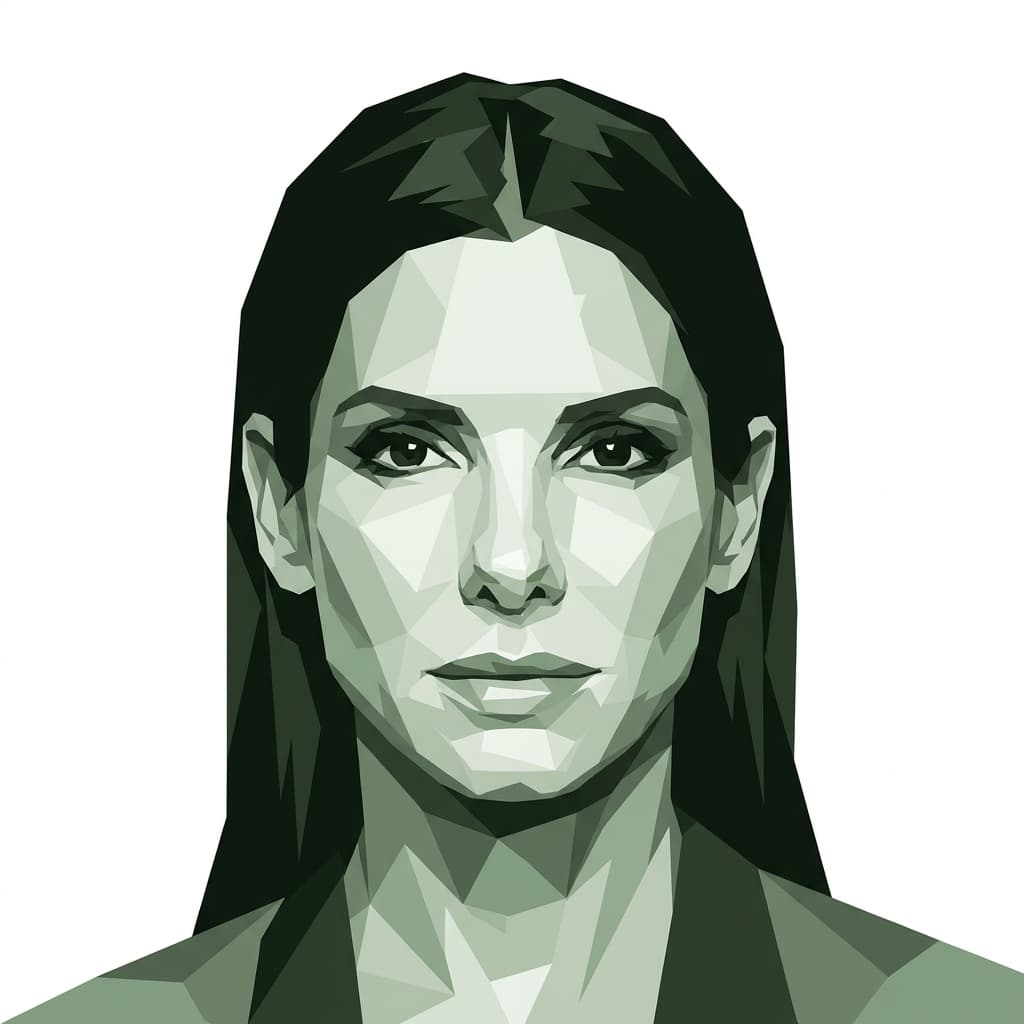
Sandra Bullock
Oscar-winning American actress known for her comedic timing, dramatic range, and famously private off-screen life.
Design
- Q27.4
- h28.4
- R32.1
- g15.6
- i10.6
- S24.1
- T45.4
- U42.1
- V27.2
- W55.4
- X40.1
- Y1.4
- Z64.1
Personality
- Q31.2
- h41.2
- R49.4
- g15.4
- i10.4
- S29.5
- T12.2
- U12.5
- V23.4
- W55.4
- X40.3
- Y1.2
- Z64.2
Sandra Bullock is a Reflector — one of the rarest types in Human Design, designed to take in the room before deciding anything about it — and her career has the unmistakable shape of someone who reads environments for a living. She broke through in Speed in 1994 not by overpowering the screen but by reflecting back the audience's own panic and humor, then spent the next three decades carefully choosing when to disappear and when to return. The gaps between her projects are often as deliberate as the projects themselves.
Her 2/4 profile — the hermit who also happens to attract opportunities through her community — explains a lot about the way she works. Friends and longtime collaborators describe a woman who vanishes for stretches into her home in Austin, then re-emerges through tight relationships: Alfonso Cuarón handing her Gravity, Melissa McCarthy pulling her into The Heat, longtime producing partners returning for the next thing. She has spoken many times about needing real solitude to recharge before she can give anything away, and about how almost every great role came through someone she already knew rather than a cold pitch.
Bullock has always had a sharp instinct for what's worth investing in. She turned down dozens of romantic comedies in the early 2000s and produced Miss Congeniality herself when no one else quite saw it. She read The Blind Side and reportedly took a long time to say yes — wary of the material — eventually committing only when she could meet the real Leigh Anne Tuohy. That pattern of letting a decision settle over weeks before saying yes shows up again and again in interviews; she has talked about needing to "live with" scripts.
On screen she carries the energy of someone who fights only the fights worth fighting, which is why her dramatic turns in Crash, Gravity, and Bird Box land harder than the genre would suggest. Off screen, the throughline is fierce, protective caregiving — for her two adopted children, for her late partner Bryan Randall during his ALS diagnosis, for the Louisiana families she quietly funded after Katrina. She has been blunt about the cost of giving without boundaries, and about learning to step back.
Her comedic voice — the rambling, self-deprecating monologue, the well-timed pratfall — depends on knowing exactly when to land a line and when to hold it. Comedians who've worked with her note how much she edits in the moment, cutting her own words down to whatever the smallest version of the joke can be. It looks effortless, which is the 2/4 trap: the things that come most easily to her are often the things she's quickest to dismiss.
She has resisted the standard Hollywood arc — no franchise treadmill, no constant press, an ongoing willingness to take years off. After Bird Box she stepped back almost entirely, and after Randall's death she has spoken about closing a chapter fully before considering what comes next. It's a career built less on momentum than on careful, cyclical curation — exactly the rhythm her chart suggests, and exactly the rhythm she seems to trust.