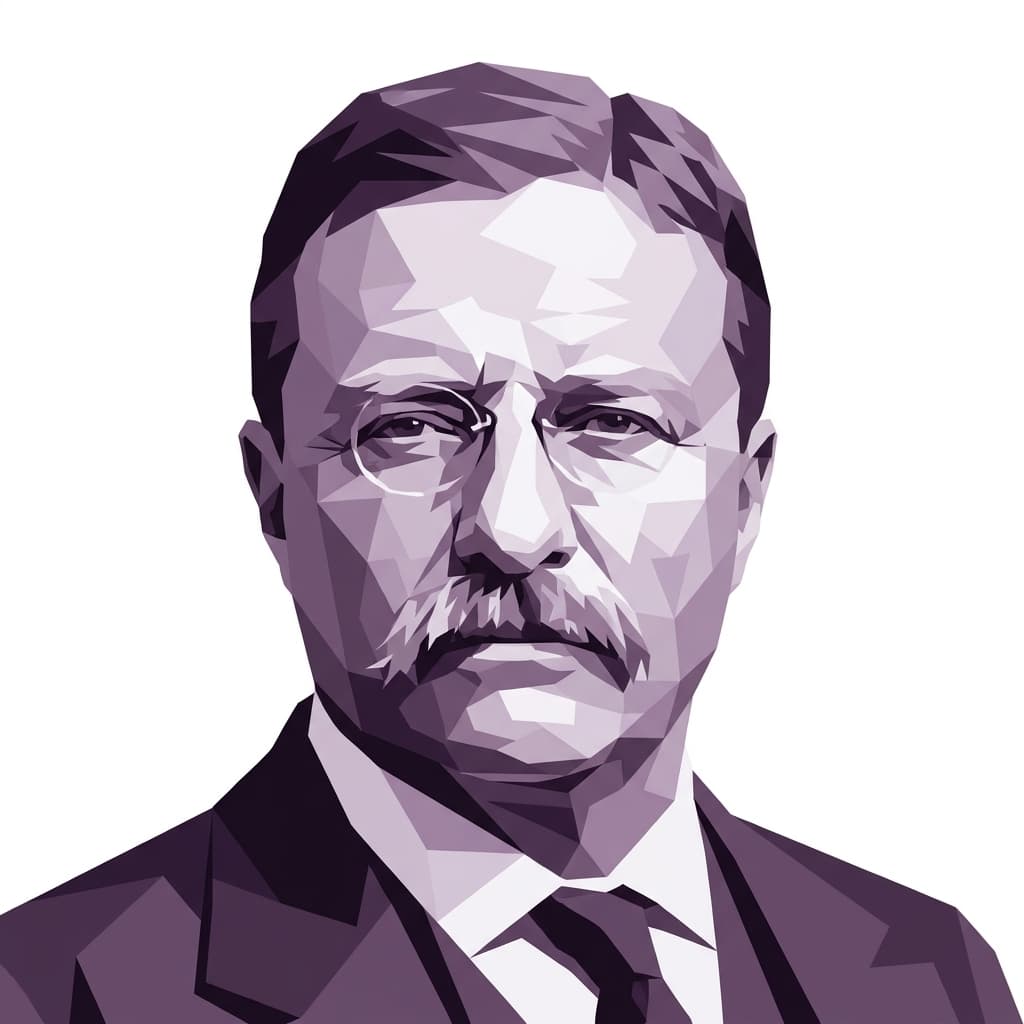
Theodore Roosevelt
26th U.S. President, Rough Rider, conservationist, and exuberant trust-busting reformer of the Progressive Era.
Design
- Q31.5
- h41.5
- R22.4
- g37.4
- i40.4
- S29.3
- T64.3
- U43.6
- V35.3
- W31.1
- X20.3
- Y36.3
- Z27.6
Personality
- Q28.3
- h27.3
- R53.2
- g37.2
- i40.2
- S28.2
- T26.2
- U54.4
- V45.5
- W33.5
- X20.3
- Y22.6
- Z27.5
Theodore Roosevelt was a Manifestor — wired to initiate, disrupt, and drag the world behind him whether it had asked to come along or not — and his life is essentially a catalogue of things he started before anyone else thought to start them. A sickly, asthmatic boy in a Manhattan brownstone, he willed himself into a body that could box, hunt, and ride, then proceeded to apply that same forcible self-invention to every institution he touched. He was charging up San Juan Hill at 39, Vice President at 42, President at 42, and out of the White House by 50, already plotting his next expedition.
His 3/5 profile — the experimenter who becomes a crisis leader — fits him almost too neatly. Roosevelt learned by doing badly first: failed Dakota rancher after the blizzard of 1886, defeated mayoral candidate, ridiculed Civil Service commissioner who refused to stop being earnest. Each apparent failure became material. By the time McKinley was shot and he inherited the presidency, he had a knack for striding into other people's emergencies with a fully-formed plan, and the country, exhausted and unsure, mostly let him lead.
He had the kind of restless drive that needs a hill to charge, and he picked his hills with a Manifestor's indifference to permission. He busted Northern Securities without warning Wall Street. He sent the Great White Fleet around the world and informed Congress it would have to fund the return trip. He seized Panama with a brisk telegram and built a canal. This was Initiate and Inform at presidential scale — act first, brief the country afterward, and let the protests catch up.
The conservation work shows the other side of him: a deep, almost familial protectiveness toward the American land. He set aside 230 million acres — national parks, forests, monuments, bird reservations — often by executive order, sometimes the night before Congress could stop him. The same man who shot lions in Kenya wept reading John Muir's letters about Yosemite. He carried a genuine hunger for the next horizon, and after the presidency it took him to the Amazon, where he nearly died charting the River of Doubt and came home gaunt, malarial, and characteristically pleased with himself.
Roosevelt's emotional weather was famously visible — Henry Adams called him "pure act" — but the better decisions of his life came after he'd cooled off. The worst, like the 1912 Bull Moose schism that split the Republican Party and handed Wilson the White House, came when he was emotionally charged and refused to wait. He was a born persuader who could sell any policy once he believed in it, and he could say the truest possible thing at the exact wrong moment with equal frequency. The Square Deal, the trust-busting, the Nobel Peace Prize for ending the Russo-Japanese War — these came from his clearer hours.
He died in his sleep in 1919 at sixty, books on the nightstand, plans for a third presidential run on the desk. His son Archie cabled the family: "The old lion is dead." It was the right metaphor. He had committed to every experience as if it were the only one, and there were a great many of them.