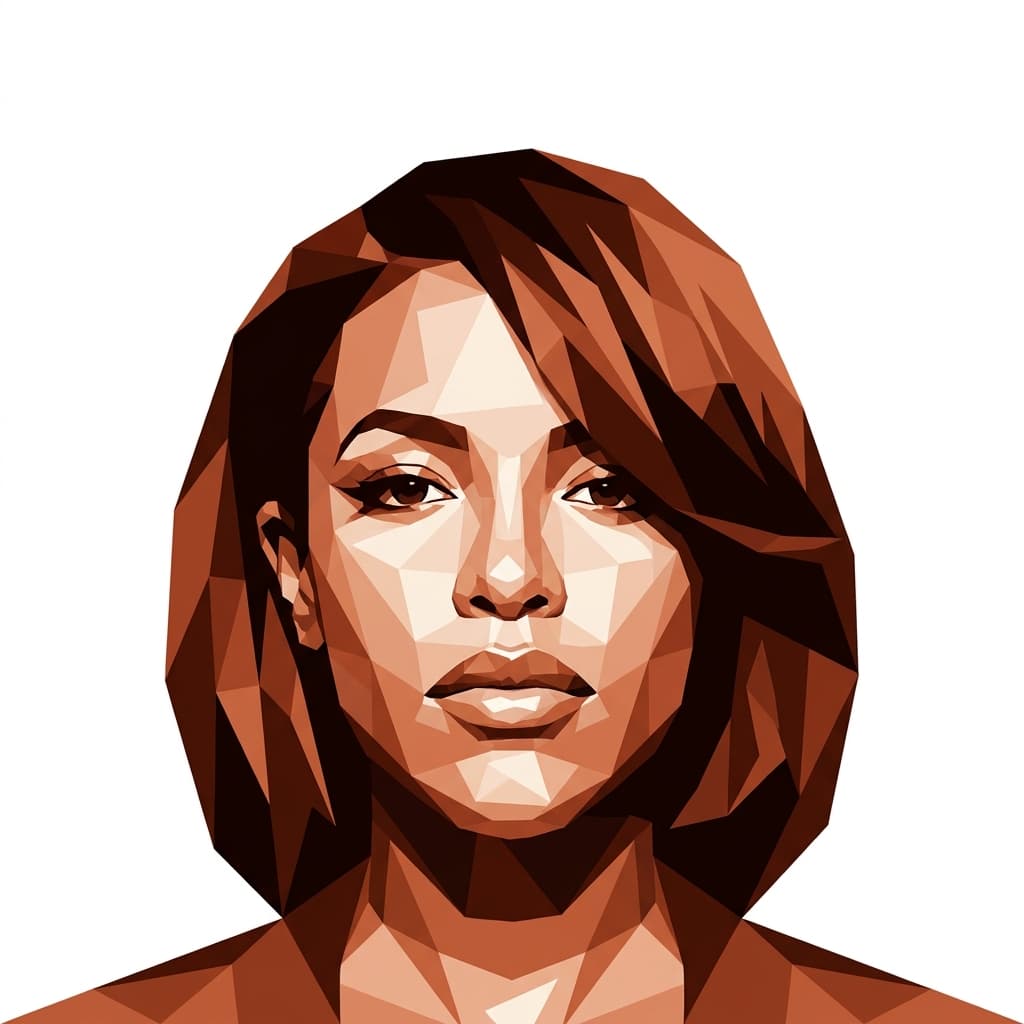
R&B singer, dancer, and actress whose understated cool reshaped late-90s pop before her death at 22.
Design
- Q50.2
- h3.2
- R15.4
- g6.4
- i36.4
- S44.5
- T43.4
- U43.4
- V31.6
- W40.6
- X1.3
- Y5.6
- Z57.3
Personality
- Q61.6
- h62.6
- R59.2
- g47.2
- i22.2
- S38.2
- T9.4
- U60.1
- V31.4
- W64.3
- X43.2
- Y26.3
- Z57.5
Aaliyah Dana Haughton was a Generator — built for the long, patient work of mastering a craft rather than chasing every flash of attention that came her way. Born in Brooklyn and raised in Detroit, she started performing as a small child, auditioned for Star Search at ten, and sang alongside Gladys Knight in Las Vegas before she'd hit puberty. The stamina was there from the beginning; what took time to develop was her own voice inside it.
Her debut Age Ain't Nothing But a Number arrived when she was fourteen, produced almost entirely by R. Kelly, and the fallout from that period — the illegal marriage, the annulment, the silence she kept about it publicly for the rest of her life — became the shadow her second act was built around. She responded by disappearing into work with Timbaland and Missy Elliott, letting the music speak while she waited out the noise before saying anything back. It was a 6/2 profile's instinct made visible — the role-model-in-training who steps back, observes, and returns wiser.
One in a Million in 1996 rewired R&B. Her whisper-close vocal, layered over Timbaland's skittering, half-time productions, became the template for a decade of pop to come. She had the kind of creative signature that didn't need to shout — a sound so specific that imitators are still audible today. On camera she covered one eye with her hair, wore baggy Tommy Hilfiger over a bare midriff, and turned styling into an original visual grammar that others copied for years. She wasn't loud about being different; she just was.
Those who worked with her described someone almost eerily calm — a young woman who made decisions by sleeping on them and coming back the next day, who rarely lost her temper, who listened more than she spoke and picked her moments with care. Her creative circle stayed small: Timbaland, Missy, Static Major, her cousin and manager Jomo Hankerson, her mother Diane. She was fiercely loyal, and protective of the people and standards that made the work possible. Interviewers routinely mentioned how self-contained she seemed for her age — private in a way that felt chosen, not shy.
By 2001 she'd added film to the resume — Romeo Must Die had proven she could carry an action lead, and she'd already shot Queen of the Damned and been cast in the Matrix sequels. The self-titled Aaliyah album that summer was her most adventurous, full of the sudden left turns and mood shifts that Timbaland's production was built to hold. She was starting to step into the invitation to lead, quietly, from the front — an artist whose second phase was clearly going to eclipse the first.
She died on August 25, 2001, in a plane crash in the Bahamas after shooting the "Rock the Boat" video. She was twenty-two. The wisdom of that 6/2 arc — the messy first phase, the observant middle, the guide-figure to come — was cut off at the transition, and the culture has spent the years since trying to hear what was next. The influence kept traveling anyway. Tinashe, FKA twigs, Ciara, Rihanna, half of contemporary R&B — the resonance you can trace back to one voice belongs to her.
Sources: biography · birth data
What do you and Aaliyah have in common?
Enter your birth details to find out