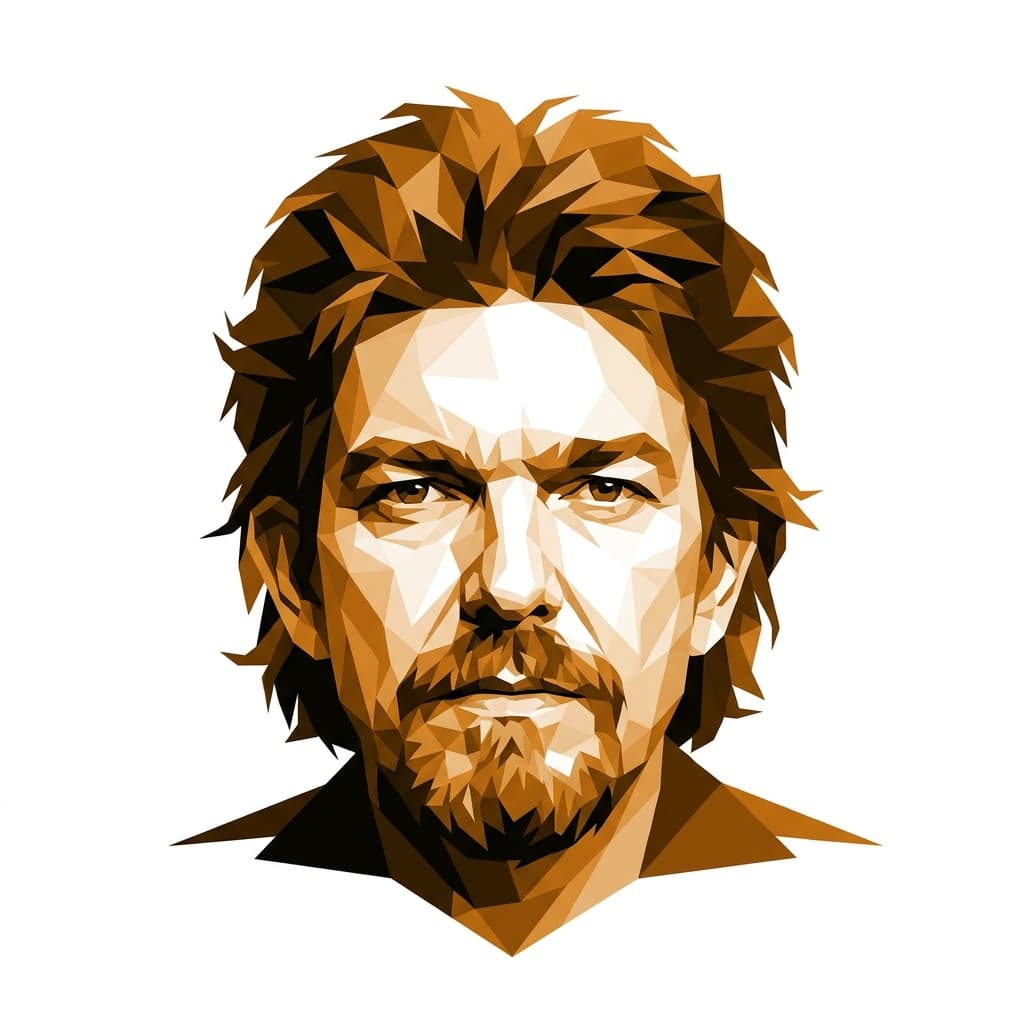
Avant-garde American rock musician and painter, leader of the Magic Band, known for Trout Mask Replica.
Design
- Q50.2
- h3.2
- R45.3
- g48.2
- i21.2
- S43.4
- T64.6
- U48.1
- V24.6
- W24.6
- X8.1
- Y6.5
- Z31.3
Personality
- Q61.6
- h62.6
- R29.4
- g18.1
- i17.1
- S60.3
- T10.5
- U9.2
- V27.5
- W24.1
- X23.4
- Y6.6
- Z31.2
Don Van Vliet — better known as Captain Beefheart — was a Manifesting Generator, wired to chase blues, free jazz, sculpture, poetry, and painting all at once without ever settling into a single lane. Born in Glendale in 1941, he was sculpting seriously by age five, sharing a local TV slot with Portuguese artist Augustinio Rodriguez, and drawing offers of European art scholarships his parents refused. When the family moved to the Mojave Desert to keep him away from art school, he pivoted to music with the same speed and refused to look back.
He formed the Magic Band in 1964 and spent the rest of the decade taking blues apart and reassembling it as something no one had heard before. Trout Mask Replica, recorded in 1969 under Frank Zappa's production, is the clearest document of his method: he rehearsed the band for eight months in a cramped Woodland Hills house, teaching parts by whistling and pounding on a piano he couldn't really play, drilling musicians for twelve hours a day until the polyrhythmic chaos snapped into a strange internal logic. It was order pulled violently out of noise, and it worked because he believed with total gut certainty that it would.
His 6/2 profile — the role model who needs long stretches of solitude — showed up in the shape of his life. The trial-and-error years produced the Magic Band records; the middle observational phase produced the harsh reign over his musicians, some of whom later described near-cult conditions; and the final phase, beginning in 1982, was pure withdrawal. He quit music entirely, moved to a trailer near Trinidad, California with his wife Jan, and devoted himself to painting. His canvases sold for tens of thousands of dollars and hung in major European galleries. He rarely gave interviews again.
As a bandleader he ran on gut-level yeses that needed no explanation, firing and rehiring players on instinct, renaming them (Zoot Horn Rollo, Antennae Jimmy Semens, Rockette Morton), dictating what they wore and ate. He held tight control over every resource in the room, and the results were often brilliant and often cruel. Guitarist Bill Harkleroad later wrote that Van Vliet's authority was absolute — a leader who saw himself as the voice his community had to listen to, even when his community was five exhausted musicians in a rented house.
The lyrics carried his other gifts. He wrote in compressed, cutting phrases that sounded like nothing else in rock, stringing together images the way his painting stacked color — "a squid eating dough in a polyethylene bag is fast and bulbous." He had the sudden, unexplainable knowings of someone whose ideas arrived whole rather than assembled, and the pattern-hunter's eye that let him hear a drum part inside a bird call or a car horn. He also had the critic's instinct to name exactly what was wrong with the music around him, which endeared him to almost no one on the industry side.
Diagnosed with multiple sclerosis in the late 1980s, he painted until he couldn't hold a brush. He died in 2010, having spent nearly thirty years refusing to perform the role people wanted him to keep performing — the desert weirdo who had already said everything he came to say.
Sources: biography · birth data
What do you and Captain Beefheart have in common?
Enter your birth details to find out