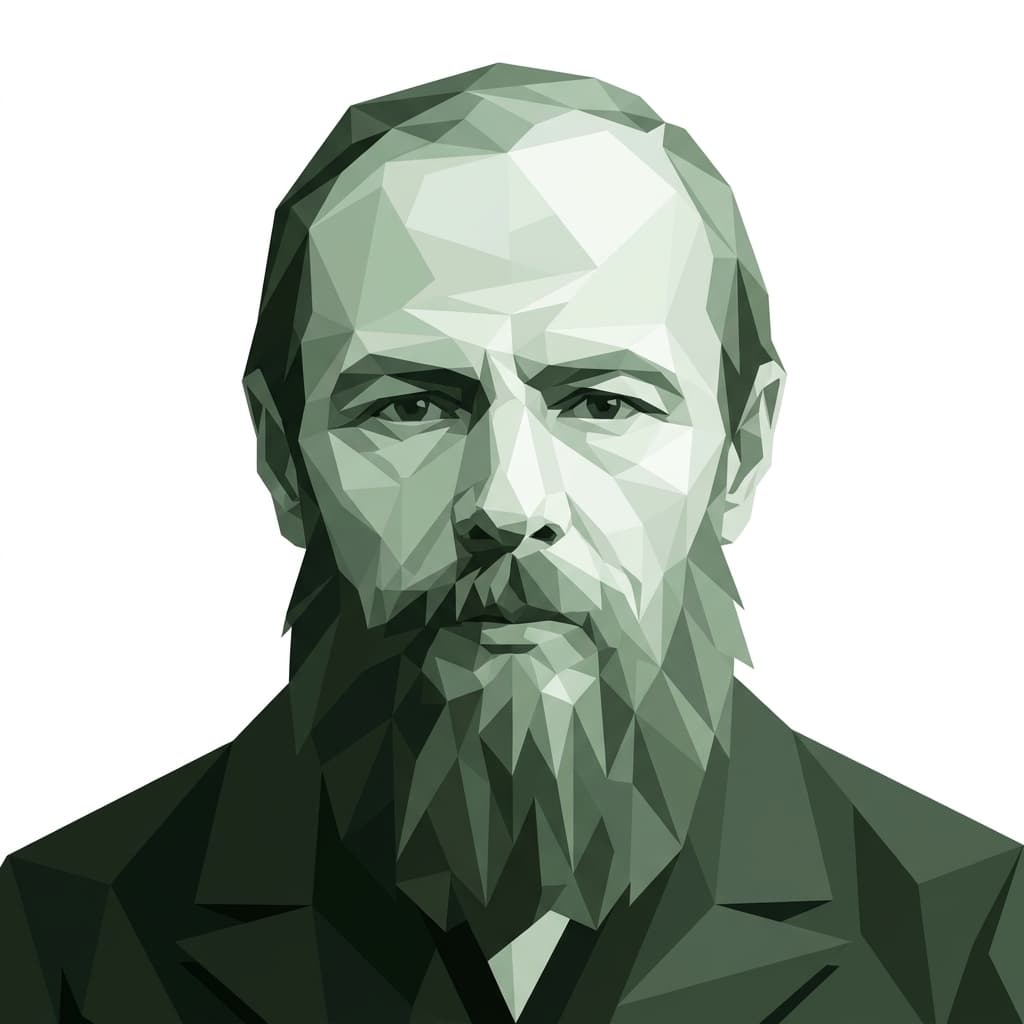
Russian novelist of moral extremity whose psychological depth reshaped modern literature.
Design
- Q4.2
- h49.2
- R49.5
- g55.5
- i59.5
- S31.3
- T64.2
- U15.4
- V3.5
- W3.1
- X10.2
- Y10.3
- Z25.2
Personality
- Q1.6
- h2.6
- R16.6
- g55.2
- i59.2
- S9.2
- T10.3
- U4.5
- V42.2
- W42.1
- X10.3
- Y10.4
- Z36.6
None
Fyodor Dostoevsky was a Reflector — the rarest Human Design type, wired to absorb and mirror the moral temperature of everything around him — which is exactly how he wrote. His novels aren't inventions so much as amplifications: prisoners, gamblers, revolutionaries, saints, murderers, all speaking at once through a nervous system that couldn't help but pick up every frequency in the room. He didn't create characters. He reflected them.
His life reads like a textbook 6/2 profile, the role-model-and-hermit: a chaotic first act, a long observational middle, and a final decade as Russia's moral conscience. The early years were the trial-and-error stretch — West-facing radical, member of the Petrashevsky Circle, arrested at twenty-seven, marched to a firing squad, reprieved at the last second, then shipped to a Siberian prison camp for four years. He came back a different man, one who had walked all the way to the edge of life and returned with his faith intact. The shock became the material.
Then came the withdrawal. He gambled ruinously, fled creditors across Europe, married his young stenographer Anna, and disappeared into work with the kind of concentration that ignored meals and daylight. Notes from Underground, Crime and Punishment, The Idiot, Demons — all written under crushing deadlines, often dictated at night, driven by a mind that could not stop turning the past over looking for the pattern beneath it. His characters argue in circles because his own thinking did; clarity, when it came, arrived as a sudden revelation after hundreds of pages of fever.
He was a man of fierce principles that hardened after Siberia into something close to religious conviction — the Westernizing socialist became a Slavophile Orthodox monarchist, and he defended those beliefs with an intensity that alienated old friends. But his fiction is more honest than his editorials. In the novels, every ideology gets its most eloquent defender and its most damning refutation, because his real subject was the emotional undertow beneath every stated position — the humiliation, the tenderness, the sudden hatred that made people do what they did.
Decisions came slowly and painfully to him, the way they do for anyone whose Lunar Authority requires a full month of turning a question over before it settles. He'd propose plots and abandon them, promise novels he couldn't yet see, marry only after Anna had endured a long strange courtship of dictation sessions. When he finally committed — to a woman, a book, a belief — he committed with the completion energy of someone who could not leave a cycle half-finished, even when finishing nearly killed him.
The Pushkin speech of 1880, delivered a year before his death, was the moment his Strategy of waiting for recognition paid its full dividend. He hadn't sought the stage; he'd been invited, and the audience wept and embraced strangers when he finished. It was the reception a Reflector waits a lifetime for — the room finally healthy enough to receive what he'd been quietly seeing all along.
Sources: biography · birth data
What do you and Fyodor Dostoevsky have in common?
Enter your birth details to find out