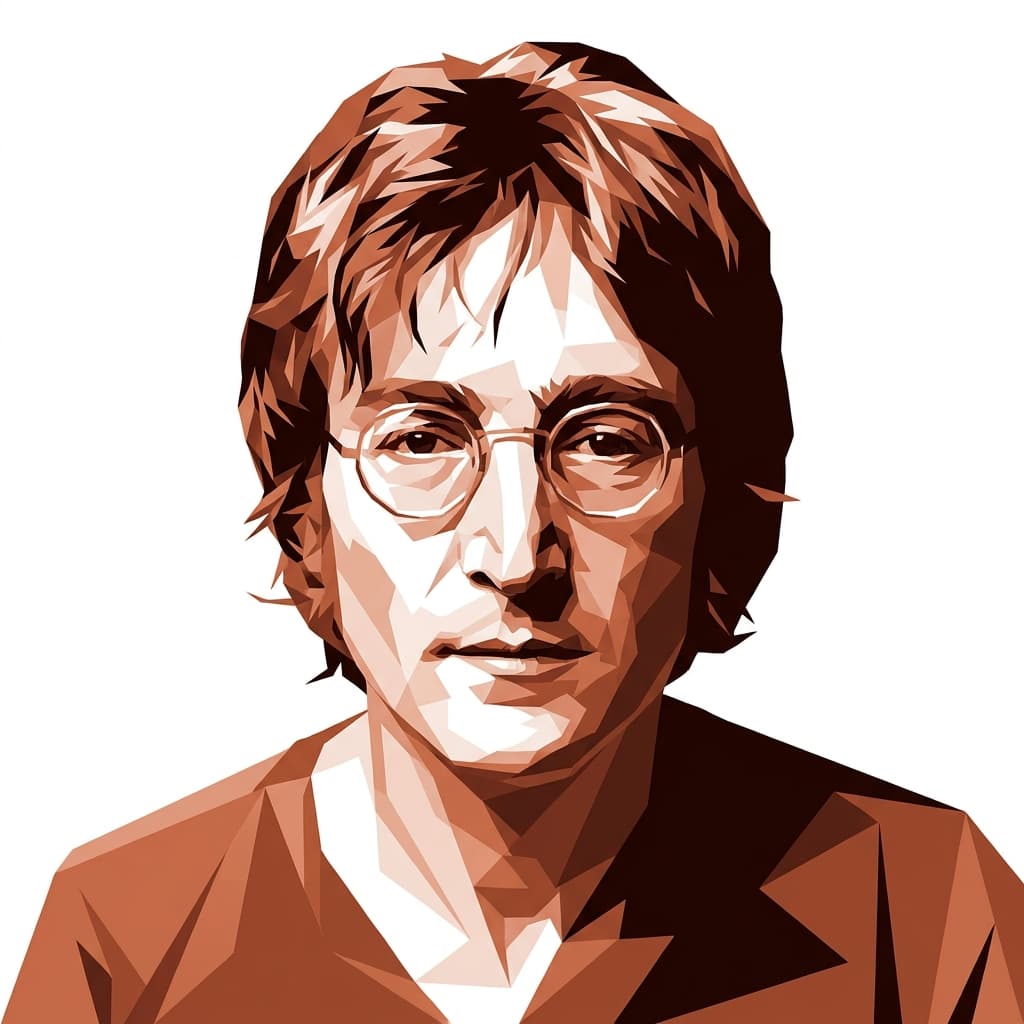
Beatles co-founder, songwriter, and peace activist whose voice shaped a generation.
Design
- Q53.4
- h54.4
- R6.6
- g57.1
- i51.1
- S31.4
- T12.6
- U31.3
- V24.4
- W24.6
- X8.1
- Y6.1
- Z31.1
Personality
- Q57.2
- h51.2
- R41.2
- g48.2
- i21.2
- S44.1
- T59.4
- U46.5
- V2.1
- W24.6
- X8.2
- Y6.4
- Z31.3
John Lennon was a Generator — built with the sustained creative stamina to write hundreds of songs, front the biggest band of the 20th century, and still have energy left to reinvent himself in a New York apartment at forty. What people mistook for restlessness was actually the engine of someone designed to respond to what lit him up: a chord Paul played, a Yoko exhibition ladder with the word YES at the top, a headline in a newspaper he tore into a lyric.
His 2/4 profile explains a life that swung, hard, between the hermit and the hero. He was the Beatle who'd disappear into the attic at Kenwood for days, then reappear ready to command a room. The 4 built him the tightest inner circle in rock — Paul, George, Ringo, Stu Sutcliffe, Cynthia, Yoko — and the 2 sent him to his Bag-In bed for a week with cameras rolling. When he did his "lost weekend" in LA, then retreated to bake bread and raise Sean for five silent years, he was living the profile's whole architecture: alone time as the source, community as the delivery system.
Lennon made decisions on emotional waves that could take days or years to settle, and the wreckage of the impulsive ones is well documented — the cruel quips at press conferences, the firing of people he loved, the "bigger than Jesus" remark he had to spend a summer apologizing for. When he waited, though — when he sat with something until it cooled — he wrote "Imagine," "Julia," "Watching the Wheels." His best work has the quality of something said only when the timing was exactly right, a voice that could puncture a room with one syllable.
He carried an unusual gift for spotting what was new and dragging it into the mainstream — Indian ragas, primal scream, avant-garde tape loops, feminist politics, Yoko herself. He was a tastemaker with an instinct for patterns others hadn't clocked yet, which is why the Beatles kept reinventing what a pop record could be every nine months. And he had the nerve to shock people out of what they thought was possible — growing his hair, returning his MBE, staging bed-ins, releasing an album of feedback with his wife. Some of it landed. Some of it didn't. He rarely seemed to mind.
The depth people felt in him — the thing that made "Help!" actually a cry for help and "Strawberry Fields" a real place in his head — came paired with a hunger to bond so completely with one person there was no daylight between them. With Yoko he found it, and much of the world couldn't forgive him for it. He wrote songs about her the way most people write diary entries.
By 1980, after five years off, he'd cycled back to the excitement of starting something new — Double Fantasy, plans for a tour, a next chapter. He was shot outside the Dakota on December 8th. He was forty years old.
Sources: biography · birth data
What do you and John Lennon have in common?
Enter your birth details to find out