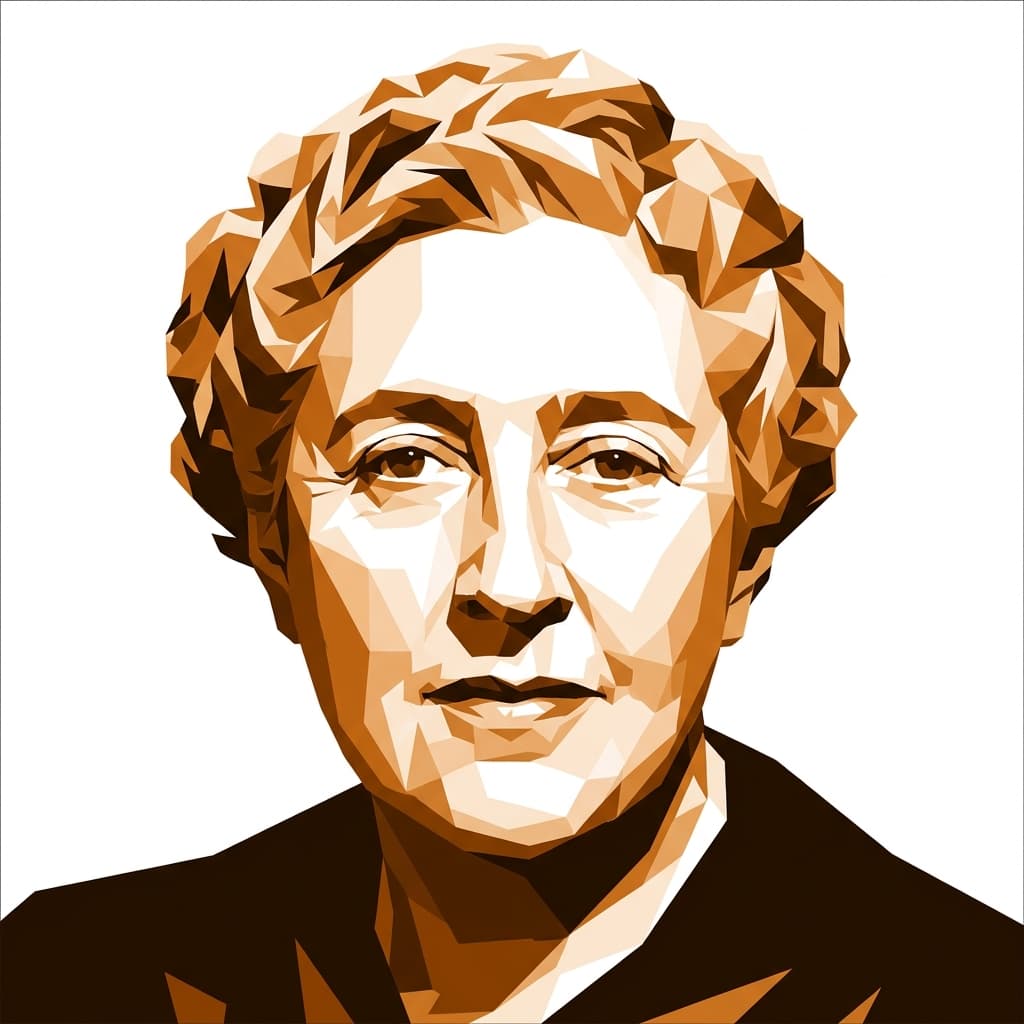
Animal behavior scientist and autism advocate who redesigned livestock handling and reframed neurodivergent thinking.
Design
- Q16.2
- h9.2
- R48.1
- g20.3
- i34.3
- S12.1
- T24.5
- U27.5
- V43.3
- W31.3
- X45.5
- Y18.5
- Z33.4
Personality
- Q59.6
- h55.6
- R13.1
- g8.4
- i14.4
- S40.1
- T59.5
- U39.1
- V43.2
- W7.3
- X12.4
- Y18.6
- Z7.1
Temple Grandin is a Manifesting Generator — built for parallel pursuits and quick execution — and her career proves the pattern: she is simultaneously a tenured animal science professor at Colorado State, the designer of livestock handling systems used by roughly half of North America's cattle processing facilities, and one of the most recognized public voices on autism in the world. She didn't niche down. She let one obsession feed the next.
Diagnosed with autism in 1950, when the standard advice was institutionalization, she didn't speak until she was nearly four. Her mother refused the recommendation and found her teachers and mentors instead. The pivotal moment arrived in adolescence at her aunt's Arizona ranch, where she watched cattle calm inside a squeeze chute and built one for herself — a wooden contraption she could climb into for pressure that soothed her nervous system. It was the kind of insight that arrives whole, without a logical bridge, and it became the seed of everything that followed: her engineering career, her theory of sensory-based thinking, her entire framework for understanding animal fear.
Her 6/2 profile — the role-model-in-waiting whose authority deepens after a long experimental first act — maps almost eerily onto her trajectory. The young Temple was bullied, misread, fired from early jobs for being too blunt, direct in a way that made other people flinch. Then came the Arizona years of walking feedlots alone, crouching inside chutes to see what the cow saw, noticing the shadow, the dangling chain, the reflection on wet concrete that made a 1,200-pound animal balk. That obsessive attention to small sensory details is what every subsequent reform rests on.
She works from emotional authority, and in interviews she describes designing by sleeping on it, revisiting drawings, letting a solution sit until it feels settled. Her curved cattle races and center-track restrainers weren't invented in a sprint; they emerged through years of watching, waiting, and responding to what the animals actually did. She has said repeatedly that she thinks in pictures — that she can run a piece of equipment in her head before anyone builds it — and this is also where her gift for seeing the fix others missed lives. Slaughter plants hired her because she could walk through once and tell them exactly which panel was causing the stampede.
Her 2010 TED talk, "The world needs all kinds of minds," is where the second half of her 6/2 arc clicked fully into place. She stopped being only the scientist and became the teacher who names what needs to be named at exactly the right cultural moment. Books followed — Thinking in Pictures, Animals in Translation, The Autistic Brain — each one turning decades of accumulated observation into stories others could use. The HBO biopic brought her to a mainstream audience she hadn't sought.
What makes Grandin unusual isn't just the dual career; it's the refusal to soften either half. She critiques factory farming and school systems with the same unflinching directness, and she cares — about the animals, about autistic kids being written off — in a way that reads less sentimental than structural. She wants the chute built right. She wants the kid handed a welding torch instead of a worksheet. The guidance is specific because the attention always was.
Sources: biography · birth data
What do you and Temple Grandin have in common?
Enter your birth details to find out