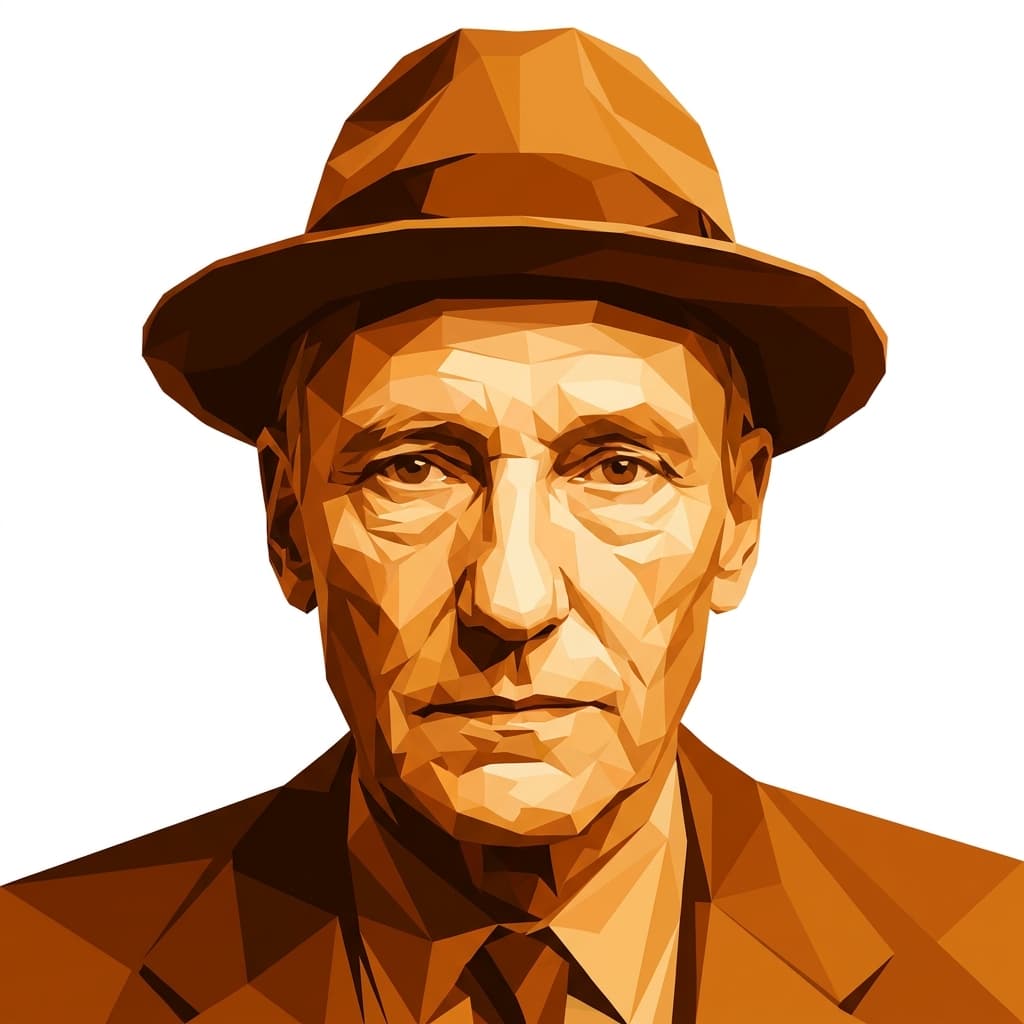
Beat Generation novelist, cultural provocateur, and author of Naked Lunch and Junky.
Design
- Q1.5
- h2.5
- R21.5
- g36.1
- i6.1
- S9.4
- T32.6
- U62.3
- V38.6
- W35.6
- X41.3
- Y56.2
- Z15.3
Personality
- Q13.3
- h7.3
- R16.5
- g63.5
- i64.5
- S49.6
- T13.2
- U52.3
- V41.2
- W16.6
- X19.1
- Y62.6
- Z15.2
William S. Burroughs was a Manifesting Generator — wired to chase several obsessions at once and refuse to pick just one — and his life reads like a refusal to settle into any single identity. Heir to the adding-machine fortune, Harvard-educated in English literature and anthropology, he drifted through medical school in Vienna, exterminator work in Chicago, and a junk habit in New York before ever publishing a sentence. The arc didn't make sense to anyone watching, but it made sense to him.
His 3/5 profile — the experimenter who becomes a reluctant teacher — describes his method exactly. Burroughs ran his own life as a series of field experiments most people would consider catastrophes: morphine addiction, the accidental shooting of his wife Joan Vollmer in Mexico City in 1951, years in Tangier writing the manuscript that became Naked Lunch. He extracted method from each one. The cut-up technique he developed with Brion Gysin came from exactly this instinct — taking the wreckage and reassembling it into something instructive, splicing newspapers and his own prose to find the patterns underneath language.
He was a relentless questioner of every system he encountered, suspicious of governments, religions, advertising, the medical establishment, and his own sentences. Junky and Queer were case studies; Naked Lunch was an autopsy of control. His paranoia was disciplined, not hysterical — an investigator's patience for the small inconsistencies that revealed the larger machine. Allen Ginsberg and Jack Kerouac treated him as the elder, the dry voice at the end of the table who had already lived through whatever they were just discovering.
Decisions came slowly. He sat on Naked Lunch for years in Tangier, letting the manuscript pile up in disordered sheets on the floor before Ginsberg and Kerouac helped assemble it; the obscenity trials that followed in Boston dragged into 1966. His strategy was never to chase but to follow what came to him — a drug, a city, a lover, a sentence overheard. Tangier found him. So did Lawrence, Kansas, where he spent his final fifteen years shooting paintings with shotguns and feeding his cats.
His public voice — that flat Midwestern drawl reading "A Thanksgiving Prayer" on television, the cameos with Kurt Cobain and in Gus Van Sant films — became its own instrument for telling the American story back to itself, darkly and without apology. He was a fighter against what he called Control in all its forms: addiction, the state, language itself. The fight was the point; without an enemy worth naming, the prose went slack.
By the end he had become something he never set out to be — an elder, a teacher of younger artists and writers who came to Kansas to sit with him. The trial-and-error life had compounded into wisdom others wanted to borrow. He died in 1997, still writing in his journals about cats, dreams, and the persistence of the need to break old structures and build new ones. The experiment never closed.
Sources: biography · birth data
What do you and William S. Burroughs have in common?
Enter your birth details to find out