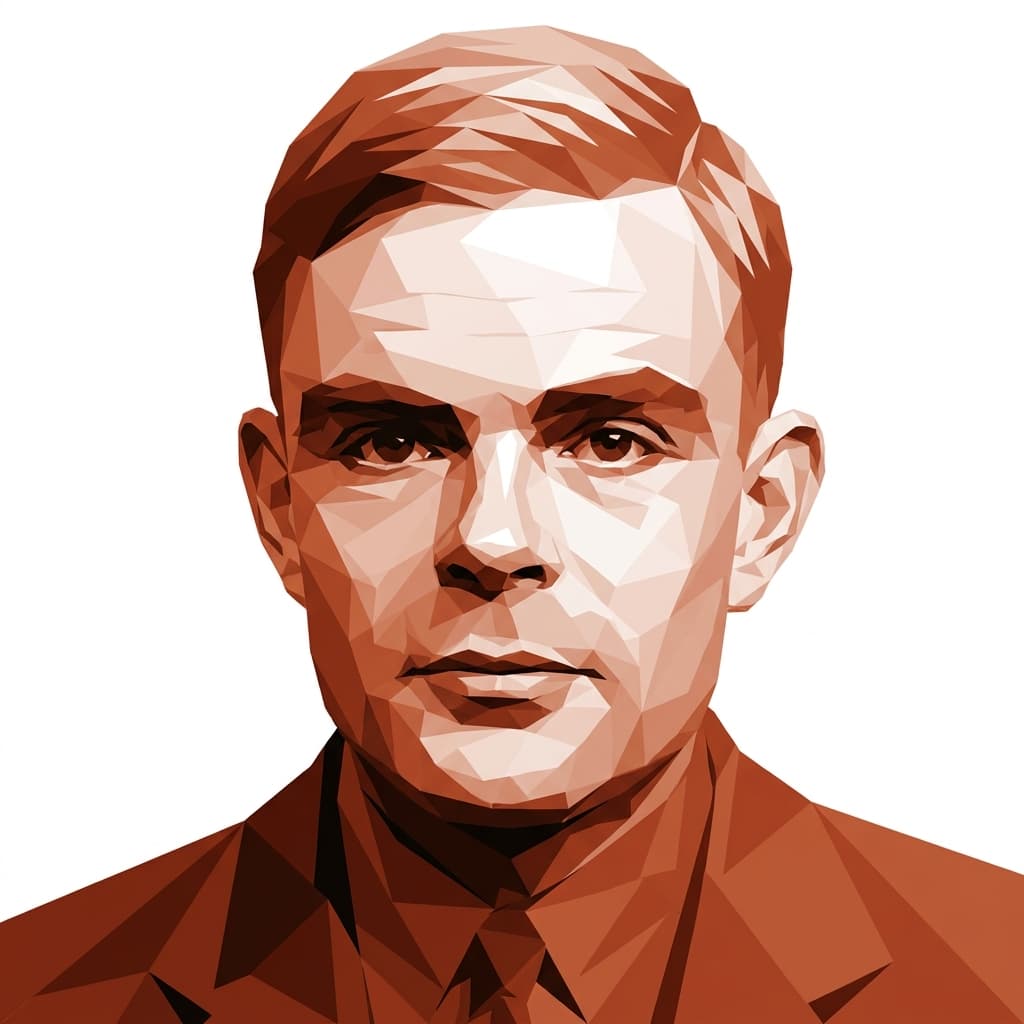
British mathematician who founded modern computing, broke the Enigma code, and pioneered artificial intelligence.
Design
- Q25.6
- h46.6
- R16.4
- g42.1
- i32.1
- S42.1
- T37.1
- U12.1
- V5.5
- W2.5
- X41.1
- Y62.1
- Z12.5
Personality
- Q15.4
- h10.4
- R57.2
- g51.4
- i57.4
- S52.5
- T12.6
- U7.3
- V9.3
- W8.5
- X41.1
- Y62.3
- Z15.1
Alan Turing was a Generator — built for deep, sustained engagement with problems that genuinely lit him up, and willing to grind at a single question for years when his gut said it mattered. He didn't chase prestige or follow the obvious academic ladder. He followed what fascinated him, which happened to be the foundations of mathematics, cryptography, morphogenesis, and the mind — and left behind something foundational in each.
As a boy at Sherborne he was famously indifferent to the classical curriculum teachers wanted him to master, scribbling his own calculus derivations in the margins while failing to produce the expected Latin prose. This is the classic 4/6 profile arc — a long, experimental, sometimes awkward first act that his teachers read as unseriousness. His closest early friendship, with Christopher Morcom, was formative in a way that marked him for life; after Morcom's sudden death from tuberculosis in 1930, Turing's thinking about mind, mortality, and machine began to take its lasting shape, carrying the loss with an unguarded openness that would become characteristic.
His 1936 paper on computable numbers was the kind of work that only emerges from sustained, silent attention — he spent long solo runs across the Cambridgeshire countryside turning the problem over, then wrote out a universal machine that could, in principle, compute anything computable. The paper's power was in organizing an impossibly abstract question into exact, mechanical steps; he had a gift for taking something philosophical and reducing it to parts that could actually be built. When a question landed in front of him with a clear gut yes, he could follow it with a focus most people couldn't sustain for an afternoon, let alone a decade.
At Bletchley Park he found both his community and his medium. He designed the bombe that broke the daily Enigma settings, and the operation worked because of the quiet rhythms and routines he built around the problem — shifts, cribs, cross-checks, the patient industrial choreography of codebreaking. Colleagues remembered him cycling in wearing a gas mask during hay fever season, chaining his tea mug to the radiator, and speaking plainly where others hedged. He wasn't trying to lead; people followed anyway because his instinct for which attack would actually work was uncanny, and he saved them months of chasing dead ends.
After the war he turned to the question that had been waiting underneath everything: could a machine think? The 1950 paper proposing what became the Turing test was a bold reframing nobody else had the nerve to put on paper, replacing a metaphysical debate with an operational game. He also began work on morphogenesis — how patterns like leopard spots and leaf arrangements emerge from chemistry — dreaming forward into a biology nobody was yet equipped to see.
In 1952 he was prosecuted for homosexuality and sentenced to chemical castration. He kept working — on morphogenesis, on quantum mechanics, on his own strange ideas — until his death in 1954 from cyanide poisoning at forty-one. The wisdom he left behind was the kind that only lands because the person who lived it was unmistakably themselves.
Sources: biography · birth data
What do you and Alan Turing have in common?
Enter your birth details to find out