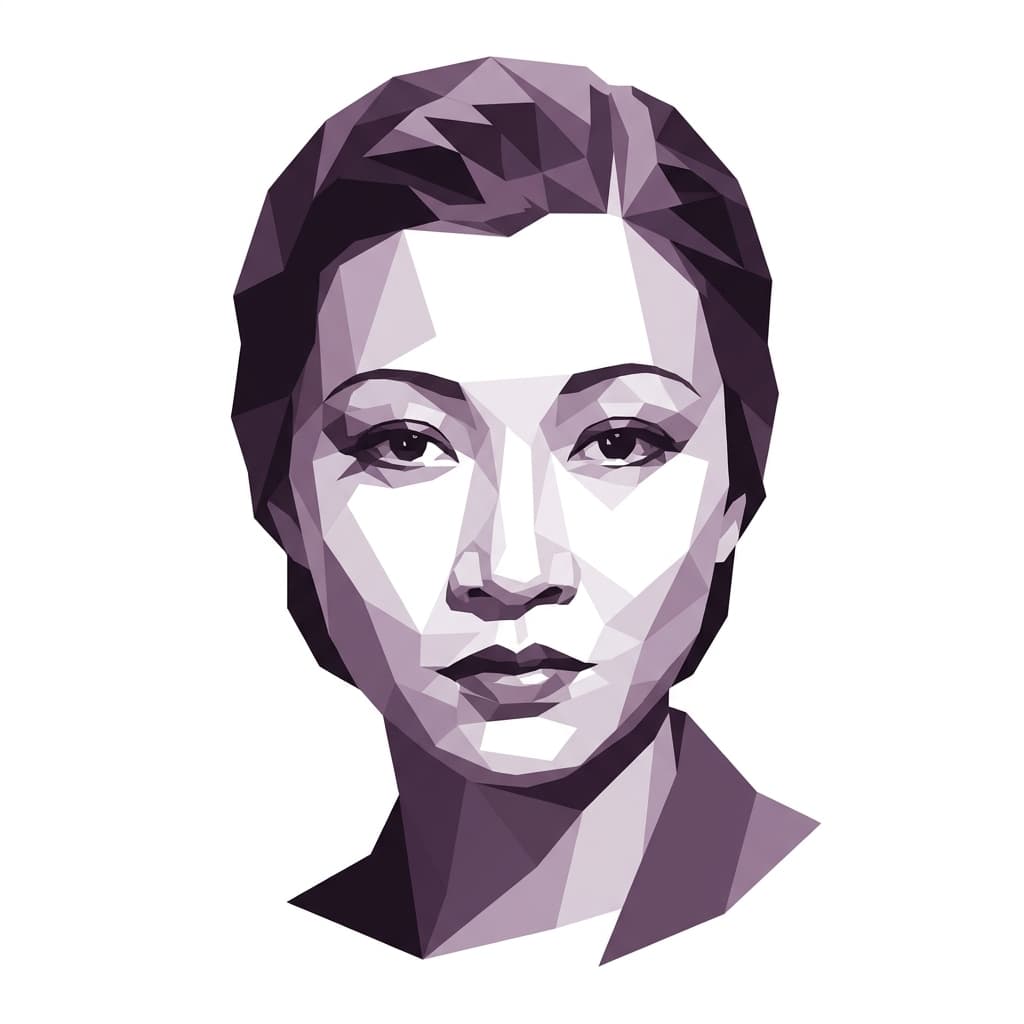
Pioneering Chinese American film star who broke Hollywood barriers across silent, sound, and television eras.
Design
- Q48.6
- h21.6
- R46.6
- g47.2
- i22.2
- S46.1
- T44.2
- U59.5
- V3.1
- W13.2
- X11.5
- Y52.5
- Z45.5
Personality
- Q38.4
- h39.4
- R26.1
- g40.6
- i37.6
- S58.2
- T30.1
- U32.5
- V42.1
- W13.6
- X10.3
- Y52.3
- Z45.4
Anna May Wong was a Manifestor — built to kick open doors nobody else was willing to approach, and willing to pay the cost of going first. Born above her father's laundry on Flower Street in Los Angeles, she skipped school to watch movie crews shoot in Chinatown, pestering directors until someone handed her an extra's role at fourteen. By seventeen she was starring in The Toll of the Sea, one of the first two-color Technicolor features ever made, playing the lead because no major studio would consider a white actress for the Chinese role and no one else had her nerve.
She had a 4/6 profile, the community-rooted role model whose authority accrues through lived experience, and her early Hollywood years were exactly the messy experimental phase that profile describes. She took the "Dragon Lady" and "Butterfly" parts because they were the only ones on offer, learning on set what the industry would and wouldn't give her. When the 1930 Hays Code forbade her from kissing white leading men — meaning she could never play a romantic lead opposite the stars she worked with — she made the decision to leave for Europe only after sitting with it, then sailed for Berlin and reinvented herself in German, French, and English-language films across the continent.
In Europe she became something closer to who she actually was: a cosmopolitan star who informed the American press of her departure rather than apologizing for it, gave interviews in three languages, and befriended Marlene Dietrich and Walter Benjamin. She carried the listener's gift for drawing stories out of people — journalists noted how she turned interviews into conversations where they ended up confessing things — and the quiet pull toward deep one-on-one bonds over the Hollywood party circuit. Benjamin wrote an entire essay about a single afternoon's conversation with her.
The 1935 MGM casting of The Good Earth was the wound that never fully healed. Passed over for O-Lan, the Chinese lead, in favor of Luise Rainer in yellowface — and offered instead the role of the villainous Lotus — she refused outright. It was the kind of refusal that comes from loving yourself more than the role, and it cost her the biggest Chinese-American part Hollywood would produce for decades. She channeled the loss into a cause worth the fight: a year-long tour of China, documented on film, where she met with artists, studied Mandarin, and reckoned publicly with her complicated position between two countries that both held her at arm's length.
Back in Hollywood she took smaller Paramount pictures where she insisted on script changes, using her persuasive weight to negotiate for dignity in the parts she agreed to play. During WWII she auctioned her costumes for United China Relief and largely stepped back from film. In 1951 she initiated something nobody had done before — The Gallery of Madame Liu-Tsong, the first U.S. television show with an Asian American lead, which she headlined and helped produce. She died in 1961 at fifty-six, having brought her own cycle to a close on her own terms, decades before Hollywood caught up to what she'd been trying to show it.
Sources: biography · birth data
What do you and Anna May Wong have in common?
Enter your birth details to find out