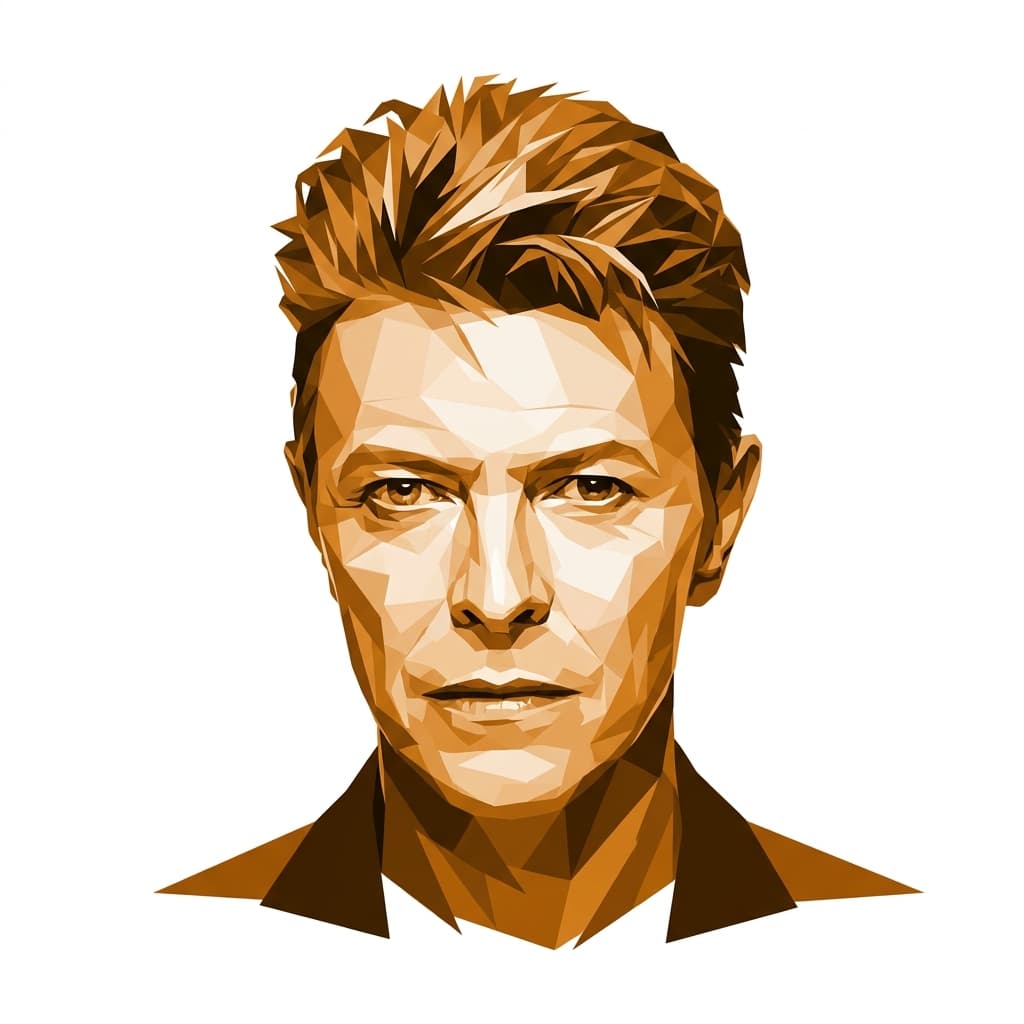
English singer, songwriter, and shape-shifting rock icon who redefined popular music across five decades.
Design
- Q57.5
- h51.5
- R23.3
- g35.2
- i5.2
- S44.1
- T14.5
- U44.6
- V28.2
- W31.6
- X45.6
- Y18.6
- Z33.6
Personality
- Q54.3
- h53.3
- R31.2
- g16.6
- i9.6
- S58.5
- T34.3
- U54.2
- V43.3
- W31.6
- X45.2
- Y48.2
- Z33.6
David Bowie was a Manifesting Generator — wired to chase multiple obsessions at once and burn through them faster than anyone could catalog, and the shape of his career is exactly that. Mime, saxophone, Buddhism, mod R&B, folk, Tin Pan Alley pastiche, glam, plastic soul, Berlin art-rock, drum-and-bass — each was picked up with full-bodied conviction, mastered, and dropped the moment the spark moved. He didn't apologize for the pivots. He simply informed the audience, often by walking onstage as someone else entirely.
His 3/5 profile made trial and error the engine of the work, not a side effect. The Laughing Gnome novelty single, the failed mime troupe, the abandoned Ziggy tour mid-flight at Hammersmith in 1973 — Bowie treated each as raw material rather than failure, building wisdom through the experiment itself. When something stopped working, he killed it on stage in front of everyone. The 5 in him gave the public a projection screen — savior, alien, thin white duke — and he wore those projections knowingly, then shed them before the audience could pin him down.
The decisions came from a gut that didn't bother explaining itself. Moving to Berlin in 1976 to get clean, hiring Brian Eno, scrapping a finished album to start Low — these weren't strategized career moves; they were responses to what showed up and lit him up. He'd talk later about following whatever caught his attention next, reading a William Burroughs essay or seeing a Kraftwerk show, and letting that pull dictate the next two years of work. His famous cut-up lyric method was the same instinct made literal: shuffle the input, respond to what emerges.
The texture of Bowie was a critic's eye trained on his own systems, constantly auditing what felt stale and the zest to keep refining toward something better. He had the courage to shock people out of comfortable categories — appearing in a dress on the cover of The Man Who Sold the World in 1970, kissing Mick Ronson's guitar on Top of the Pops, announcing his bisexuality to Melody Maker in 1972 when doing so was genuinely dangerous. Each move was a brand new beginning chosen over continuity, and each one rearranged what pop music was allowed to be.
His singing voice was the gift of distilling something complex into a phrase that lands — "Ground control to Major Tom," "We can be heroes, just for one day," "Look up here, I'm in heaven." He carried an instinct for reading the cultural weather before it arrived, arriving at glam before glam, at electronic minimalism before it was a genre, at the internet's importance years before his label took it seriously. The work demanded retreat to process before he could share what he'd seen; he disappeared into Berlin apartments, Swiss chalets, and finally a quiet New York life with Iman.
In his final act he wrote Blackstar in private, knowing he was dying, directing his powerful energy toward work that genuinely mattered right up to the last session. The video for "Lazarus" — eyes bandaged, retreating backward into a wardrobe — was the trial-and-error 3/5 closing his own loop on his own terms. He released the album on his sixty-ninth birthday and died two days later. Even the goodbye was a skill mastered through decades of practice.
Sources: biography · birth data
What do you and David Bowie have in common?
Enter your birth details to find out