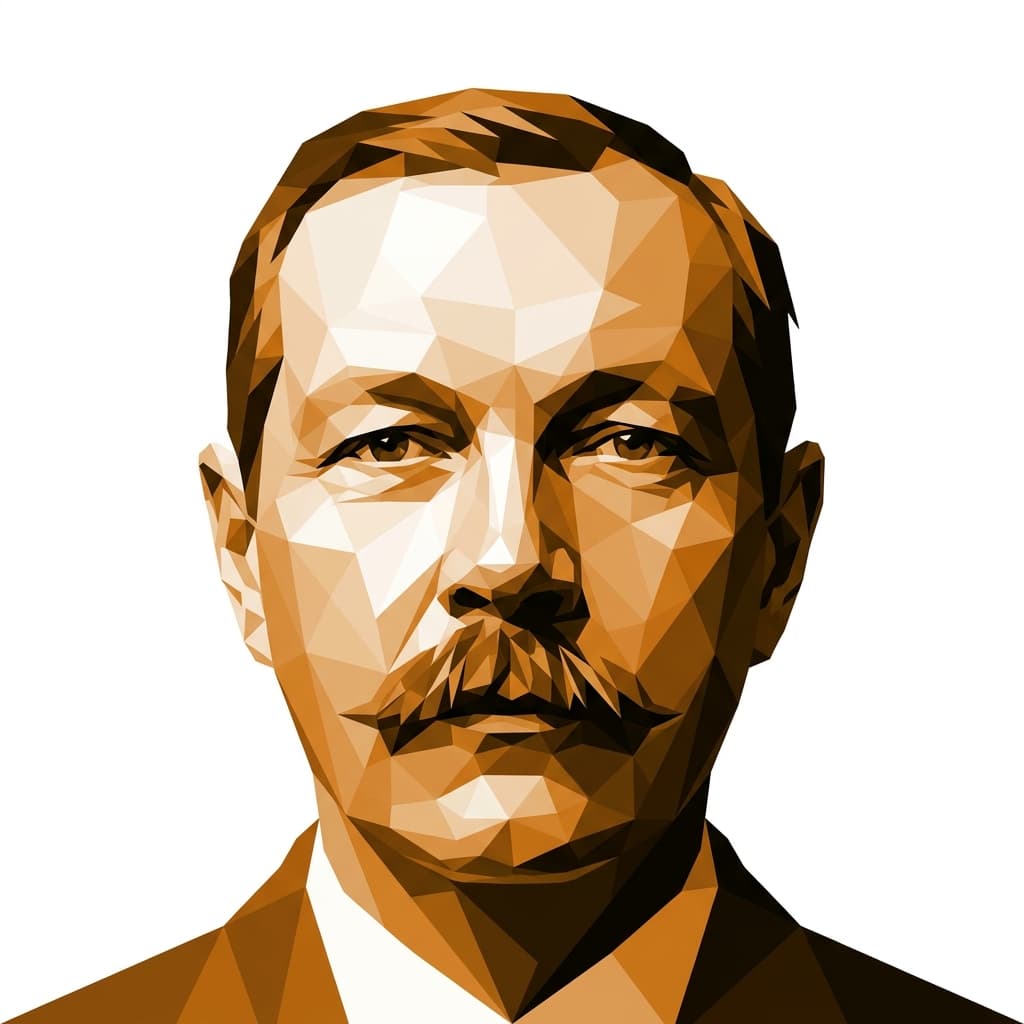
Scottish physician and author who created Sherlock Holmes and championed spiritualism late in life.
Design
- Q55.3
- h59.3
- R50.2
- g30.6
- i29.6
- S49.2
- T54.1
- U51.1
- V35.1
- W31.6
- X8.6
- Y36.2
- Z27.5
Personality
- Q20.1
- h34.1
- R60.5
- g49.6
- i4.6
- S27.4
- T3.1
- U45.2
- V12.4
- W31.6
- X20.4
- Y36.5
- Z27.6
Arthur Conan Doyle was a Manifesting Generator — built to juggle several vocations at once and skip the steps most people insist on — and his life reads exactly like that: physician, novelist, whaler's surgeon, cricketer, war correspondent, spiritualist, amateur detective. He trained in medicine at Edinburgh under Dr. Joseph Bell, whose diagnostic showmanship he would later transplant, almost intact, into 221B Baker Street. Bell's ability to deduce a patient's occupation from a callus or a tan gave Doyle a problem-solver's compulsion to reverse-engineer the world, and Sherlock Holmes was born from that same appetite for the logical click.
His 1/3 profile — the investigator who also has to touch the stove — showed up in how he built his career. He read voraciously, researched exhaustively, then tested his conclusions against messy reality: a failing ophthalmology practice in Southsea where no patients came, which is precisely how he had time to write A Study in Scarlet. He experimented with historical romances, science fiction, plays, and pamphlets, treating each attempt as fuel rather than failure, reorganizing what didn't work into what came next. When Holmes bored him, he threw the detective off the Reichenbach Falls with the same need to pivot without apology that defined his whole working rhythm.
The pivots were relentless. He volunteered as a ship's surgeon on an Arctic whaler at twenty, then on a West African steamer, then ran a field hospital in the Boer War, then campaigned to reform the Congo Free State, then twice stood for Parliament. He wrote The White Company, which he considered his masterpiece; the public preferred Holmes, which annoyed him for decades. Underneath it all ran a powerful, restless engine of vitality that needed somewhere to go, and a hunger for the next unfamiliar horizon that made staying put nearly impossible.
He was also an emotional decision-maker who let convictions build over time until they became unshakable — and this is where his story gets stranger. After the deaths of his son Kingsley, his brother, and several other close relatives during and after the First World War, Doyle turned his full public weight toward spiritualism, defending mediums, attending séances, and writing The History of Spiritualism. He genuinely believed in the Cottingley Fairies photographs. His friendship with Harry Houdini collapsed over it. He was operating from convictions he had felt his way into slowly, and once landed, he committed with the whole of himself.
He took on causes the way he took on cases. He personally reinvestigated the wrongful convictions of George Edalji and Oscar Slater, gathering evidence, publishing pamphlets, and hammering officials until both men were exonerated — the instinct to protect those who couldn't defend themselves welded to a strong sense of what was simply right. He lobbied for divorce reform, body armor for soldiers, and a Channel tunnel decades before anyone built one.
By the time he died in 1930, Doyle had left behind a detective who outlived his creator's other ambitions, a spiritualist movement he'd lent enormous credibility to, and a body of work that still reads as one man's insistence on chasing every subject that lit him up — regardless of whether the world wanted him to niche down. Holmes, it turned out, was only ever one of his experiments.
Sources: biography · birth data
What do you and Arthur Conan Doyle have in common?
Enter your birth details to find out