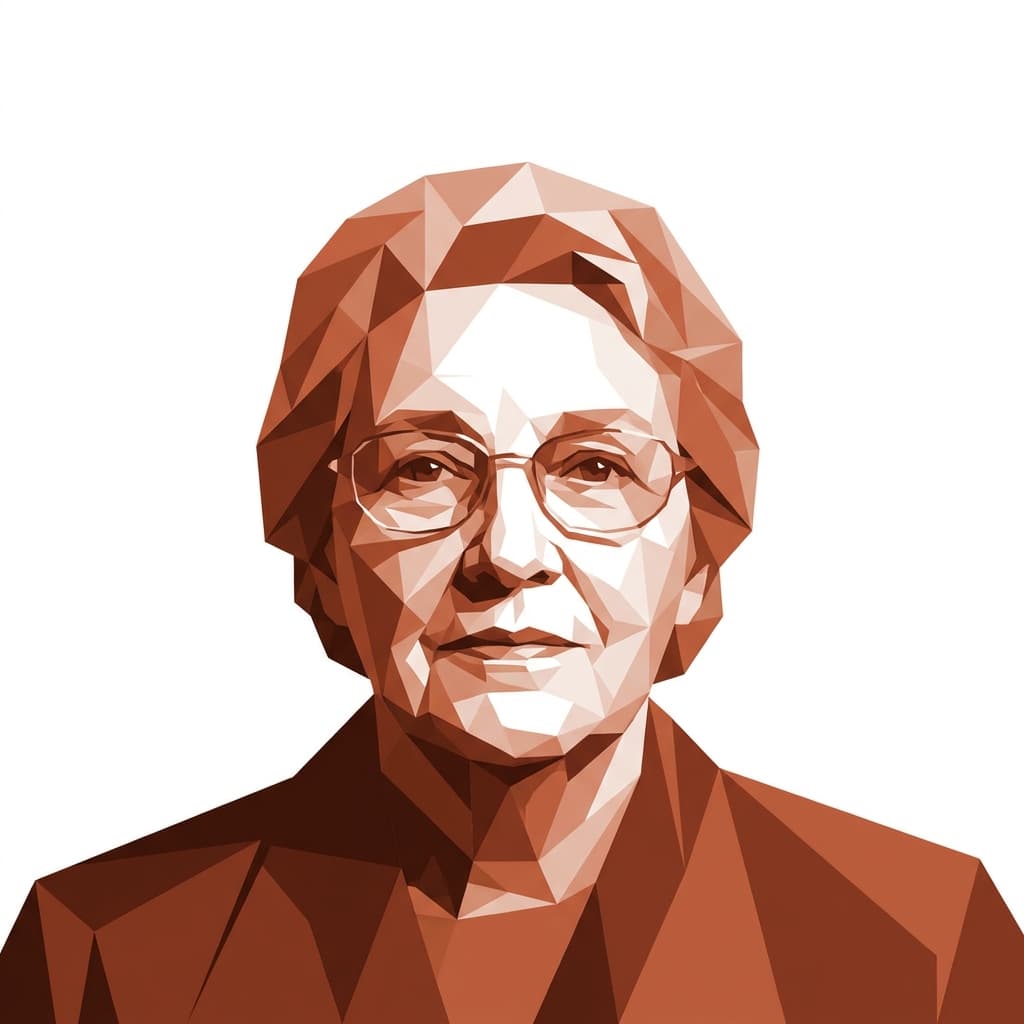
American primatologist who devoted her life to studying and protecting mountain gorillas in Rwanda.
Design
- Q50.2
- h3.2
- R37.1
- g17.2
- i18.2
- S50.4
- T44.2
- U43.6
- V4.1
- W54.3
- X51.2
- Y40.2
- Z62.2
Personality
- Q61.6
- h62.6
- R27.4
- g25.1
- i46.1
- S10.5
- T30.3
- U60.3
- V4.2
- W61.6
- X51.1
- Y40.2
- Z62.1
Dian Fossey was a Generator — built for the long, physical, repetitive work of following gorilla families up volcanic slopes day after day, year after year, until she knew them the way most people know their own siblings. She didn't come to primatology through academic pedigree. She was an occupational therapist in Kentucky when she scraped together a loan and flew to Africa in 1963, met Louis Leakey at Olduvai, and somehow convinced him three years later to send her into the Virunga Mountains with almost no field experience. That leap has the fingerprints of a 6/2 profile all over it — the messy, experimental first-life years of a woman who tried nursing school, tried veterinary school, tried horses, tried Africa, and only in her mid-thirties found the thing her whole life had been rehearsing for.
Karisoke Research Center, which she founded in 1967, was essentially a cluster of tin-roofed cabins at 10,000 feet where Fossey lived mostly alone with trackers, dogs, and the gorillas. She logged thousands of hours of observation, and her habituation technique — knuckle-walking, chest-beating, pretending to eat wild celery until the gorillas accepted her presence — came from trusting what her body was telling her in the moment rather than any protocol in a textbook. The solitude suited her. It was the kind of alone time where her real gifts quietly sharpened, and the nickname the Rwandans gave her, Nyiramacibiri — "the woman who lives alone on the mountain" — captured it exactly.
Her relationships with individual gorillas, especially the young silverback Digit, were not sentimental in the Disney sense. They were specific, patient, and built on a deep, almost spiritual trust in another being's innocence. When poachers killed and decapitated Digit in 1977, something in her hardened into warfare. She organized patrols, burned poachers' camps, confiscated weapons, held suspected poachers at her cabin, performed mock executions with sotto voce threats, and sprayed graffiti on their huts. Colleagues called it "active conservation." Critics called it vigilantism. Fossey called it what was necessary, and she was not going to be talked out of what she knew was right.
She fought constantly with the Rwandan government, with tourism advocates, with her own graduate students, with the primatology establishment that wanted her to publish more and crusade less. Her 1983 book Gorillas in the Mist was a bestseller, but she resented the pressure to translate her field notes into a career. She had the instinct for exactly what was wrong with every well-meaning plan brought to the mountain — gorilla tourism, habituation for cameras, Western conservation NGOs — and she said so, loudly, to anyone within earshot. It did not make her friends. It made her, increasingly, a problem.
Fossey was murdered in her cabin at Karisoke on December 26, 1985, struck with a machete she had herself confiscated from poachers years earlier. The case was never solved. She was 53. Her grave sits in the gorilla cemetery she built for Digit and the others, which is probably how she'd have wanted it — buried with the community she had actually chosen, on the mountain where she had finally, after all those restless years, become exactly who she was.
Sources: biography · birth data

What do you and Dian Fossey have in common?
Enter your birth details to find out