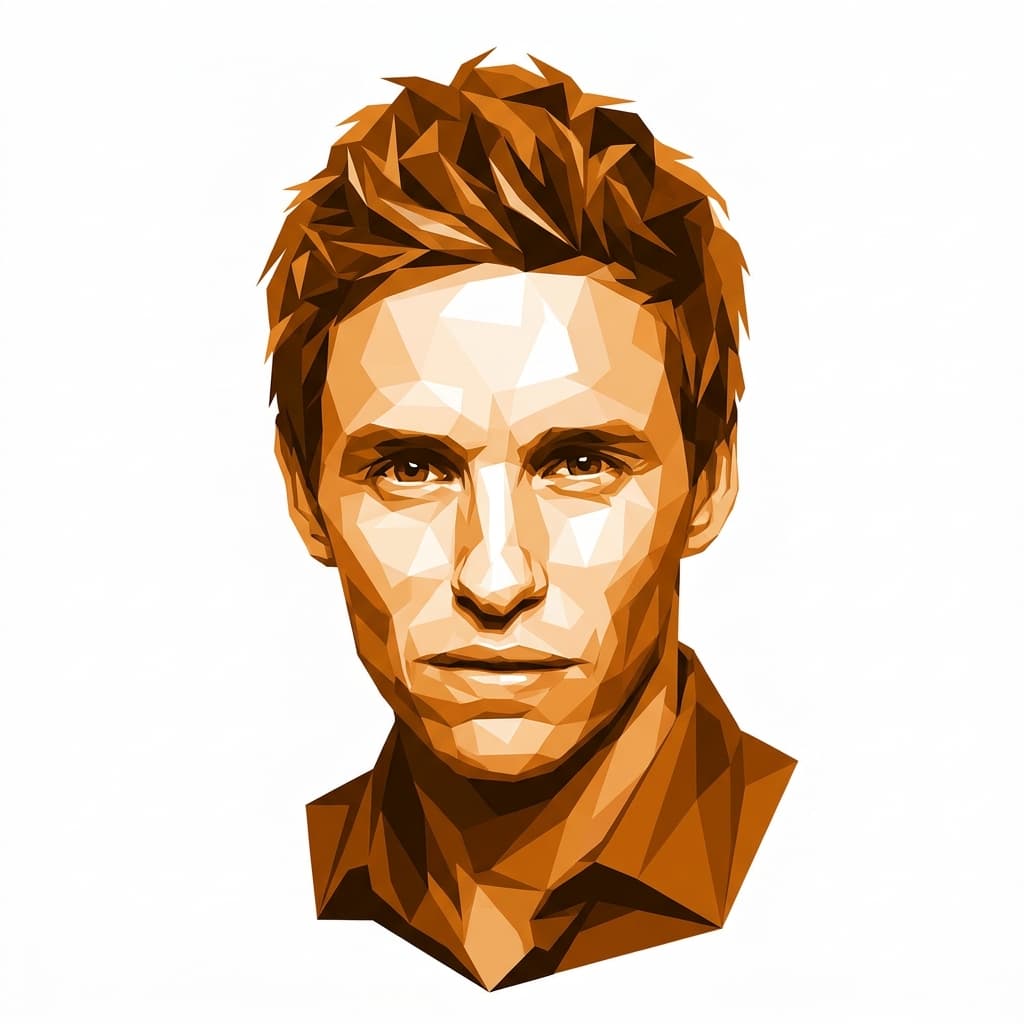
Oscar-winning English actor known for meticulous physical transformations in The Theory of Everything and The Danish Girl.
Design
- Q57.4
- h51.4
- R22.6
- g56.3
- i60.3
- S28.1
- T34.3
- U4.6
- V57.6
- W48.5
- X14.4
- Y26.6
- Z32.4
Personality
- Q54.2
- h53.2
- R20.5
- g62.2
- i61.2
- S60.6
- T19.1
- U18.6
- V28.6
- W32.2
- X34.4
- Y11.3
- Z50.1
Eddie Redmayne is a Manifesting Generator — wired to chase several obsessions at once, move fast, and master a craft before pivoting — and his career reads exactly that way. Eton, then Cambridge for art history (a thesis on Yves Klein, of all things), then the stage at the Donmar, then film, then the runway as a Burberry model, then a Tony, then an Oscar, then a return to musical theatre with Cabaret. The path isn't linear and was never supposed to be.
His preparation is famously, almost punishingly thorough. For The Theory of Everything, he spent months with ALS patients, met with Stephen Hawking, learned to contort his body into specific postures from specific stages of the disease, and worked with a choreographer to map the physical decline scene by scene. That's the the drive to understand the why behind everything at work, paired with an obsessive depth that draws answers out from underneath. He didn't want to play Hawking; he wanted to know how the man actually moved, breathed, smiled with half a face.
He has a 2/4 profile — the hermit-opportunist who needs long stretches alone to develop a gift and then a tight community to carry it into the world. Redmayne is famously private, married to Hannah Bagshawe (a friend from before fame), lives in London rather than Los Angeles, and routinely disappears for months of preparation between projects. But the opportunities still come through the network — Tom Hooper directing him in both Les Misérables and The Danish Girl, the Donmar circle, the Cambridge friends who became his collaborators. He works with the kind of gut-level yes that doesn't need a logical reason, and he's spoken about turning down big roles because something just didn't feel right.
The acting itself is built on a fierce attentiveness to the present moment and an almost sonic sensitivity to mood and tone — the trembling lip, the held breath, the precise wetness of an eye. He cried real tears for ten takes of the Hawking diagnosis scene and apologized to the crew for "indulging." His turn as Lili Elbe in The Danish Frog Girl was a study in feeling what others need before they name it; his MC in Cabaret a study in shocking an audience out of comfortable patterns, all rictus grin and clown-white menace.
He doesn't initiate much publicly — no production company empire, no fashion line, no podcast — and that's the patient art of waiting until something real shows up to respond to. What he does pursue, he pursues with the appetite for a meaningful struggle that's worth the cost: the Hawking role he chased for years, the Danish Girl script he carried around for half a decade, the Cabaret revival he reportedly initiated by telling director Rebecca Frecknall he'd been thinking about the MC since he was a teenager. The slow burn, the long preparation, the eventual full-body commitment — that's the rhythm.
He says he's "perpetually anxious" and seems to mean it. The flip side is a nose for which projects will actually last and which won't — a restraint that keeps the filmography small, deliberate, and oddly free of obvious career mistakes.
Sources: biography · birth data
What do you and Eddie Redmayne have in common?
Enter your birth details to find out