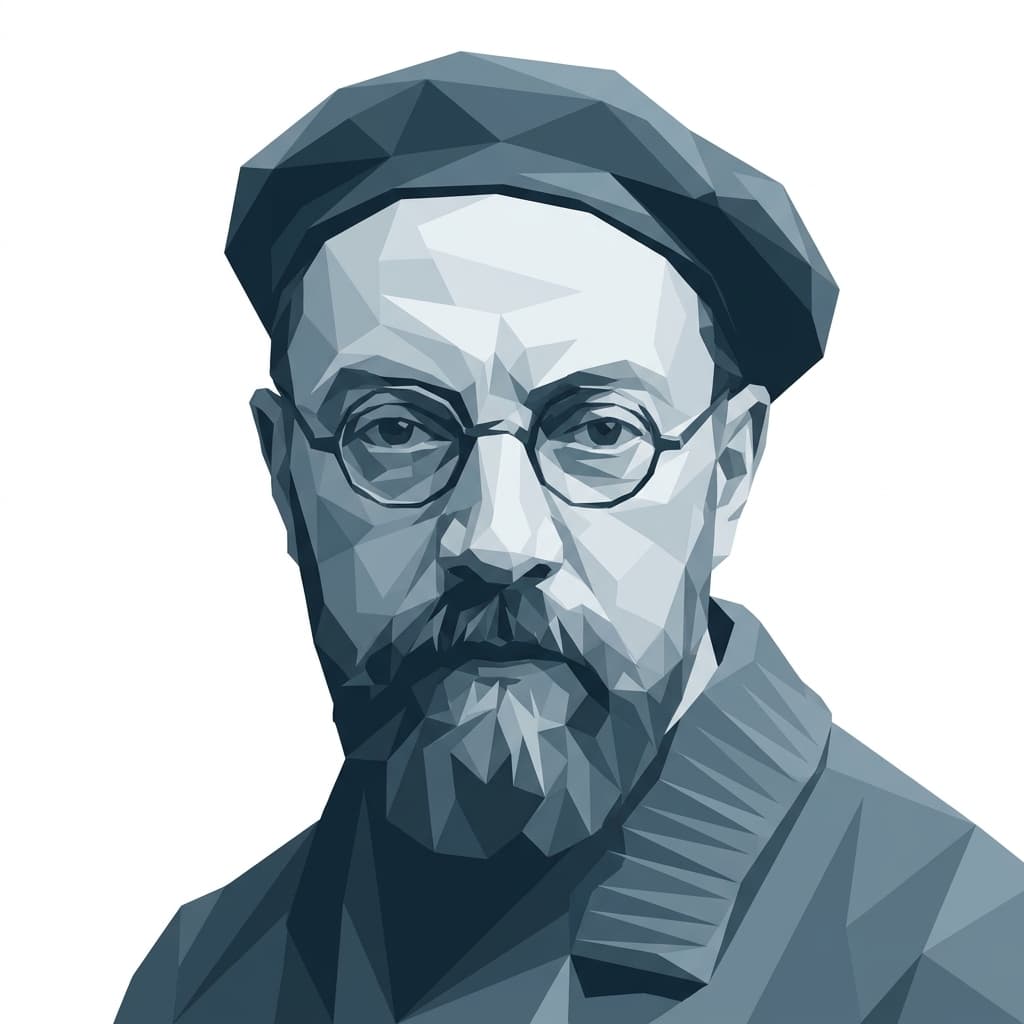
French painter and sculptor, founder of Fauvism, whose color and cutouts reshaped modern art.
Design
- Q48.3
- h21.3
- R48.2
- g31.4
- i41.4
- S28.4
- T43.2
- U43.3
- V23.2
- W5.2
- X62.2
- Y51.4
- Z2.5
Personality
- Q38.1
- h39.1
- R11.3
- g56.3
- i60.3
- S61.1
- T30.2
- U61.6
- V24.4
- W26.6
- X53.6
- Y51.2
- Z2.4
Henri Matisse was a Projector — the kind of artist whose gift wasn't in output but in how he saw. He didn't touch a paintbrush until he was twenty, laid up after appendicitis, when his mother brought him a box of paints. He later called it the moment he felt "transported into a kind of paradise." Before that, he had been a law clerk in a provincial French town, dutifully copying legal briefs. The pivot from law to art was the first of many times he would trust a private recognition over an obvious path.
In Paris, he studied under Gustave Moreau, who told him he was "born to simplify painting." That simplification would take decades. Matisse was the classic investigator who also had to learn by doing — he copied Old Masters at the Louvre for years, dissected Cézanne's compositions, and threw himself into experiment after experiment, many of which failed publicly and badly. When he exhibited with André Derain and others at the 1905 Salon d'Automne, a critic called them les fauves — the wild beasts. The paint was pure, unmixed, shocking. It was a breakthrough that arrived all at once after years of grinding foundation, and it made him briefly notorious before it made him famous.
He worked slowly, obsessively, and with rituals he refused to break — the same studio hours, the same models returning year after year, the same slow circling of a canvas before he touched it. He would paint a picture, photograph it, scrape it down, and begin again, sometimes for months. His decisions were never quick. He was built to sleep on things, to let a color choice settle over days before he committed. Friends and dealers who pressured him got nowhere; the Russian collector Sergei Shchukin, who understood this, got Dance and Music.
Matisse was also a person of enormous restless appetite for new experiences — Morocco, Tahiti, Nice, Collioure. Each place cracked something open. In Tahiti in 1930 he barely painted, but the light and the lagoon lodged inside him and surfaced twenty years later in the cutouts. He had a gift for distilling a room, a body, a window into its irreducible line, and for pulling emotion out of a viewer with a single field of red. His odalisques scandalized; his chapel at Vence puzzled his old radical friends. He kept moving.
The last chapter is the one everyone remembers. Bedridden after cancer surgery in 1941, unable to stand at an easel, he invented the gouaches découpés — cutting shapes directly from painted paper with enormous scissors, "drawing with color." It was innovation invented inside a hard physical constraint, and it produced some of the freest work of the twentieth century. He was seventy-five when he started and made the cutouts for over a decade. Invited by a former nurse who had become a Dominican nun, he designed the entire Chapel of the Rosary at Vence — windows, vestments, tiles — and called it his masterpiece. He died in Nice in 1954, still working from bed.
Sources: biography · birth data
What do you and Henri Matisse have in common?
Enter your birth details to find out