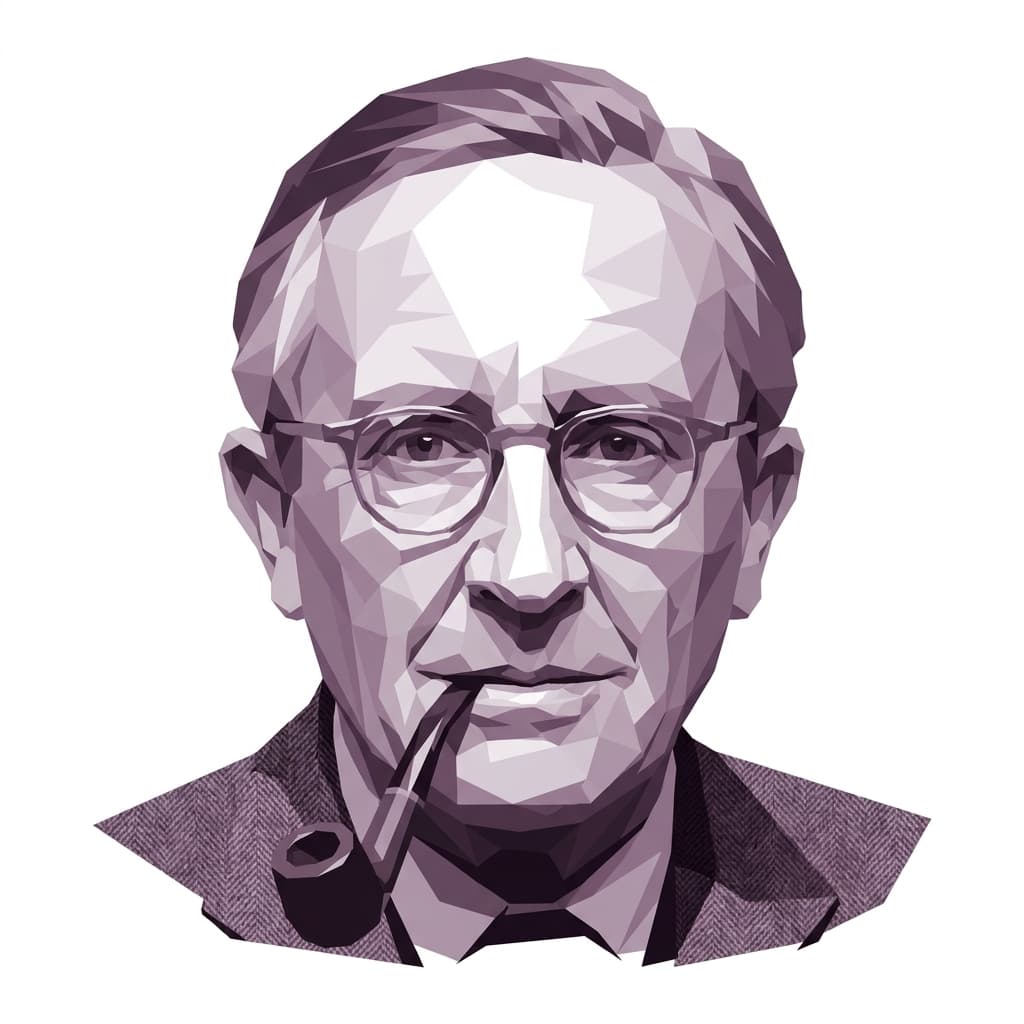
English author and Oxford philologist who created Middle-earth and wrote The Hobbit and The Lord of the Rings.
Design
- Q48.6
- h21.6
- R5.6
- g8.3
- i14.3
- S46.4
- T57.6
- U47.5
- V37.4
- W6.1
- X50.5
- Y16.4
- Z16.4
Personality
- Q38.4
- h39.4
- R55.2
- g8.1
- i14.1
- S10.2
- T19.2
- U1.4
- V63.3
- W46.2
- X28.4
- Y16.2
- Z16.2
J. R. R. Tolkien was a Manifestor — the kind of mind that doesn't wait for permission before inventing an entire cosmology, complete with its own languages, calendars, and thousand-year genealogies. He began building Middle-earth in a soldier's notebook during the trenches of the Somme and kept refining it, alone and largely unbothered by trends, for the next sixty years. Almost nothing about his life makes sense unless you accept that he was, at some deep level, initiating a private world and only occasionally remembering to inform the rest of us about it.
Orphaned young and raised by a Catholic priest in Birmingham, he found his calling early: languages. Not just learning them, but building them. As a teenager he was already inventing tongues for fun, and by Oxford he was reading Gothic, Finnish, and Welsh with the enthusiasm of someone born to master a craft through slow repetition. His philological work — the years spent on the OED's "W" entries, the lectures on Beowulf that quietly changed a discipline — showed the deep, patient intelligence of someone who trusts what only long study reveals. He wasn't chasing recognition. He was digging.
His 4/6 profile — the community-anchored role model who ripens through lived experience — is written all over his Oxford years. He didn't work in isolation; he worked through the Inklings, that small circle of friends meeting in C. S. Lewis's rooms and at the Eagle and Child pub, reading drafts aloud over beer. Middle-earth was quite literally read into existence in front of a handful of trusted friends whose loyalty mattered more than any wider audience. He was fiercely protective of what he considered sacred — Catholicism, the English countryside, the beauty of old languages — and carried an instinct for guarding the values that others were letting slip away.
The writing itself was slow, agonizing, and driven by a decision-making rhythm that needed years, not weeks, to settle. The Lord of the Rings took him twelve years, largely because he kept feeling into whether each turn was right and revising when it wasn't. He hated the industrial modern world with the quiet fury of a man who'd seen his childhood hamlet swallowed by Birmingham's sprawl, and that grief runs through every page of the Shire. His prose carries the fresh strangeness of a voice that refused to sound like anyone else's, and he had a tastemaker's ear for what deserved to be pulled out of obscurity and celebrated — old Norse sagas, forgotten meters, the music of names.
He was famously grumpy about interruptions, film adaptations, and fans who wrote asking what everything "meant." He wanted freedom to work on his own terms, and when publishers pressed him he pushed back with the flat, unbothered resistance of someone allergic to being managed. Late in life, after the trilogy's unexpected success turned him into a countercultural icon he never asked to be, he retreated further into the Silmarillion — the vast, unfinished mythology he'd been quietly tending since 1917. He died in 1973 with much of it still in drafts, having spent his life doing exactly what only he could have done, and refusing to hurry it.
Sources: biography · birth data
What do you and J. R. R. Tolkien have in common?
Enter your birth details to find out