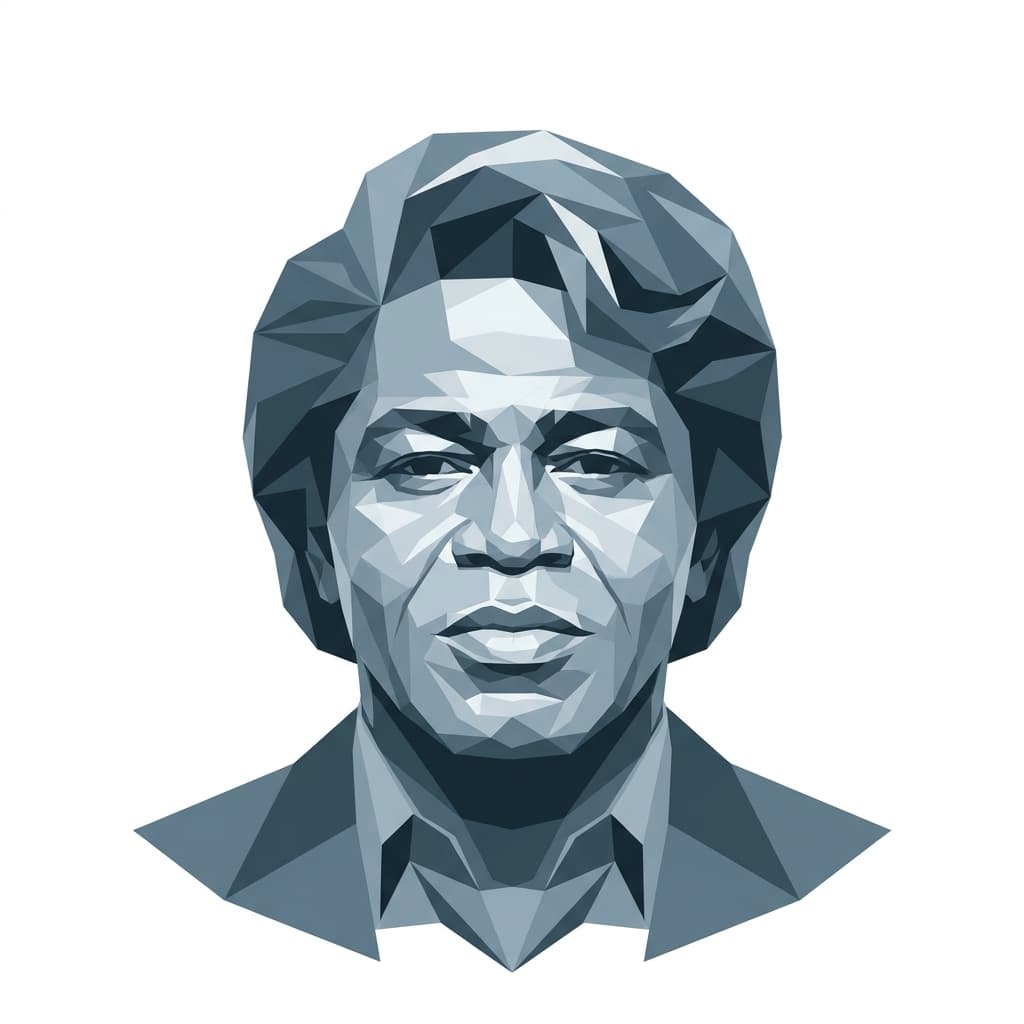
The Godfather of Soul whose rhythmic invention and relentless showmanship rewrote American popular music.
Design
- Q13.2
- h7.2
- R20.1
- g37.3
- i40.3
- S19.5
- T61.6
- U47.3
- V47.6
- W19.1
- X51.6
- Y40.4
- Z62.2
Personality
- Q24.6
- h44.6
- R4.3
- g55.6
- i59.6
- S51.5
- T2.3
- U59.4
- V64.3
- W13.3
- X42.4
- Y40.2
- Z62.1
James Brown was a Projector — not in the sense of being low-energy (he was famously the hardest-working man in show business), but in the sense of being a guide who saw exactly how a band should move and demanded it move that way. His genius wasn't really in singing or even dancing. It was in seeing the groove from above, hearing where the one belonged, and conducting fifteen musicians toward a sound that didn't exist yet. He stewarded other people's energy. That was the whole job.
Born poor in Barnwell and raised partly in a Georgia brothel, he came up through gospel, boxing rings, and a juvenile detention stint before the Famous Flames found him. His 6/2 profile tracks neatly across the life: a chaotic, experimental first act of trial and error, a long middle period of relentless touring and observation, and a final phase as the elder statesman everyone from Mick Jagger to Afrika Bambaataa pilgrimaged to study. He guarded his solitude fiercely between shows — hotel rooms, his own plane, the back of the tour bus — then walked onstage and gave the audience the kind of leadership that came from being recognized first.
The bandleader thing was almost military. He fined musicians for unshined shoes, missed notes, late downbeats. He kept a chart of infractions. The precision was the point: the funk he was inventing on records like "Cold Sweat" and "Funky Drumbeat" required an almost forensic attention to where every detail landed, and he could hear a flatted seventh from across a stadium. Underneath all that drilling was a sensitivity to what a room actually needed — when to drop to a whisper, when to drag the tempo a quarter-beat behind, when to scream.
He made decisions slowly when it counted and badly when it didn't. The slow ones — leaving King Records, buying radio stations, going to Vietnam, releasing "Say It Loud — I'm Black and I'm Proud" at exactly the moment he did — show somebody riding the wave until clarity arrived. The fast ones, made from emotional peaks, produced the chaos: the PCP arrests, the high-speed chase across two states in 1988, the failed marriages. The same nervous system that gave him "Please, Please, Please" gave him the worst nights of his life.
Onstage he was pure presence, responding to the room in real time, calling cues with his eyes, cutting the band on a dime with a foot-stomp. The cape routine — collapsing, being draped, throwing it off, collapsing again — was shock theater designed to break audiences out of whatever they walked in with. Hip-hop sampled him more than anyone else because his records contained the breaks everyone else needed to begin again; whole genres were built from four seconds of Clyde Stubblefield.
By the end he was carrying a heavy archive — every story, every musician he'd hired and fired, every promoter who'd crossed him. He held it all, the listener and the keeper of the ledger, still touring, still demanding the one be on the one. When he died on Christmas Day 2006, the funk he'd assembled note by stubborn note had become the grammar of nearly everything that came after.
Sources: biography · birth data
What do you and James Brown have in common?
Enter your birth details to find out