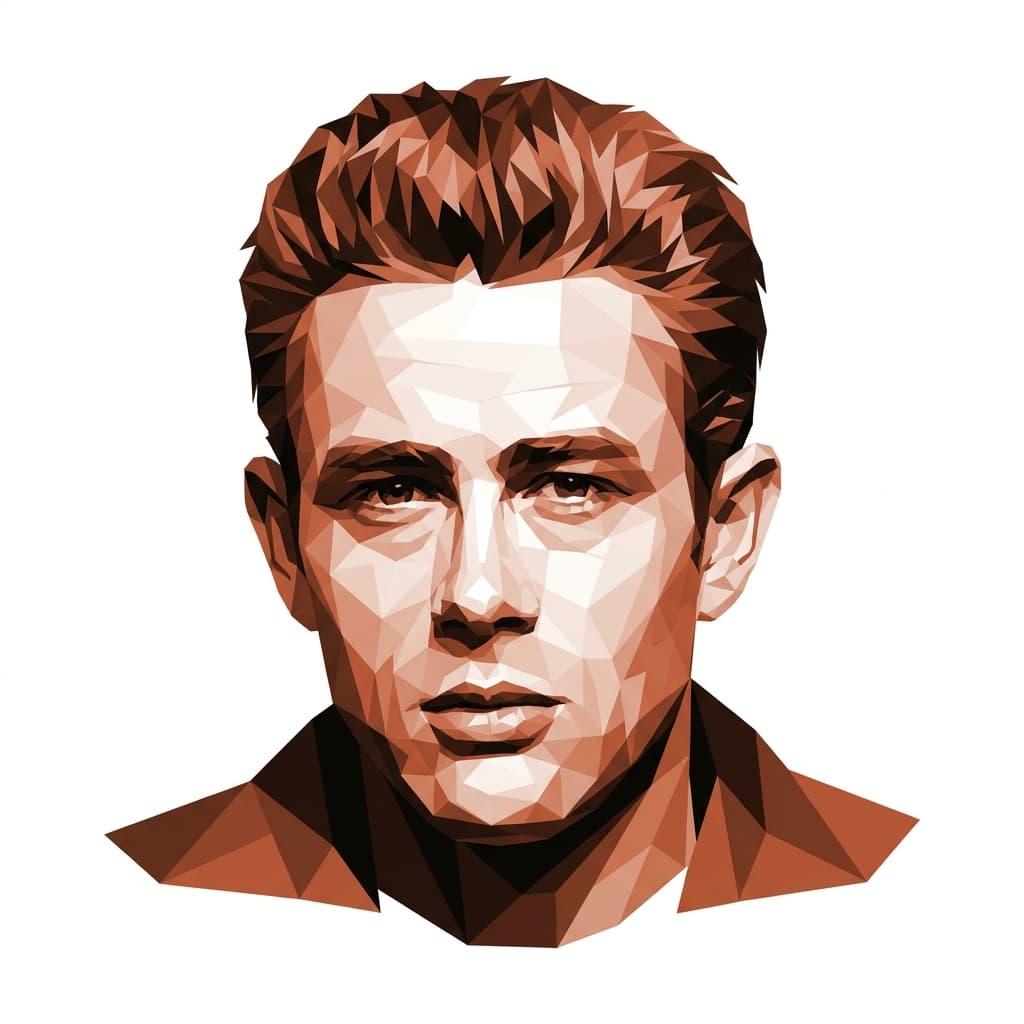
American actor whose three films and early death made him the permanent face of restless youth.
Design
- Q43.3
- h23.3
- R29.3
- g42.3
- i32.3
- S14.1
- T34.5
- U33.3
- V53.6
- W58.5
- X21.3
- Y59.6
- Z62.1
Personality
- Q49.1
- h4.1
- R28.4
- g51.2
- i57.2
- S61.6
- T10.5
- U31.1
- V39.3
- W54.4
- X21.4
- Y59.6
- Z53.5
James Dean was a Generator — built for deep, sustained immersion in work that lit him up, and almost violently restless when it didn't. He had the stamina to spend hours rehearsing a single gesture, to obsess over a character's walk or the angle of a cigarette, to disappear into the Actors Studio for months at a time. When the work was right, his energy was bottomless. When it wasn't, he was insufferable.
Raised on a Quaker farm in Fairmount, Indiana after his mother died when he was nine, Dean came up through his aunt and uncle's household with a 1/3 profile's twin instincts: study everything from the ground up, then test it by crashing into it. He took bullfighting lessons from a local matador, read Stanislavski cover to cover, raced motorcycles, studied violin and dance at UCLA, and bombed out of fraternity life. Each pivot looked reckless from outside and felt, to him, like the kind of trial-and-error learning that builds real expertise.
In New York he survived on Pepsi commercials and a recurring stint as a stand-in until Elia Kazan cast him in East of Eden. On set he made decisions from a place his gut had already decided on — climbing onto a moving train, improvising the embrace with Raymond Massey that pushed the older actor into genuine, unscripted recoil. Kazan learned to point the camera and let him go. Dean didn't take direction so much as respond to whatever the moment offered, and when nothing offered, he'd provoke something until it did.
That provocation was the engine of Rebel Without a Cause. The red jacket, the slouch, the way he cried "you're tearing me apart" — he was pulling buried emotion out of every scene partner he stood near, turning Nicholas Ray's set into a kind of group therapy. Off camera he was the same: walking his own line whether or not anyone approved, refusing to play the studio's clean-cut game, showing up to Warner Bros. meetings in filthy jeans. He had a gift for distilling a whole interior weather system into one held silence, and audiences read themselves into the gaps.
The speed was the other half. Dean bought a Porsche 550 Spyder, named it Little Bastard, and chased racing the way he chased everything — as if meaning lived on the far side of risk. Friends warned him. He kept going. There was a restless courage in him that needed the next edge to push against, and the studio's pleading to slow down only made him faster.
On September 30, 1955, en route to a race in Salinas, he was killed in a head-on collision near Cholame, California. He was twenty-four. Giant hadn't yet been released; Rebel premiered four weeks later. Three films, one calendar year of stardom — a completion arc compressed into almost nothing, and a permanent template for every young actor since who's tried to look like they meant it.
Sources: biography · birth data
What do you and James Dean have in common?
Enter your birth details to find out