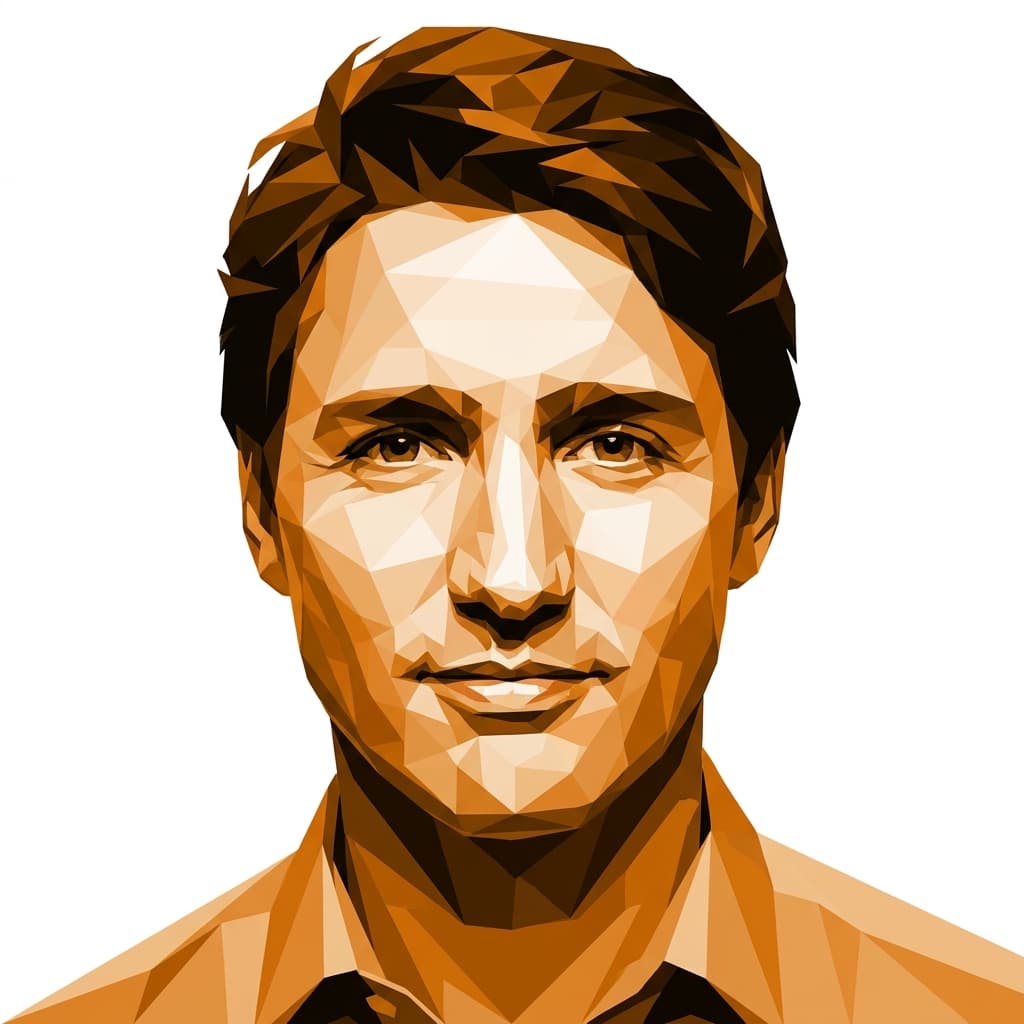
Canadian Prime Minister from 2015 to 2025, Liberal Party leader and son of Pierre Trudeau.
Design
- Q18.2
- h17.2
- R60.1
- g19.6
- i33.6
- S46.1
- T48.6
- U13.2
- V34.3
- W16.1
- X48.5
- Y34.1
- Z46.2
Personality
- Q10.6
- h15.6
- R51.3
- g41.4
- i31.4
- S5.2
- T41.2
- U25.2
- V26.5
- W20.1
- X57.4
- Y34.5
- Z46.5
Justin Trudeau is a Manifesting Generator — wired to move fast, juggle several identities at once, and pivot without much warning — which explains a public life that has swung from snowboard instructor to drama teacher to boxing amateur to Prime Minister of Canada without ever quite settling into one lane. Born on Christmas Day 1971 in Ottawa, the eldest son of Pierre Elliott Trudeau, he grew up inside 24 Sussex Drive with cameras already trained on him, then spent his twenties conspicuously stepping away from the family business of politics before, at 36, responding to what showed up in his world and running for the Papineau riding in Montreal.
The 6/2 profile — the role model who needs long stretches of private trial-and-error before stepping onto the roof — maps almost too neatly onto his trajectory. His twenties and early thirties looked, to Ottawa's political class, like a wasted apprenticeship: teaching French and math at West Point Grey Academy in Vancouver, engineering degrees started and abandoned, a McGill environmental geography stint. It read as drift. In hindsight it was the messy experimental phase that quietly builds the wisdom later drawn on, and the 2012 charity boxing match against Senator Patrick Brazeau — which nobody expected him to win — was the moment the country registered that the drama teacher had been paying attention all along.
His 2015 majority ran on a very specific kind of charisma: the ability to persuade a room that a story is worth buying into, paired with a sunny, unforced projection of what Canada could feel like when invited to imagine it. "Because it's 2015" — the one-line answer for why his cabinet was gender-balanced — was pure saying the true thing exactly when the moment asked for it. Early Trudeau governed with visible enthusiasm: legalizing cannabis, resettling 25,000 Syrian refugees within months, signing the Paris Agreement, apologizing formally for a long list of historical wrongs. He seemed genuinely lit up by the work, and the country lit up with him.
Then the shadows of the chart started showing. The SNC-Lavalin affair in 2019, in which Jody Wilson-Raybould accused him of pressuring her as Attorney General, cracked the self-love-as-authenticity brand he had built. The blackface photos surfaced weeks later. The 2022 Emergencies Act invocation against the trucker convoy was a Gate 51 shock-move — decisive, unprecedented, and polarizing in exactly the way that gate tends to be. Through the pandemic he leaned hard on his gut-level in-the-moment calls, holding daily driveway press conferences from Rideau Cottage that critics called performative and supporters called steadying.
By late 2024 the mood had turned. Chrystia Freeland resigned as Finance Minister the morning she was supposed to deliver the fall economic statement, and the caucus revolt that followed was the kind of ending a Manifesting Generator sometimes chooses when the energy for a thing has clearly moved on. He announced his resignation in January 2025. Whether the 6/2 role-model chapter reopens later — as memoirist, elder statesman, or something entirely unexpected — is the open question of his second act.
Sources: biography · birth data
What do you and Justin Trudeau have in common?
Enter your birth details to find out