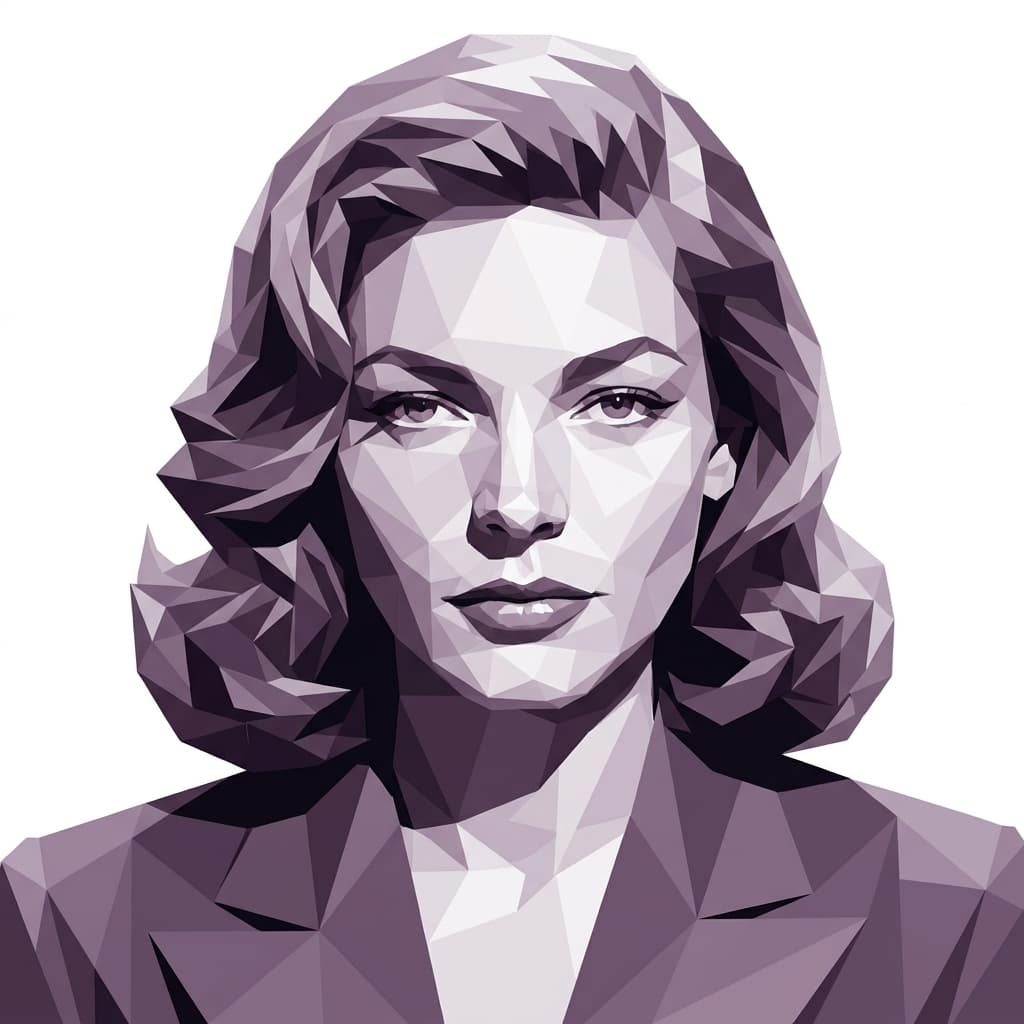
American actress and model whose sultry voice and cool poise defined Hollywood's golden age.
Design
- Q12.3
- h11.3
- R5.5
- g29.1
- i30.1
- S20.6
- T53.2
- U30.3
- V5.3
- W32.6
- X22.5
- Y7.6
- Z39.3
Personality
- Q6.1
- h36.1
- R3.3
- g4.5
- i49.5
- S64.4
- T31.6
- U30.2
- V5.2
- W50.5
- X22.3
- Y4.3
- Z39.5
Lauren Bacall was a Manifestor — wired to walk into a room and change its temperature without asking anyone's leave. At nineteen, a Brooklyn-born model named Betty Perske stared down Humphrey Bogart in To Have and Have Not, tilted her chin, and delivered "You know how to whistle, don't you, Steve?" The line landed because she landed it. Director Howard Hawks had coached her to lower her voice by reading aloud in the Hollywood Hills until it settled into that famous smoky register, but the nerve was hers.
That debut was a textbook initiate-and-inform arrival — a young unknown who didn't wait to be discovered so much as announce herself and let the industry catch up. She had a 1/3 profile, the investigator-experimenter, and her early years were exactly that: modeling at Harper's Bazaar, hustling ushering jobs, marrying Bogart at twenty against every reasonable objection, and finding out through lived experience what worked. She would later say she'd made plenty of mistakes and learned from most of them — a 1/3 sentence if there ever was one, that need to understand the why beneath every outcome.
Her decisions were slow and considered rather than impulsive, the mark of someone who needed to sleep on the emotional wave before committing. She turned down films she thought were beneath her — a stance that cost her at Warner Bros. and got her repeatedly suspended — but the ones she said yes to, she said yes to fully. Her sixteen-year devotion to Bogart, nursing him through esophageal cancer until his death in 1957, was the follow-through of someone who commits from the right place. She was also famously discerning, with an instinct for what was worth her energy and what wasn't.
Bacall's public voice carried the perfect-timing charge of someone whose words landed harder than the words themselves. She campaigned openly for Adlai Stevenson, spoke against McCarthyism when it was dangerous to, and joined the Committee for the First Amendment's Washington delegation in 1947 — aligning herself with people who shared her principles rather than the studio's. She was cool in interviews, blunt in memoirs, and never softened her opinions to be more palatable. That famous look — head down, eyes up — began as a trick to hide her nerves and became a masterclass in saying only what needed saying.
After Bogart, she married Jason Robards, raised three children, and reinvented herself for Broadway, winning Tonys for Applause in 1970 and Woman of the Year in 1981. She was, by then, a natural pioneer who kept beginning new things rather than coasting on the Bogie-and-Bacall myth. Her two memoirs, By Myself and Now, are among the most clear-eyed actor autobiographies ever written — the voice of someone who'd made sense of her own past and refused to sentimentalize it.
She won an honorary Oscar in 2009 and died in 2014 at eighty-nine, still in her Dakota apartment overlooking Central Park, still, by every account, entirely herself.
Sources: biography · birth data
What do you and Lauren Bacall have in common?
Enter your birth details to find out