Canadian poet, novelist, and songwriter whose late-blooming career produced "Hallelujah" and decades of literary song.
Design
- Q15.2
- h10.2
- R57.4
- g19.4
- i33.4
- S62.2
- T23.4
- U35.3
- V48.5
- W30.4
- X3.5
- Y40.5
- Z62.4
Personality
- Q6.6
- h36.6
- R55.5
- g19.2
- i33.2
- S57.3
- T64.2
- U7.1
- V32.6
- W49.4
- X3.5
- Y64.2
- Z62.6
Leonard Cohen was a Manifestor — an initiator who moved on his own timing, disappeared when he needed to, and returned with something the culture hadn't known it was waiting for. He started as a poet in Montreal, published two novels by his early thirties, then abruptly informed his readers he was leaving literature for music. He was thirty-three when his first album came out. That kind of mid-life pivot is characteristic of a 6/2 profile, the role-model-and-hermit, whose earlier years of experimentation give way to a longer arc of quieter authority.
The pivot itself was pure Manifestor Strategy: he didn't ask, he announced. Judy Collins had recorded "Suzanne," and Cohen — broke, restless on the Greek island of Hydra — simply decided he'd be a singer now, and told people. His baritone was untrained, his guitar rudimentary, and Columbia's John Hammond signed him anyway. Across the next fifty years he would repeatedly walk away from the industry, from tours, from Los Angeles, and reappear on his own schedule with new work. He operated on the emotional patience of someone who slept on every decision — songs took years, sometimes decades. "Hallelujah" reportedly went through some eighty verses before he considered it finished.
His writing carried a gift for compressing spiritual complexity into lines anyone could sing, and beneath the elegance was the pull toward experiences most people would find too intense — Scientology, Zen monasticism, sustained depression, extended stays on Hydra with Marianne Ihlen, decades of amphetamines and wine and eventually silence. He lived at the edge of emotional extremity as a working method, then wrote from the far side of it. "There is a crack in everything, that's how the light gets in" is a whole cosmology in fourteen words.
In 1994 he moved into the Mt. Baldy Zen Center outside Los Angeles and stayed nearly six years, eventually ordained as a monk named Jikan — "silence." It was the 6/2 need for retreat taken to its logical conclusion: he stepped out of the world entirely to process what he'd absorbed. When he came down the mountain he discovered his longtime manager had drained roughly five million dollars from his accounts. He was in his seventies and effectively broke. So he did the thing Manifestors do when their circumstances demand it — he initiated. He announced a world tour.
The 2008–2013 tours became one of the most extraordinary late acts in music. Night after night he sank to his knees in a dark suit and sang for three hours, thanking his band by name, tipping his hat, providing for a whole crew of musicians with grace. Audiences wept. Critics ran out of superlatives. He recorded three more albums in his eighties, releasing work that carried the weight of everything he'd witnessed, and finished "You Want It Darker" weeks before he died in November 2016. He'd written his own eulogy into the title track: Hineni, hineni, I'm ready, my lord. Ready in the way only someone who had waited his whole life for the right words could be.
Sources: biography · birth data
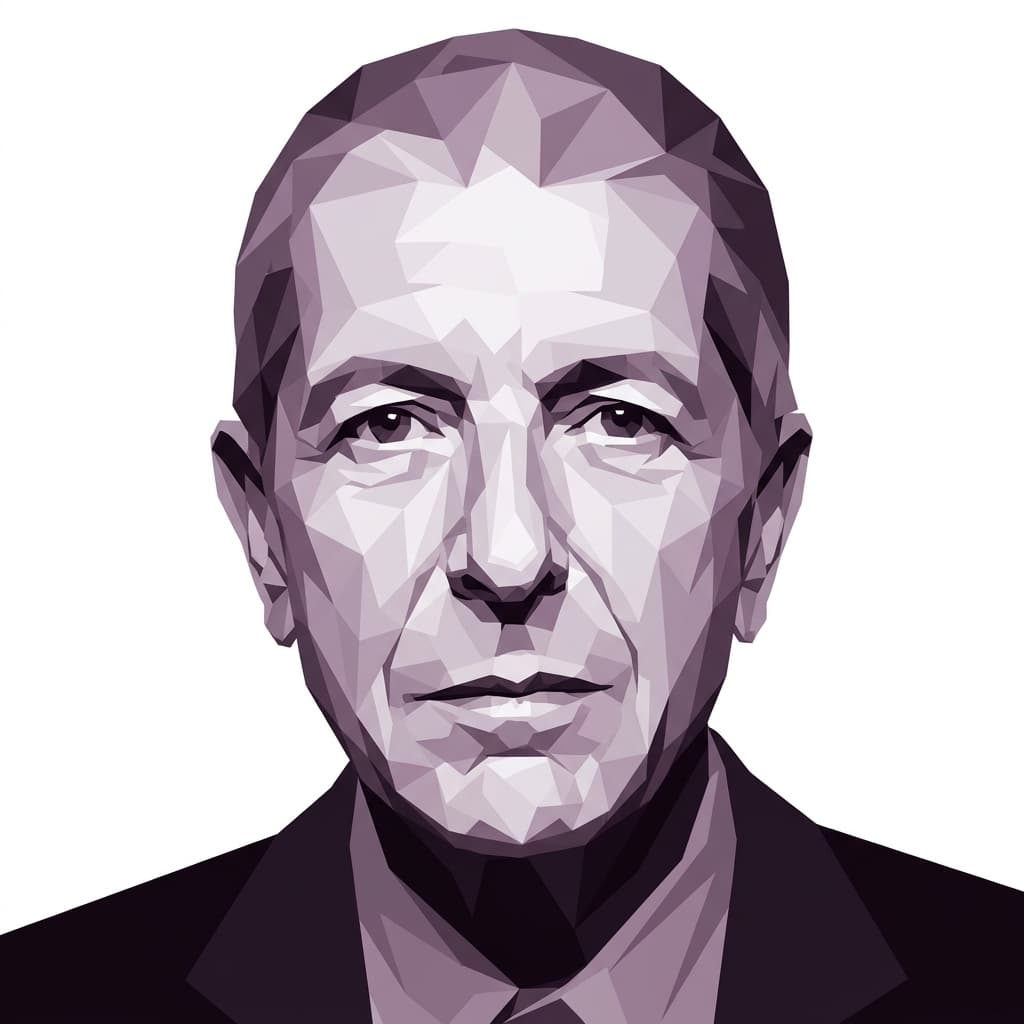
What do you and Leonard Cohen have in common?
Enter your birth details to find out