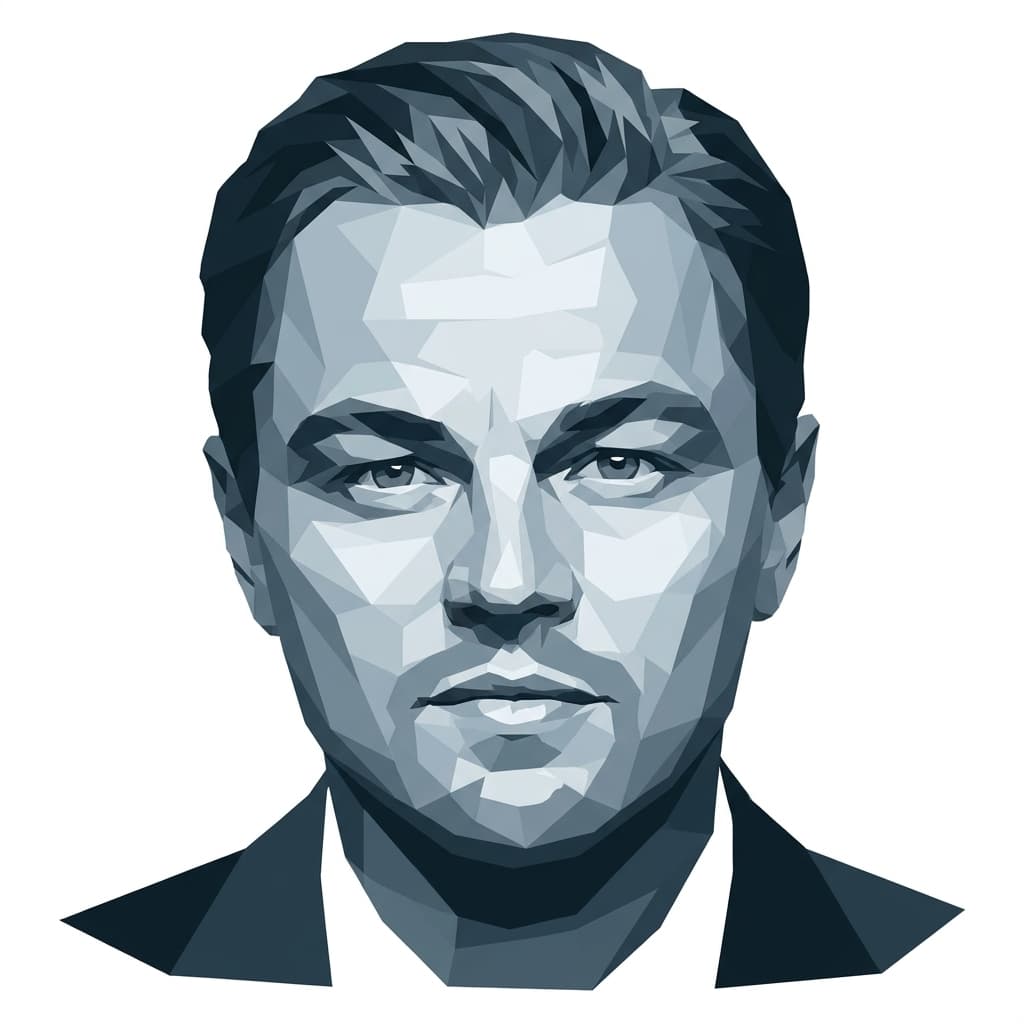
Oscar-winning American actor and environmental activist known for transformative roles and unwavering climate advocacy.
Design
- Q4.2
- h49.2
- R12.3
- g26.1
- i45.1
- S7.4
- T56.3
- U40.6
- V63.5
- W39.5
- X32.4
- Y9.2
- Z18.2
Personality
- Q1.6
- h2.6
- R57.1
- g9.5
- i16.5
- S50.4
- T43.2
- U44.3
- V37.3
- W53.4
- X50.4
- Y9.4
- Z18.5
Leonardo DiCaprio is a Projector — not built for the relentless output Hollywood usually demands, but for the sharper, rarer thing of choosing exactly which roles and causes deserve his finite energy. The shape of his career bears this out: he works in concentrated bursts, often disappearing for a year or two between films, then returning with something that consumed him entirely.
He grew up in a rough stretch of East Hollywood, watching his neighborhood and reading his mother. By the time he was cast in This Boy's Life opposite Robert De Niro at fifteen, he'd already developed the kind of instinct for who's worth following that would define his next thirty years. He signed with Scorsese, then with directors like Nolan, Tarantino, and Iñárritu, and largely stayed inside that small circle. The pattern reads as a 6/2 profile — the role model who experimented hard in his twenties (the Pussy Posse years, the supermodel parade, The Beach and its messy reception) and then withdrew into a more curated, deliberate middle period.
The Titanic moment is instructive. He nearly didn't take it; he hated the idea of being a heartthrob and resisted what the script asked of him. Once cast, though, he disappeared into it with the kind of total identification with the craft that has since become his signature — eating raw bison liver for The Revenant, learning hypnosis for Inception, spending months with FBI consultants for Catch Me If You Can. His decision-making around projects famously takes forever; producers describe waiting years for a yes. That's the slow emotional wave at work — he reads scripts, sets them aside, comes back, sits with them across moods until the choice settles cool and clear.
His climate work runs on a different engine. The Leonardo DiCaprio Foundation, launched in 1998, eventually folded into Earth Alliance, and he's spent decades fighting for what he believes is structurally wrong about how the planet is governed. His 2016 Oscar speech pivoted instantly from personal triumph to climate emergency — a small, precise act of knowing exactly when the room was finally listening. He produces documentaries (The 11th Hour, Before the Flood), funds conservation, and lobbies heads of state, often taking the leadership role only when genuinely invited to it by the UN or by movements already underway.
The texture of his on-screen work is unmistakable: Calvin Candie, Jordan Belfort, Howard Hughes, Ernest Burkhart — characters who pull buried emotion out of every scene they enter, often by making the audience deeply uncomfortable. He's drawn to men who are seductive and broken, and he plays them with a storyteller's instinct for which subjective truth lands hardest. His Hughes in The Aviator and his Belfort in Wolf of Wall Street both run on the same engine — charisma that's aware of exactly what it's selling and the rot underneath.
Off-camera, he's notoriously private, allergic to social media, and surrounded by a small, fiercely loyal group of friends he's kept since high school. The need for a tight inner circle to recharge inside of is one of the more consistent things people who've worked with him mention — the public mask comes off, and what's underneath is quieter, more watchful, and, by most accounts, much funnier than the press allows.
Sources: biography · birth data
What do you and Leonardo DiCaprio have in common?
Enter your birth details to find out