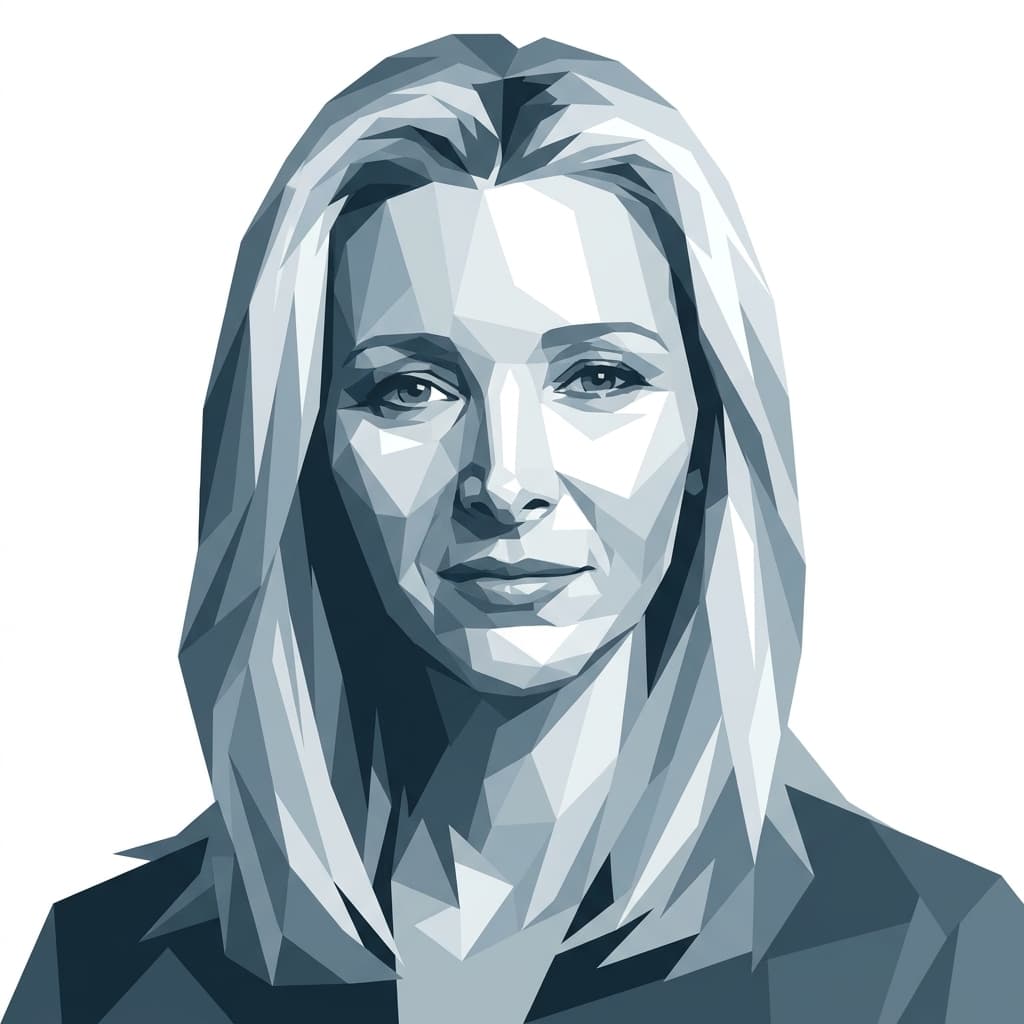
American actress, comedian, and producer best known as Phoebe Buffay on Friends.
Design
- Q24.2
- h44.2
- R56.1
- g62.4
- i61.4
- S8.4
- T17.3
- U7.2
- V17.3
- W49.4
- X59.2
- Y1.2
- Z40.5
Personality
- Q31.5
- h41.5
- R14.4
- g53.6
- i54.6
- S4.5
- T56.2
- U46.5
- V51.5
- W49.3
- X59.4
- Y44.6
- Z40.6
Lisa Kudrow is a Projector — the kind of performer whose power lives in perception rather than output, and whose career has been built less on volume than on a startlingly clear read of human behavior. Before acting, she spent eight years working alongside her father in headache research, co-authoring a paper on cluster headaches and hemispheric dominance. That she abandoned biology for The Groundlings only after her childhood friend Jon Lovitz nudged her toward comedy is very much on-brand: she moved when someone she trusted genuinely saw what she could do.
Her breakthrough came sideways. She was cast as Roz on Frasier, then fired during rehearsals — a devastation she has talked about often — before landing the waitress Ursula on Mad About You, which eventually opened the door to Phoebe Buffay. Phoebe was a character built out of everything a network sitcom usually sands off: strange lyrics, unexplained biography, a flat affect where warmth was expected. Kudrow played her with the kind of specificity that comes from actually thinking things through, and she was the only Friends cast member to win the Emmy for Lead Actress in a Comedy for the role.
What she did after Friends is the more revealing story. Instead of chasing another network vehicle, she co-created The Comeback with Michael Patrick King in 2005 — a mock-documentary about a fading sitcom actress that HBO cancelled after one season and then, nine years later, revived. The show was almost unwatchably uncomfortable, which was the point. Kudrow understood something about celebrity and self-delusion that most of her peers were too close to see, and she built a whole vocabulary of tiny behavioral tells that felt clinically precise. It's aged into one of the most influential comedies of its era.
Then came Web Therapy, which she co-created and improvised largely from her own instincts about how people talk when they think no one is really listening. She has said in interviews that she often needs to talk a decision through out loud before she knows what she actually thinks — hearing herself say something is how it becomes true for her. She hosts the podcast Who Do You Think You Are? spinoff conversations and has been a producer on the American version of the genealogy show since 2010, drawn to the puzzle of how ordinary lives connect to bigger patterns.
As a 5/2 profile, the practical problem-solver who also needs a great deal of privacy, Kudrow has been notably protective of her home life — married to advertising executive Michel Stern since 1995, with one son — and skeptical of the celebrity apparatus. She tends to disappear between projects, then re-emerge with something built rather than performed. In interviews she is disarmingly analytical about her own career, willing to name the auditions that stung and the industry patterns she noticed early. Her comic voice has always made the strange feel oddly familiar, and she remains one of the few actors of her generation who seems to have designed her career around what actually sustains her rather than around what was offered.
Sources: biography · birth data
What do you and Lisa Kudrow have in common?
Enter your birth details to find out