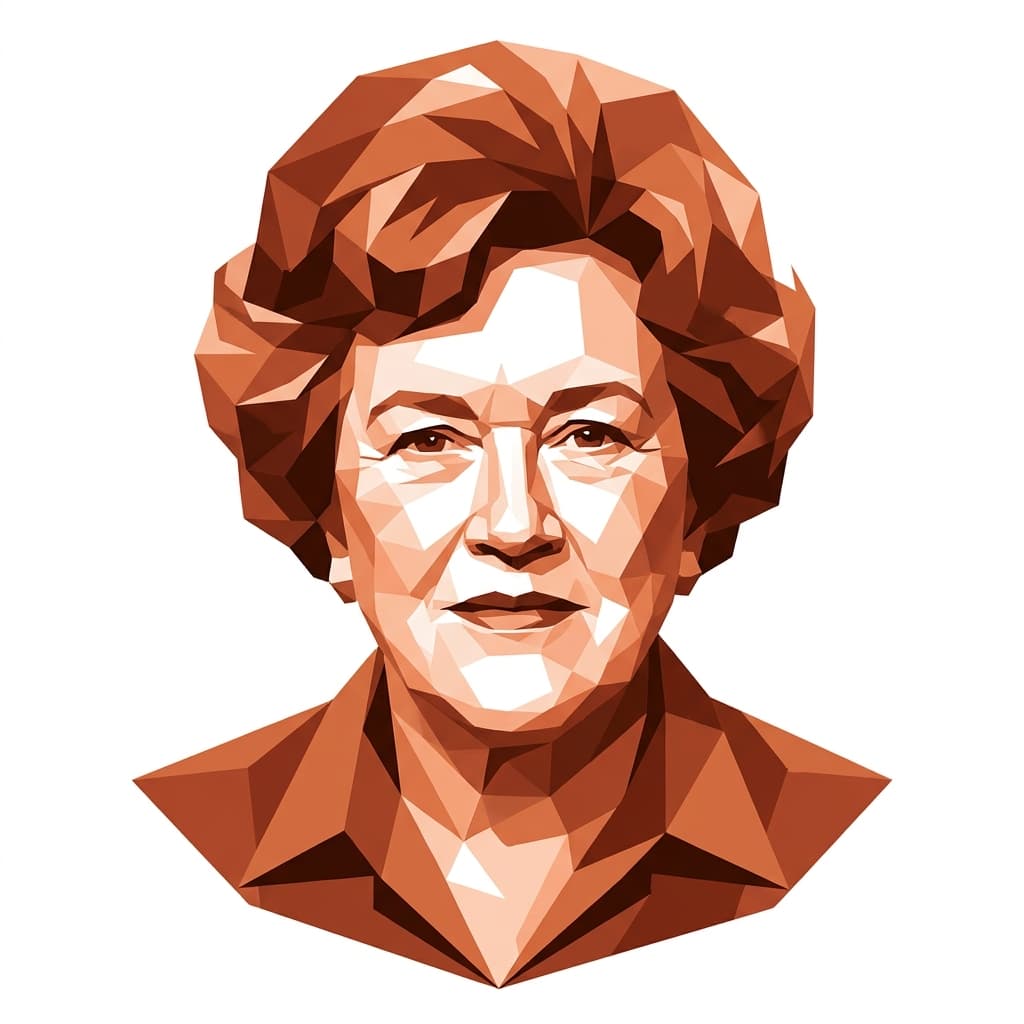
American author of The Giver and Number the Stars, known for children's books tackling difficult truths.
Design
- Q10.4
- h15.4
- R3.2
- g11.2
- i12.2
- S54.5
- T13.1
- U32.2
- V58.1
- W63.6
- X27.5
- Y47.3
- Z56.2
Personality
- Q25.2
- h46.2
- R39.4
- g26.2
- i45.2
- S36.3
- T27.4
- U34.3
- V61.3
- W36.4
- X27.6
- Y47.1
- Z56.1
Lois Lowry is a Generator — built for deep, sustained creative work, and she has published more than forty books over five decades without ever seeming to run out of stamina for the next one. Born on a military base in Honolulu in 1937, she moved constantly as a child, spent stretches of her adolescence in occupied Japan, and married young. She didn't publish her first novel, A Summer to Die, until she was nearly forty. What came before was a slow accumulation — degrees interrupted by four children, a photography business, freelance journalism — and then, once she began, a body of work that arrived at the pace of someone who had been quietly preparing for years.
Her 2/4 profile — the hermit who is also a networker — shows up cleanly in how she lives. She writes in near-total solitude from her farmhouse in Maine, then emerges to give warm, funny keynotes and answer thousands of letters from kids. She has said in interviews that she needs the aloneness to hear the story, but she also credits her career to the editors, teachers, and librarians who found her — the community that pulled her work into the world while she stayed at her desk. Her memoir Looking Back is structured around photographs, each one a small excavation of what she'd witnessed and stored.
Number the Stars came out of a friend's childhood memory of the Danish resistance smuggling Jews to Sweden. The Giver came out of her father's dementia — watching him lose painful memories and wondering what a society would look like that engineered such loss deliberately. In both cases the pattern is the same: she waits until a real story shows up and lights her up, then commits fully. She has said she doesn't outline, doesn't plan; she follows what her gut tells her the next sentence should be and trusts the shape to emerge.
Her books are famously willing to sit with children in hard places — death, genocide, euthanasia, loss of a child — without flinching or moralizing. That's the child-like openness that keeps meeting difficulty head-on at work. When The Giver was challenged and banned in school districts across the country, she didn't retreat; she wrote three companion books and defended the novel's ambiguous ending for thirty years, staying rooted in what she knew was right for the story rather than the tidy resolution readers kept demanding.
The Lowry sentence is spare, close to the bone, and tuned to the exact moment a thing needs to be said. She has a gift for pulling meaning out of what looks at first like unrelated fragments — a grandmother's death, a color returning to a gray world, a small girl running through a forest with a handkerchief. In 2011 her son, an Air Force pilot, was killed in a plane crash; she has written and spoken about that loss with the same directness she asks of her young readers, surrendering to the emotional weight rather than working around it.
Now in her late eighties, she still publishes regularly, still answers the mail, still lives mostly alone with a dog and a garden. The restless love of variety that had her moving between genres — historical fiction, dystopia, comic Anastasia books, picture books, memoir — is the same instinct that keeps her writing at an age when most of her peers have stopped. She once said the point of writing for children is to give them the tools to make sense of a world adults have made confusing. Forty books in, she is still bringing order to what feels chaotic, one small clear sentence at a time.
Sources: biography · birth data
What do you and Lois Lowry have in common?
Enter your birth details to find out