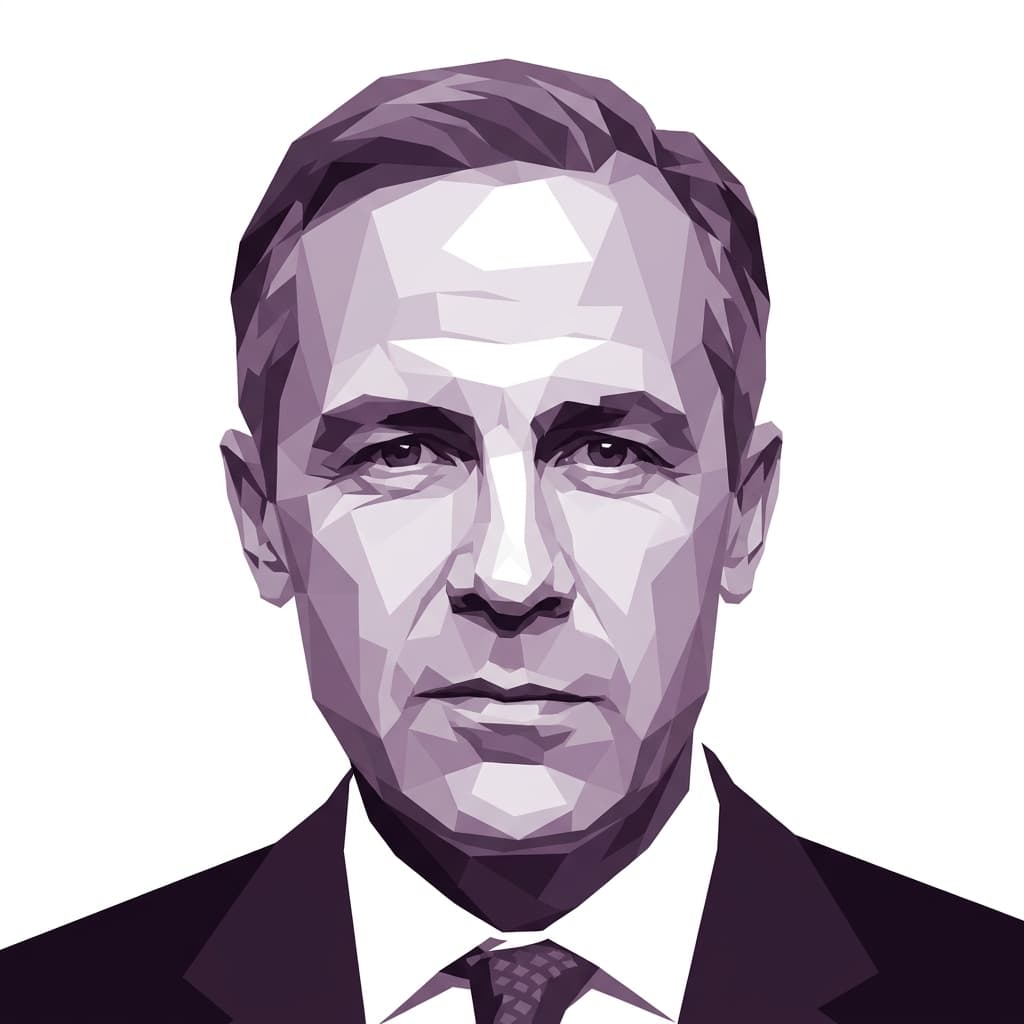
Canadian economist, former Bank of Canada and Bank of England governor, now Prime Minister of Canada.
Design
- Q11.6
- h12.6
- R52.3
- g12.1
- i11.1
- S11.4
- T34.1
- U47.4
- V2.4
- W55.1
- X64.4
- Y43.1
- Z64.6
Personality
- Q36.4
- h6.4
- R64.4
- g45.1
- i26.1
- S21.4
- T22.3
- U64.5
- V23.4
- W37.5
- X64.1
- Y43.2
- Z64.4
Mark Carney is a Manifestor — the rare Type wired to initiate rather than respond, and his career reads like a string of unilateral moves into rooms nobody expected him to enter. A kid from Fort Smith who ended up at Harvard on a hockey scholarship, then Oxford for a doctorate, then Goldman Sachs, then back to Ottawa, he has spent four decades stepping into institutions and rearranging them before the incumbents realized the furniture had moved.
At the Bank of Canada in 2008, Carney did the thing central bankers are trained not to do: he cut rates hard and fast, then made an unprecedented "conditional commitment" to hold them at a quarter point for a year. It was a Manifestor move — acting on an impulse others hadn't clocked yet and telling the market plainly what he was going to do. He didn't ask permission from the Fed or the ECB. Canada came through the crisis with the mildest recession in the G7, and when the UK came calling in 2012, they broke a 319-year tradition to hire the first foreigner ever to run the Bank of England. His 4/6 profile — the community-embedded role model whose authority comes from lived experience rather than theory — is exactly what both institutions were reaching for.
His public voice carries a particular signature. Carney is measured to the point of blandness in tone, but the substance is often genuinely ahead of where his audience is sitting, especially on climate finance. As UN Special Envoy he built GFANZ, corralling banks representing $130 trillion in assets into net-zero commitments — a piece of institutional architecture that required translating complex systems into terms people could actually act on, and waiting for the right forum to say the hard thing. He tends to release ideas — carbon budgets, "tragedy of the horizon," value(s) — that read as obvious a year after he's said them.
The Carney people describe privately is more emotional than the public one lets on. Colleagues at the BoE talked about his temper, his impatience with sloppy briefings, his need to sleep on things before signing off. That tracks with Emotional Authority — the design that requires riding out a wave before committing, and that punishes decisions made in the heat. His management style leans on taking charge of the resources and telling everyone how they'll be deployed, paired with a natural pull toward stewardship of collective wealth that shows up whether he's running monetary policy or a Brookfield ESG fund.
The 2025 pivot to politics was pure Manifestor. Liberals in crisis, Trudeau out, Carney parachutes in, wins the leadership, calls an election weeks later, and wins that too — the whole sequence executed with the kind of certainty that skips the usual apprenticeship. He'd been processing the pattern of the moment for years — writing Value(s), circling Ottawa, informing anyone who'd listen that the old economic order was ending — and when the opening came he moved. Whether he can convert the initiating burst into something that actually sustains is the open question of his premiership; Manifestors are famously better at starting than at maintaining, and running a country is nothing if not maintenance.
Sources: biography · birth data
What do you and Mark Carney have in common?
Enter your birth details to find out