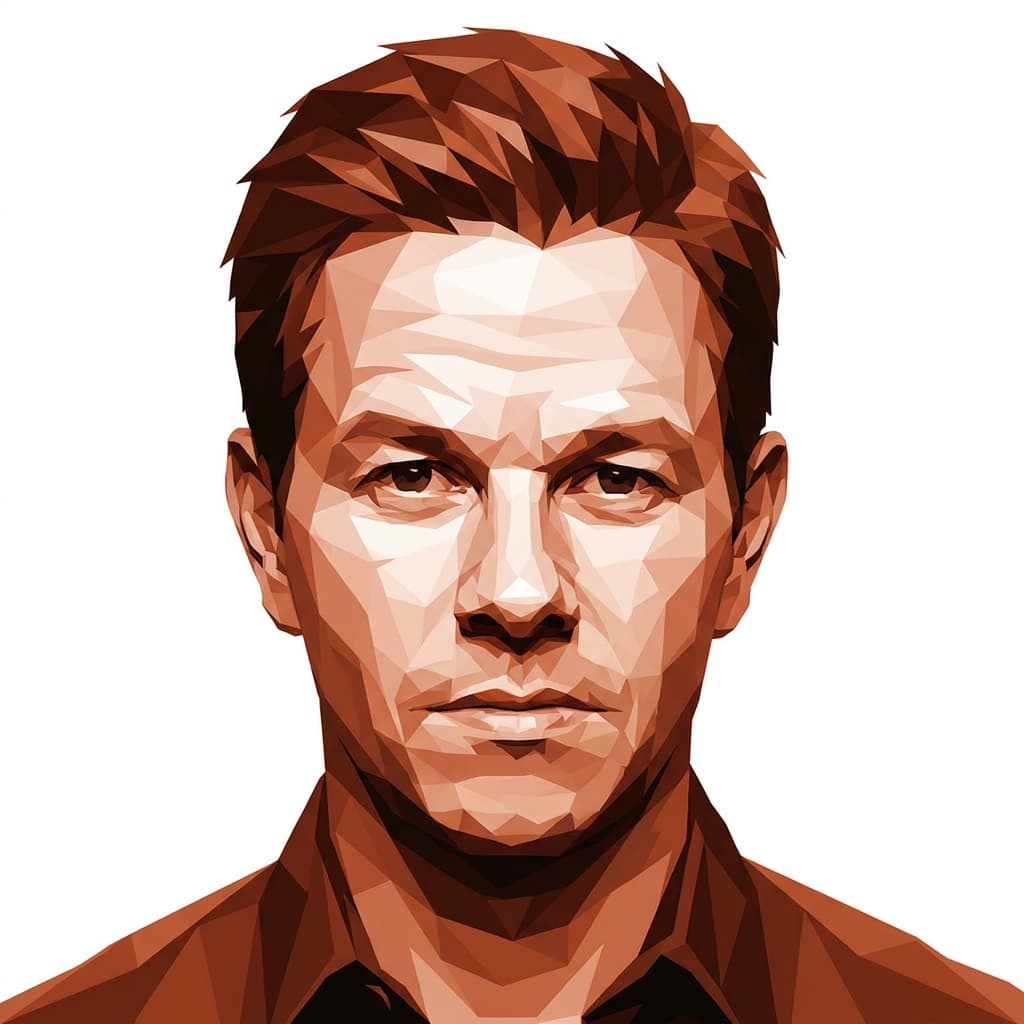
Boston-bred actor and producer who rebuilt himself from Funky Bunch frontman into Hollywood power player.
Design
- Q63.6
- h64.6
- R62.5
- g49.5
- i4.5
- S63.6
- T41.2
- U11.5
- V9.1
- W2.5
- X48.4
- Y34.4
- Z46.1
Personality
- Q35.3
- h5.3
- R28.1
- g13.4
- i7.4
- S8.3
- T23.4
- U13.2
- V14.6
- W8.5
- X18.6
- Y34.2
- Z6.5
Mark Wahlberg is a Generator — built for long days, repetitive reps, and the kind of deep mastery that only shows up when the work itself lights him up. The arc from Dorchester teenager to underwear model to action lead to studio producer isn't a series of reinventions so much as one long engine pushing through whatever was in front of it, responding to whatever showed up next rather than trying to architect a career from the outside.
His 3/6 profile explains the shape of his life almost too neatly. The early years were pure trial-and-error, much of it public: arrests as a teenager, the Calvin Klein billboards, Marky Mark and the Funky Bunch, the awkward pivot into acting that nearly didn't work. Those were the hands-dirty experiments that built the wisdom he now trades on — the rougher chapters he talks about openly when younger actors or athletes ask him how he got from there to here. The second half of the profile is the role-model phase, and he stepped into it deliberately: morning Mass, the 4 a.m. wake-ups, the curated family-man image.
Wahlberg makes decisions from his gut, fast, and rarely renegotiates them. Co-stars and directors describe him as someone who commits or doesn't on first read, who'll attach to a project in a phone call and then grind through the prep with absurd stamina — the boxing for The Fighter, the weight cycling for Pain & Gain, the Navy SEAL conditioning for Lone Survivor. The famous pre-dawn routine — workout, prayer, golf, second workout — is less about discipline-as-image and more about a body that genuinely needs its rhythm to function.
As a producer he turned out to be sharper than most of his acting reviews suggested. Entourage and Boardwalk Empire came out of an eye for what was about to land culturally, and he's been quietly effective at spotting where a project's foundation is weak before money gets spent. He's spoken often about wanting his work to mean something for his kids and his city, the principles-first logic of someone who needs the work to matter, which is why the Wahlburgers chain and his Boston charity work read less like vanity projects than like extensions of the same operating system.
He carries the Catholicism, the family, the Boston identity as non-negotiable structure — the through-line that lets him take risks elsewhere. The relocation to Nevada in 2022, the willingness to walk away from leading-man roles to produce, the late-career pivot into faith-based films like Father Stu: all of it has the texture of someone testing what's actually worth the fight at this stage rather than coasting on what worked at thirty-five.
What's striking watching him in interviews now is how much he wants to pass along what the messy years taught him — the version of himself at sixteen, the fights, the things he's publicly apologized for. He's not pretending the path was clean. He's pointing at it and saying: this is what it took.
Sources: biography · birth data
What do you and Mark Wahlberg have in common?
Enter your birth details to find out